

Cataracts are not a death sentence for your vision. They are, in fact, one of the most successfully treated conditions in all of medicine. The problem is that too many patients in Thane wait years longer than they should — either because they don't recognize the symptoms or because they're afraid of surgery.
Let's fix both of those things right now.
What Is a Cataract, Exactly?
Your eye has a natural lens sitting behind the iris (the colored part) and the pupil. This lens is normally clear and transparent — it focuses light onto the retina so you can see sharply.
A cataract forms when proteins in this lens begin to clump and cloud over. This cloudiness gradually blocks and scatters light as it enters the eye, causing the visual distortions that characterize the condition.
It is not a film growing over your eye's surface. It is not caused by eye strain or reading in dim light. And it cannot be treated with drops, diet changes, or glasses — only surgery can remove it.
The World Health Organization (WHO) identifies cataracts as the leading cause of blindness globally, responsible for approximately 51% of world blindness.
What Causes Cataracts?
The most common cause is age. After 50, the lens proteins naturally begin to break down and clump. By age 75, most people have some degree of cataract development.
But cataracts are not exclusive to the elderly. We see them in:
Diabetic patients — High blood sugar accelerates lens protein damage
Patients on long-term corticosteroids — Oral, inhaled, or even topical steroids can trigger posterior subcapsular cataracts
Trauma — A blow to the eye can cause a traumatic cataract at any age
Congenital cases — Some infants are born with cataracts, requiring urgent treatment to prevent permanent vision loss
Post-uveitis or radiation exposure — Inflammatory or radiation-related cataracts
Recognizing the Symptoms — Before It Gets Worse
Cataracts develop slowly. Most patients adapt so gradually they don't realize how much their vision has deteriorated until it becomes functionally disabling.
Common symptoms:
Blurry, hazy, or "foggy" vision that glasses don't fully correct
Increased glare and halos around lights — especially car headlights at night
Colors appearing washed out, faded, or yellowed
Double vision in one eye
Frequent changes in spectacle power — needing a new prescription every few months
Difficulty reading in low light even with glasses
In our clinic, we often see patients who've changed their glasses prescription two or three times in a year. That pattern of rapidly shifting prescription — especially in someone above 55 — is a strong clinical signal that a maturing cataract is the underlying issue.
When Is Surgery Actually Needed?
There's a persistent myth that cataracts must "ripen" before surgery. That's outdated thinking from several decades ago.
Today, surgery is recommended when the cataract impairs your daily function — whether that's reading, driving, cooking, or recognizing faces. You and your surgeon decide together based on your symptoms and lifestyle, not based on how dense the cataract looks on a slit lamp.
Waiting too long has real consequences. A hyper-mature cataract (one left untreated for too long) is harder to remove surgically, increases complication risk, and can itself cause secondary glaucoma or inflammation inside the eye.
The Surgical Procedure: What Actually Happens
We perform phacoemulsification
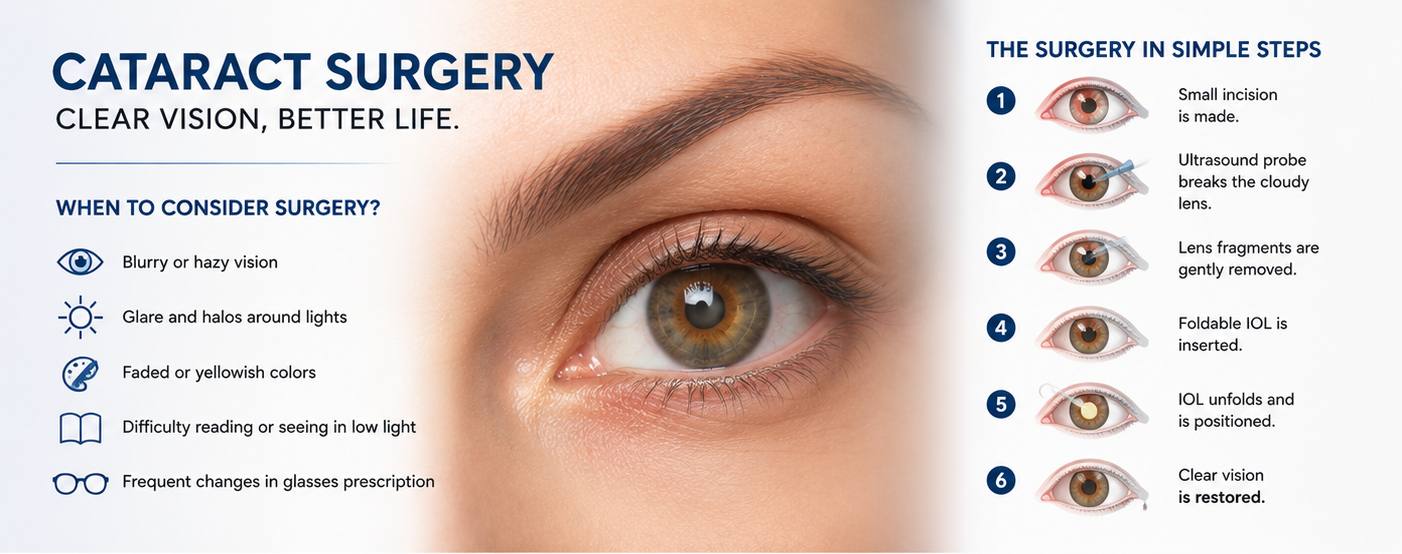
— the gold-standard technique used worldwide for cataract removal.
How it works:
The eye is numbed with topical anesthetic drops. No injections. No general anesthesia in most cases.
A small incision — roughly 2 to 2.5 mm — is made at the edge of the cornea.
An ultrasonic probe is inserted to break up the cloudy lens into tiny fragments.
The fragments are gently suctioned out.
A foldable artificial lens — called an intraocular lens (IOL) — is folded and inserted through the same small incision, then unfolded inside the eye.
The incision is self-sealing. No stitches needed in most cases.
The entire procedure takes 15 to 20 minutes under normal circumstances.
Choosing the Right Intraocular Lens (IOL)
This is where cataract surgery gets genuinely personalized. Your IOL is not one-size-fits-all.
Types of IOLs available at Radhakrishna Netralay:
Monofocal IOL: Clear vision at one distance (usually far). Reading glasses needed for near work. Covered by most insurance.
Multifocal IOL: Designed for both distance and near vision. Reduces glasses dependence significantly. May cause some night glare initially.
Toric IOL: Corrects astigmatism along with cataract. Best for patients with significant pre-existing astigmatism.
Extended Depth of Focus (EDOF) IOL: Provides a range of vision with fewer halos than traditional multifocals.
We use A-scan biometry and IOL Master measurements for precise IOL power calculation. Errors in this step are the most common cause of post-surgical refractive surprise — meaning you end up needing stronger glasses than expected. We don't let that happen.
Recovery: What to Expect Week by Week
Day 1–2: Vision may be slightly blurry initially as the eye heals. This is normal. Most patients notice a dramatic improvement within 24–48 hours.
Week 1: Avoid rubbing the eye. Use prescribed antibiotic and anti-inflammatory drops as directed. No swimming, no heavy lifting.
Week 2–4: Vision continues to stabilize. Most patients return to their routine activities within a few days.
6–8 weeks: Final spectacle prescription (if needed) is given once vision fully stabilizes.
Frequently Asked Questions
Q1. Is cataract surgery painful? No. The eye is numbed with topical anesthetic drops before the procedure. You may feel slight pressure during surgery, but there is no pain. Post-operatively, mild discomfort or a gritty sensation is normal for a day or two.
Q2. Can cataracts grow back after surgery? The natural lens is permanently removed and replaced with an IOL, which cannot develop a cataract. However, some patients experience a condition called posterior capsule opacification (PCO) — where the membrane behind the IOL becomes cloudy — months or years later. This is corrected quickly and painlessly with a YAG laser procedure in the clinic.
Q3. Can both eyes be operated on at the same time? Typically, we operate one eye at a time, with at least a week between the two procedures. This reduces infection risk and allows the first eye to heal before the second is treated.
Q4. What if I have both cataracts and some other eye condition like glaucoma or diabetes? This is common. Your surgical plan will be modified accordingly. Diabetic patients need pre-operative blood sugar stabilization. Glaucoma patients may need combined procedures. Your surgeon will explain the specific approach for your situation.
Q5. How soon can I return to work after cataract surgery? Most patients with desk jobs return to work within 3–5 days. Those in physically demanding occupations may need 2 weeks before full activity. Your surgeon will give you specific guidance based on your job requirements.
Comments
Log in or sign up to join the conversation.