

When people evaluate a carpet, they usually look at the pile, yarn, colour, and finish. The material underneath receives far less attention. Yet the carpet backing fabric plays an important role in how the carpet is constructed and how consistently it performs during manufacturing.
For many carpet applications, woven polypropylene is used as the primary backing because it offers a practical combination of strength, dimensional stability, consistent construction, and process compatibility. But the choice is not simply about selecting “polypropylene.” The fabric’s construction and specifications need to match the carpet being produced.
What Is Primary Carpet Backing?
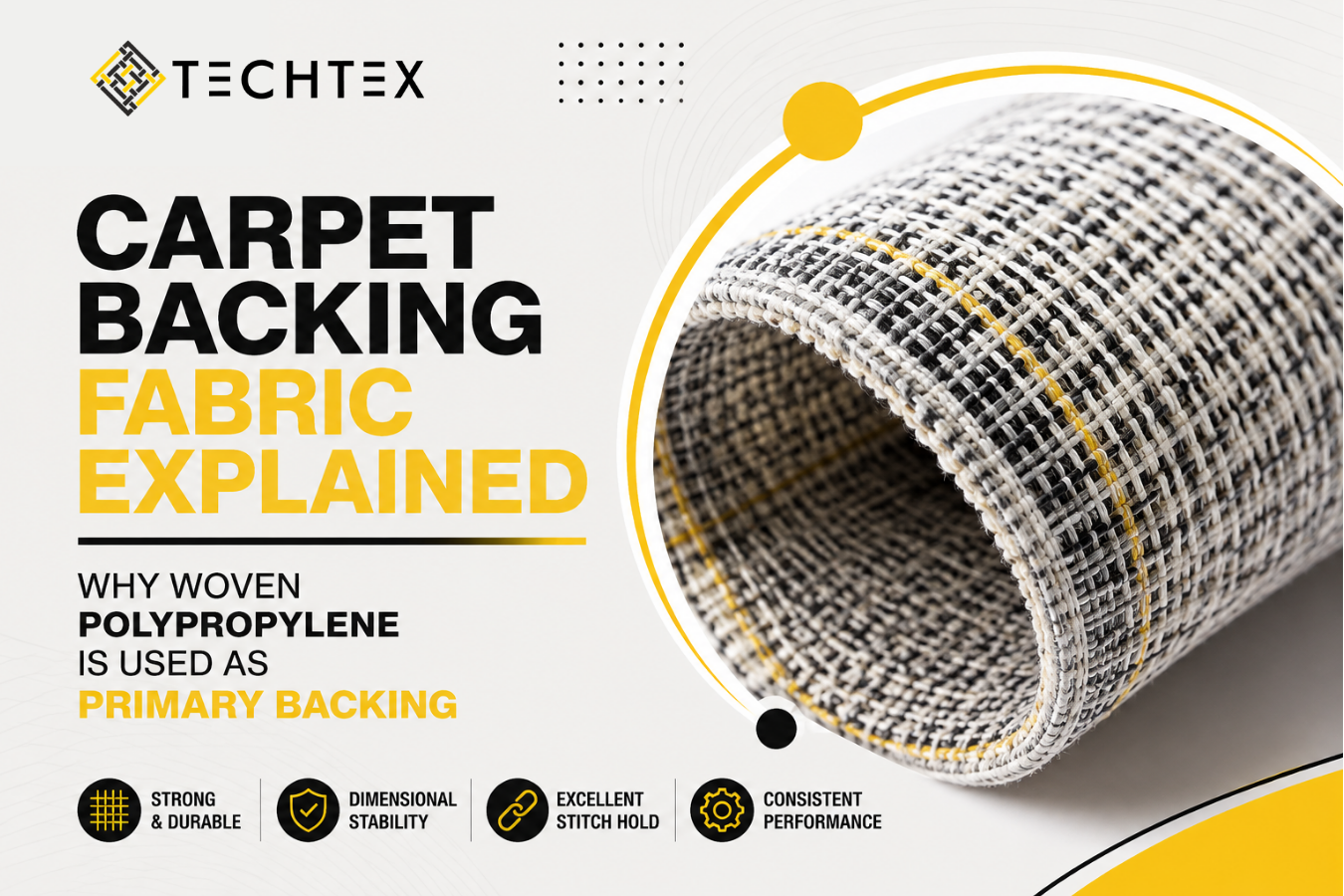
Primary Carpet backing is the fabric into which carpet yarn is tufted. During production, needles pass the yarn through the backing to form the carpet pile.
The backing therefore needs to provide a stable base while tolerating the mechanical forces involved in tufting and handling. If the fabric stretches excessively, tears, or varies significantly across its width, it can create difficulties during production and affect the consistency of the finished carpet.
This makes primary carpet backing a functional part of the carpet construction rather than just a supporting layer.
Why Is Woven Polypropylene Used?
Woven polypropylene is made by interlacing polypropylene tapes or strands into a defined fabric structure. This construction gives the material characteristics that can be useful for primary backing.
One of the key considerations is tensile strength. The backing must withstand the stresses created during tufting without losing its structural integrity.
Another is dimensional stability. Carpet manufacturers generally need a backing that maintains reasonably consistent dimensions during processing. Excessive movement or deformation can affect carpet construction and production accuracy.
Polypropylene also has relatively low moisture absorption compared with many conventional textile fibres. This can make it suitable where moisture resistance and consistent handling are considerations.
However, these properties should not be viewed in isolation. The performance of a woven polypropylene carpet backing depends on how the fabric itself is engineered.
The Weave Matters as Much as the Polymer
Two fabrics can both be described as polypropylene backing but behave differently in production.
The difference can come from factors such as tape dimensions, weave pattern, fabric density, GSM, manufacturing tolerances, and surface characteristics. These variables influence the fabric’s strength, flexibility, stability, and handling behaviour.
This is an important point for buyers: polypropylene is the material; the fabric construction determines how that material performs in a particular application.
For example, a backing designed for a dense tufted carpet may require different characteristics from one intended for a lighter construction. Selecting a fabric purely because it has a higher weight or is labelled “heavy duty” can therefore be misleading.
Does Higher GSM Mean Better Carpet Backing?
Not necessarily.
GSM, or grams per square metre, tells you how much the fabric weighs, but it does not tell you everything about its performance. A higher GSM can be useful in some applications, but it does not automatically mean greater suitability.
A buyer should consider GSM alongside:
Tensile strength: Can the fabric withstand the forces involved in processing?
Dimensional stability: Does it maintain its dimensions under manufacturing conditions?
Weave consistency: Is the structure uniform across the roll?
Tufting compatibility: Does it work with the intended yarn and tufting process?
Roll-to-roll consistency: Can the same characteristics be maintained throughout production?
The right specification is the one that fits the carpet construction—not simply the one with the highest number.
What Should Buyers Look for in Carpet Backing Fabric?
Before choosing a carpet backing fabric, manufacturers and sourcing teams should first understand the requirements of their own production process.
Start with the carpet construction, expected tufting conditions, yarn type, stitch density, and required finished dimensions. From there, evaluate the backing specification.
Fabric consistency deserves particular attention. A backing may meet a nominal GSM or strength requirement but still cause problems if its construction varies across the width or from one production batch to another.
For larger-volume manufacturing, reliable supply and repeatable specifications can be just as important as the initial fabric specification.
Woven Backing Is About Construction, Not Just Cost
Price is naturally part of any sourcing decision, but choosing the lowest-cost woven carpet backing can create problems if the fabric does not suit the production process.
An unsuitable backing can contribute to processing difficulties, inconsistent tufting, dimensional variation, or unnecessary material waste. These costs may be less obvious at the purchasing stage but become significant during production.
A better approach is to compare backing fabrics based on their complete technical specification and expected performance rather than price per kilogram alone.
Where Does Polypropylene Backing Fit in Carpet Construction?
Primary backing is only one component of a finished carpet. Depending on the product, additional layers may include adhesives, coatings, secondary backing, and other materials.
The job of the primary backing is to provide the fabric foundation into which the carpet is constructed. Its characteristics therefore need to work with the rest of the system.
For manufacturers evaluating polypropylene carpet backing, the important question is not simply whether polypropylene is suitable. It is whether the specific woven construction provides the required strength, stability, consistency, and processing behaviour for the intended carpet.
A Practical Way to Choose Primary Backing
The most reliable selection process starts with the application and works backward.
Define the carpet construction first. Then determine the required backing weight, strength, dimensional behaviour, weave characteristics, and tufting compatibility. Finally, check whether the supplier can maintain those specifications consistently across production batches.
This approach helps avoid a common sourcing mistake: choosing a fabric based on a single specification while overlooking how the complete fabric construction will behave in manufacturing.
For manufacturers evaluating purpose-built carpet backing polypropylene, Techtex offers woven primary carpet backing developed for carpet manufacturing requirements.
The Bottom Line
Woven polypropylene is used as primary backing because it can provide a useful balance of strength, stability, low moisture absorption, and consistent fabric construction. But the polymer itself is only part of the equation.
The better question is: Does the backing’s GSM, weave, strength, dimensional stability, and processing behaviour match the carpet being manufactured?
That is what separates a suitable primary carpet backing from a material that simply looks right on a specification sheet.
Comments
Log in or sign up to join the conversation.