

Physical Infrastructure as a Value Driver in Corporate Real Estate
When enterprise financial officers, operations directors, and real estate investors analyze property overhauls or new corporate facility acquisitions, capital allocations are typically directed toward high-visibility structural improvements, green energy modifications, or top-tier enterprise cloud software. However, the foundational layer that determines the maximum operational capacity of any modern commercial space remains hidden behind the drywall and across open ceiling grids. Layer 1 low-voltage telecommunication infrastructure holds the weight of your entire digital enterprise. Treating network layouts as a minor utility or a basic after-the-fact installation introduces hidden technical deficits that actively choke productivity and erode long-term asset value.
In an economy completely reliant on high-volume data streams, automated inventory networks, and dense Power over Ethernet (PoE) architectures, physical signal integrity is directly linked to operational margins. A frequent structural oversight during fast-paced commercial office buildouts is the careless routing of communication pathways. Running unshielded twisted-pair (UTP) copper data cables raw through ceiling grids directly adjacent to high-voltage power conduits exposes delicate digital signals to continuous electromagnetic interference (EMI). These electrical runs emit powerful magnetic fields that bleed into neighboring copper pairs, altering signaling waveforms. This distortion leads to corrupted data structures that fail routine cyclic redundancy checks at the network switch face, forcing endless hardware retransmission loops. This invisible cycle rapidly exhausts facility bandwidth, drives up connection latency, and triggers the exact software application lag that frustrates employees and developers alike.
Securing certified Structured Cabling Services in Dallas Texas completely insulates your corporate real estate assets from these environmental disruptions. Licensed low-voltage installation crews implement strict physical path isolation boundaries using dedicated steel J-hook support loops or custom overhead raceways. This engineering precision provides absolute line frequency stability up to 500MHz, protecting your hardware investments from unexpected downtime and ensuring your systems run at their maximum rated capacity.
Shifting from Fragmented Point-to-Point Disorganization to Hierarchical Topologies
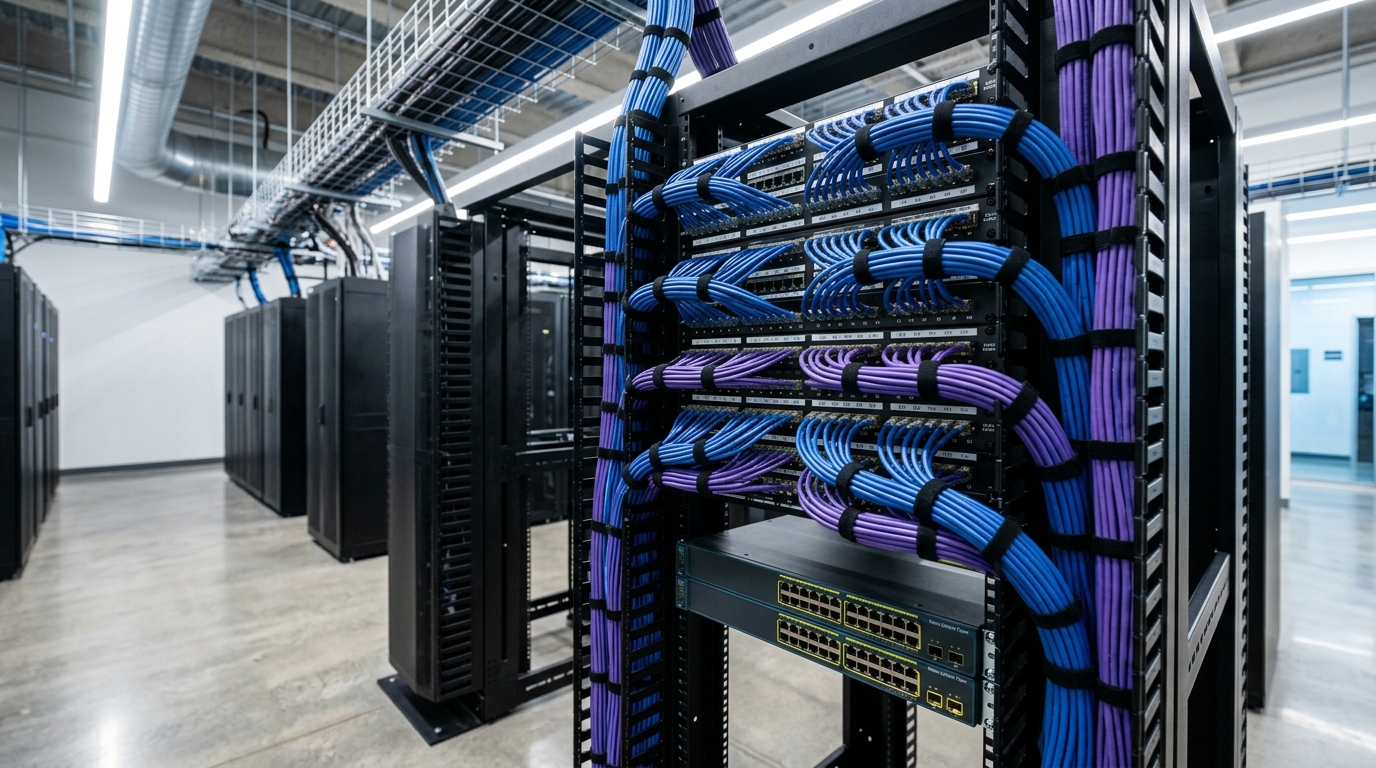
Furthermore, the physical execution of your cable layout dictates your facility's long-term maintenance overhead and organizational scaling speed. Legacy or unmanaged corporate office layouts frequently fall into the trap of point-to-point wiring loops, where an installer runs a single raw wire directly from an office workstation drop straight to an unprotected network switch port without any structured intermediate patch connections. As an organization scales its physical headcount or deploys advanced components like IP security cameras and wireless access points, this unmanaged method turns your server enclosures into chaotic, tangled "spaghetti racks" that block necessary equipment ventilation, trap heat, and complicate basic troubleshooting tasks.
Sustainable business scaling requires transitioning to a standardized, hierarchical architectural layout that transforms physical assets into a cleanly organized modular grid system. This design establishes permanent horizontal cable paths leading from multi-user room drops back to a centralized Main Distribution Frame (MDF) or localized Intermediate Distribution Frames (IDFs). Every single data line is neatly terminated into a designated patch panel port and clearly labeled based on an unvarying system schema. Subsequent workplace expansions, hardware additions, or device rearrangements are then completed efficiently by simply swapping short external patch cords at the panel face, leaving the structural building infrastructure completely untouched. Adhering to this structured approach significantly reduces diagnostic downtime and gives your operations team a highly adaptive, scalable platform built to handle future enterprise growth smoothly.
Comments
Log in or sign up to join the conversation.