

Written by Kurt Reiman
Canada's exporters received a much-needed shot in the arm last week when Belgium reversed its opposition to the Canadian European Free Trade Agreement, effectively paving the way for improved access to 28 European Union member states...[but] there is still substantial work ahead to resuscitate Canada's export businesses [and,] unfortunately, there are no quick fixes on the horizon for this lingering export malaise.
Momentum for trade deals has stalled
- amid a growing populist backlash against free trade,
- the [weak] loonie has so far failed to lift non-energy exports,
- oil prices have recovered but are still half of where they were in 2014, and
- unit labor costs have steadily eroded Canada's competitive position.
The Bank of Canada recently ratcheted down its estimate of Canadian economic output in 2017 and 2018 in part because of a more downbeat assessment of Canada's export prospects...
The costs of free trade
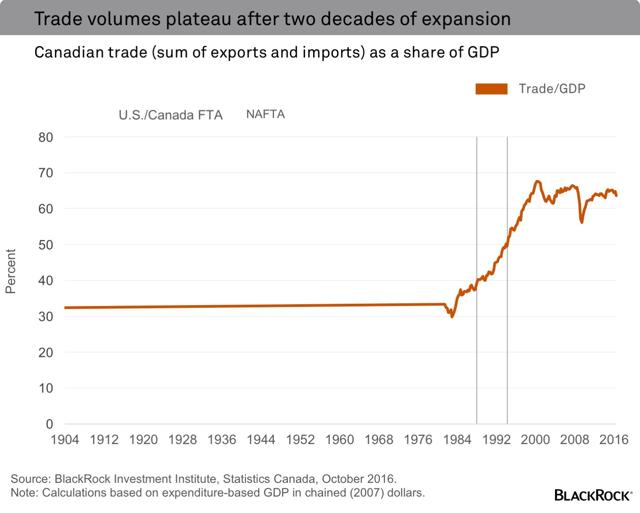
- The share of trade (as measured by the sum of imports and exports) in the Canadian economy more than doubled from a generational low of 30% in the early 1980s to roughly 65% today, thanks to successive trade deals in the 1990s (see the chart below). However, there has been virtually no growth in Canadian trade since the turn of the millennium.
- Meanwhile, international trade has plateaued after years of steady growth and little progress in deepening trade ties is being made.
- The Trans-Pacific Partnership has lost key backing from the next U.S. president no matter who wins in November and
- NAFTA is getting its quadrennial tongue lashing from U.S. presidential candidates.
For a country that depends as much as Canada does on exports for generating economic activity, the shifting international consensus on trade is concerning.
A cheaper currency is no panacea
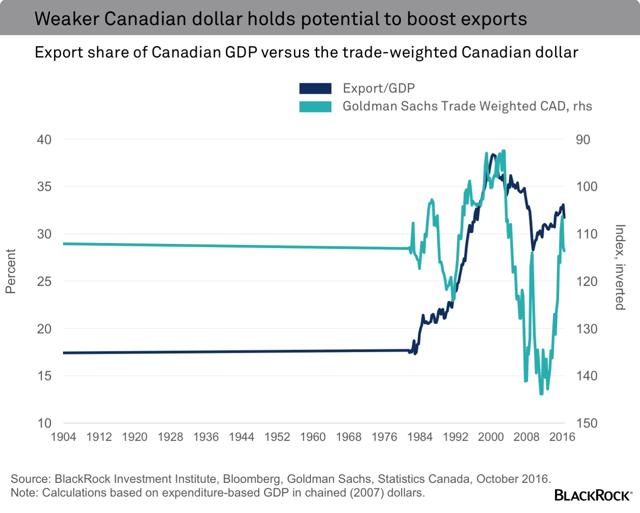
- The loonie has depreciated 25% on a trade-weighted basis since 2012, according to Goldman Sachs research. Conventional wisdom would have predicted a surge in exports after a fall in the currency of this magnitude but exports have only nudged modestly higher and are well below the late 1990s heyday (see the chart below).
- ...Why haven't exports taken off?
- It takes time for depreciations to work their way through to economic activity.
- Moreover, productivity and changes in commodity prices matter just as much, if not more, to export competitiveness.
- At the same time, the current slow growth regime is a global one and currency depreciation is a natural byproduct when there is excessive demand on monetary policy to spur growth.
Trade on worse terms
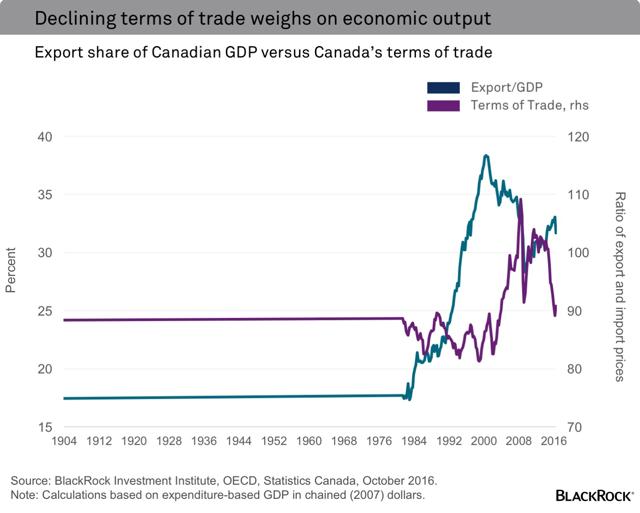
Canada's terms of trade have weakened steadily thanks in large part to the falling price of oil, which is still off by as much as 50% since 2014, and other industrial export commodities (see chart below).
- High oil prices and expanded trade with China and other emerging markets boosted Canada's terms of trade during the early years of the new millennium, only to turn down when the commodity super cycle ended in 2014.
- High oil prices are pernicious in other ways:
- When oil wealth was abundant, efforts to boost productivity fell by the wayside
- and high commodity prices have historically boosted the loonie, which weighs on export competitiveness in non-energy sectors.
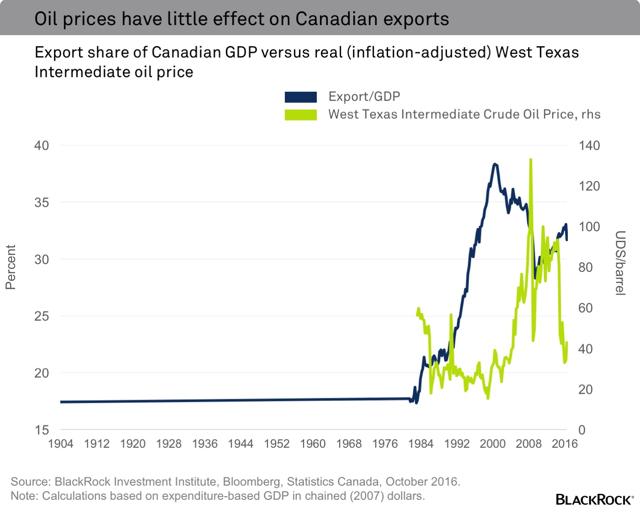
For those who might think that a recovery in oil prices will yield a bright outlook for Canadian exports, it's unlikely it will work that way.
- Oil prices are unlikely to return to the levels that prevailed from 2011-14 and the rise so far only retraces a small part of the lost ground.
- Moreover, there is hardly any relationship historically between exports activity and oil prices (see the chart below).
As long as U.S. and global economic growth remain anemic and free trade has lost its dynamism, Canada's exports are unlikely to accelerate faster than the overall economy.


.webp)
Comments
Log in or sign up to join the conversation.