

Reports on Canada’s monthly labor force and jobs growth are widely recognized as being both volatile and often misleading.
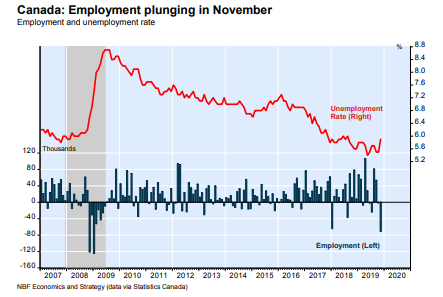
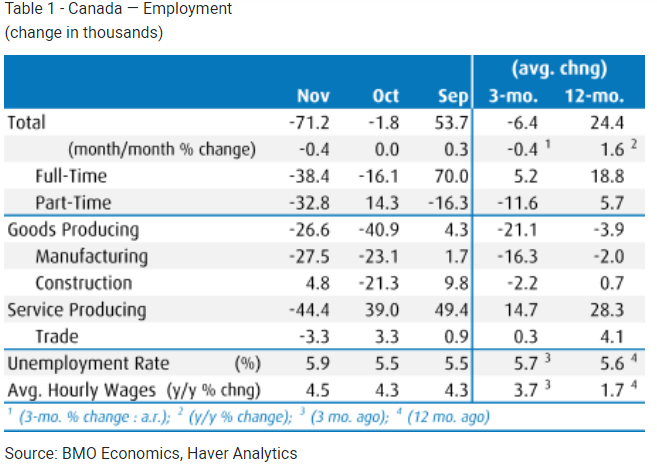
The latest release of data for November, which recorded the steepest monthly employment contraction since the 2008-2009 recession, certainly lives up to its reputation of volatility. The Canadian unemployment rate rose four-tenths of a percentage point in November to 5.9%, its highest level since August 2018.
Our own expectation for November employment was quite low since Canadian job growth over the past year has been much stronger than the economy.
Nonetheless, the 71,000-job loss in November, largely attributed to a sharp decline of jobs in the private sector and in Quebec, was quite surprising. Bear in mind the pessimistic outlook for the global economy and the US economy has recently been fading even as the Canada’s employment deteriorated.
Because Canada’s monthly labor force figures are so volatile, it is better to take a longer-term view of these developments.
On that basis, Canada created 285,000 new jobs this year, which still represents the second-best performance since the end of the Great Recession. Furthermore, 86% of these jobs were full-time employment.
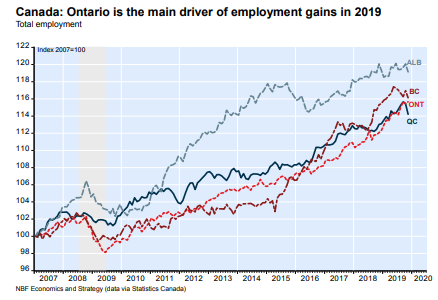
Regionally, Quebec lost 45,100 jobs in November due to declines in manufacturing as well as accommodation and food services. Alberta and B.C. both lost 18,200 jobs in November.
And about 76% of the jobs created over the past year were centered in Ontario, a huge proportion considering that Ontario is only about 40% of the Canadian labor market.
Nonetheless, the bleak November jobs report calls into question the Bank of Canada’s stubbornness in not following the US Fed in lowering interest rates this year.
The latest jobs report followed a recent decision by the Bank of Canada to keep its benchmark interest rate on hold at 1.75%, where it has been set for more than a year.
In its latest interest rate decision, the Bank of Canada observed that the Canadian economy has remained resilient despite the global uncertainty caused by the trade war between the United States and China.
We will soon see whether November’s huge job loss was a statistical aberration. If not, expect a Canadian interest rate cut in the first quarter of 2020.
(Click on image to enlarge)
(Click on image to enlarge)
(Click on image to enlarge)


Comments
Log in or sign up to join the conversation.