

Canada’s Urban Labor Force Is Expanding Faster Than The American. Immigration Policies Explain Some Of The Differences
The job markets in both the US and Canada has been surging over the past couple of years.
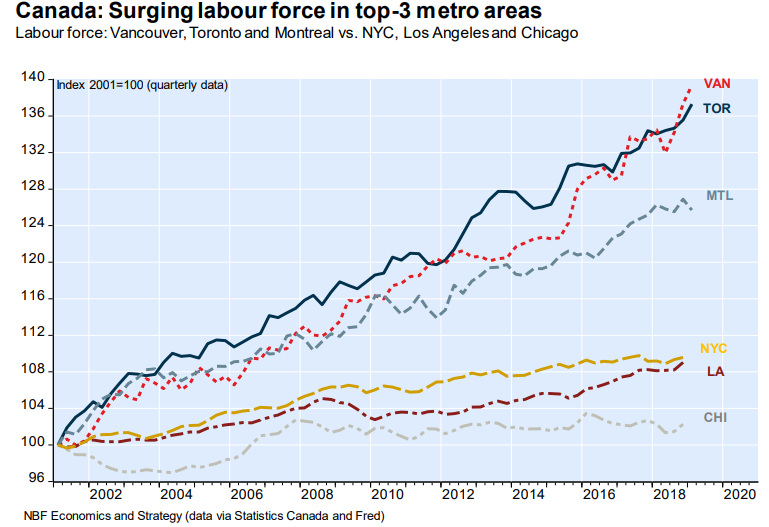
It is interesting to observe, however, that the job expansion in Canada’s three top urban markets has been faster than the jobs growth in comparable three large urban areas in the US.
As set out in the following chart, the cities used for comparison on the Canadian side are Vancouver, Toronto, and Montreal. The cities used for comparison on the American side are New York, Los Angeles, and Chicago.
The employment growth differences between Canada and the US using this kind of comparison since 2002 is quite striking.
Stefane Marion of the National Bank concludes that the rising gap between the two countries is probably due to differences in both the scale of immigration as well as the locational effects of Canada’s immigration policy.
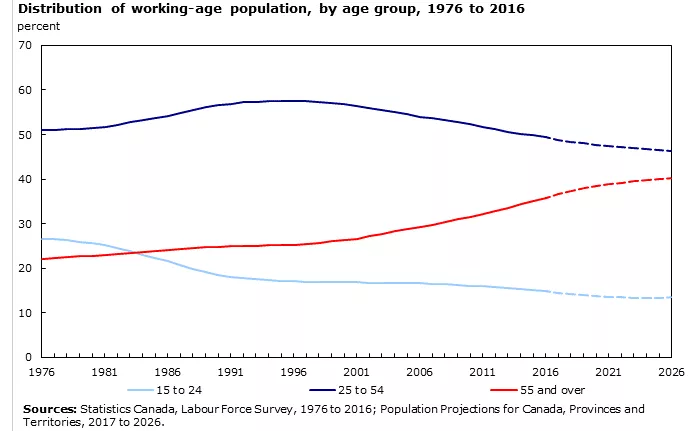
As he observes, Canada’s immigration policy targets young and educated immigrants who tend to settle mostly in the large cities. As well, Canada also records the fastest growth in population among the OECD nations.
Indeed, Canada accepts far more immigrants per capita than the US. And according to a recent BMO study, nearly half of all millionaires in Canada are immigrants or second-generation residents, compared to just one-third in America.
Around two-thirds of new Canadian permanent residents arrive through economic immigration programs. In contrast, only 16 per cent of new Green Card holders (lawful permanent residents, or LPRs) in the U.S. arrive through economic immigration categories.
Politicians and commentators in other countries continually point to Canada’s points-based economic immigration as a shining example of a positive, open immigration strategy that creates opportunities for newcomers and Canadians alike.
Moreover, international students studying in Canada usually can stay longer after graduation than the comparable situation in the US.


Comments
Log in or sign up to join the conversation.