

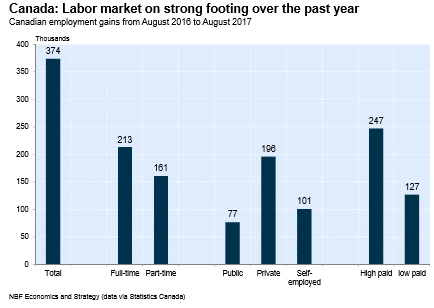
The Canadian economy created 374,000 new jobs between August 2016 and August 2017. This represented an extremely rapid expansion of the job market.
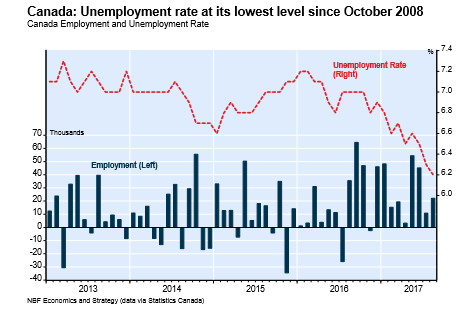
In terms of monthly changes, employment in August increased by 22,000 following a 10,900 gain in July. The unemployment rate in August dropped to 6.2% from 6.3% in the previous month. Not only did the jobless rate drop to its lowest level since October 2008, the “augmented” jobless rate (known as U-6 in the U.S.) also fell to a cyclical low in August.
The August employment increase was significantly skewed towards part-time jobs, while full-time employment declined. Despite some weakness on the jobs front in August, earlier strong gains contributed to full-time employment averaging a solid monthly increase of 17,800 over the past year.
However, only 57% of the jobs created over the past year were full-time positions, and not surprisingly the service industries led the way with 306,600 new positions.
In terms of the provinces, the four largest—Ontario, Quebec, B.C. and Alberta—created 99% of the new jobs. As a recent BMO Focus report indicated (August 25), B.C. led the country with 3.6% y/y job growth followed closely by Quebec with 3% growth.
Nonetheless, as in the U.S. and other advanced economies, improved job growth has not triggered higher wage or price inflation in Canada. In addition, while many experts are convinced that the economy is operating at close to full employment, the accompanying chart shows that Canadian unemployment rate in the 1960s was often as low as 3%.
Bear in mind that over the past half-century there has not been any meaningful change in the way the Canadian unemployment rate is calculated. When Canada’s unemployment rate is re-stated using the American methodology, Canada’s jobless rate would still be about 1% higher than the recent low 4.4% U.S. rate.
The conventional wisdom, which is not fully shared by this economist, is that the Canadian economy has recently been growing at above the full capacity growth rate of the economy. Indeed, Canada’s real GDP did expand at a 3.7% and 4.5% annual rate in Q1 and Q2 of this year. Full capacity growth is generally thought to be closer to 3%. Nonetheless, there is still considerable slack in the Canadian economy.
Canada’s labor force survey data which is reported monthly tends to be quite volatile, and as well, has always had problems with seasonal adjustments. Consequently, month to month changes in employment are somewhat less meaningful than the twelve-month change data which provide a clearer picture. Not surprisingly given the recently strong real GDP growth rates, Canada’s job market has been quite robust.
Finally, though wage increases in Canada are starting to creep up, they still are quite low. As of August, the year-over-year increase in average hourly earnings rose to 1.7% compared with a 1.2% pace in July. This still represents a very low rate of increase. However, the Statistics Canada wage index which is based on payroll employment points to faster increases in wages. The fixed weight payroll survey reported a 2.7% y/y increase in June relative to a low at the start of the year of 1.5%.
The main point is, that Canada’s economy still has considerable potential for non-inflationary job growth. As well, the unemployment rate should still fall considerably below its August 6.2% level.


Comments
Log in or sign up to join the conversation.