

“The Fall Economic Statement is proposing three important immediate changes to Canada's tax system, in order to enhance business confidence in Canada:
- Allowing businesses to immediately write off the cost of machinery and equipment used for the manufacturing or processing of goods.
- Allowing businesses to immediately write off the full cost of specified clean energy equipment to spur new investments and the adoption of advanced clean technologies in the Canadian economy.
- Introducing the Accelerated Investment Incentive, an accelerated capital cost allowance (i.e., larger deduction for depreciation) for businesses of all sizes, across all sectors of the economy, that are making capital investments.”
(Government of Canada, Economic Statement, Fall 2018)
It used to be the case that Canada’s fall Economic Statement was nothing more than an exercise in fine-tuning of the economic numbers from the previously released annual Budget.
In recent years, however, the Economic Statement has become more political and at the same time, more akin to a mini-Budget than an Economic Statement. This is certainly the case for Canada’s November 2018 Economic Statement.
It is not as if the Canadian economy and its government faced no real challenges. Here are three major challenges to the economy and its competitiveness.
- The recent massive cut in the US corporate tax rate has placed future investing in Canada at risk;
- The major decline in international oil prices and the record high negative spread between global oil prices and what Canadian producers receive has pummelled Canada’s oil industry, which accounts for at least 25% of Canadian investment spending;
- And of course, there are the tariffs on Canadian steel and aluminum exports to the US which have hurt these industries and the confidence of investing in Canada.
In other words, the Canadian government felt it had little option but to respond to the competitiveness concerns in its latest mini-Budget. As well, despite the relatively strong economy, the Trudeau government rather cleverly decided to modestly boost the economy without incurring too heavy a revenue loss. However, the government also decided to postpone any plan for a balanced budget in the near-term future.
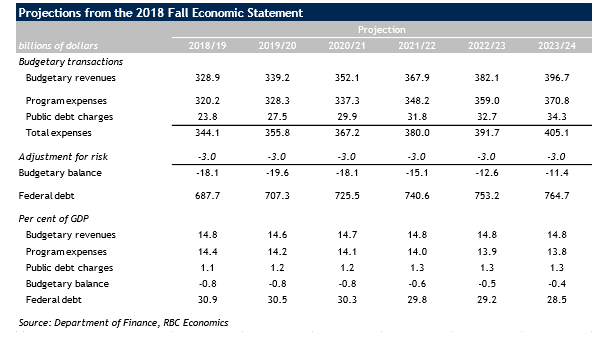
Thus, the November Economic Statement shows larger annual budget deficits than was set out in the previous 2018 Budget. T
The new projections have the deficit increase to $19.6 billion in fiscal year 2019/20 and then to decline only gradually to $11.4 billion as of fiscal year 2022/23.
The cumulative deficits for the fiscal year 2018/19 to 2022/23 add up to $83.5 billion, compared to $78.3 billion reported in the previous Budget 2018.
The centerpiece of the Canadian response to the aggressive US corporate tax package was the introduction of accelerated depreciation for business investment, which will immediately expense 100% of the costs for manufacturing and processing machinery and equipment, along with clean energy equipment.
The total cost to the government in terms of foregone revenue from the faster write-offs of qualifying machinery and equipment as well as clean energy is $14.4 billion, with more than half of the revenue loss occurring in the next two fiscal years. These incentives will be gradually phased out beginning in 2024.
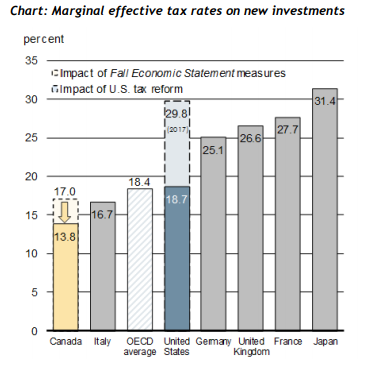
As the following chart illustrates, the new expensing rules should lower Canada’s marginal effective tax rate on new investment from 17% to 13.8%.
Note that Canada’s effective tax rate compares rather favorably to the new 18.7% effective tax rate in the US, which also allowed for accelerated depreciation alongside last year’s corporate tax cut.
The Canadian government’s claim that it is still pursuing a fiscally prudent policy is partly predicated on how much better Canada’s fiscal outlook looks compared to the US and other advanced economies. The standard comparison here is the budget deficit to GDP ratio. As well, the government also points out that the country’s debt to GDP ratio will continue to decline in the future.
The Canadian government’s mini-budget was designed to strengthen the business climate in Canada, and in this way, it will be helpful to Canadian industry. Nonetheless, the fiscal strategy that Canada is pursuing is still quite risky.
Canada (somewhat like the US) is injecting new fiscal stimulus at a time when the economy is already in decent shape.
The emphasis on the declining debt to GDP ratio argument, which the government favors, seems to support a pro-cyclical fiscal policy, rather than the counter-cyclical approach that most economist would prefer.
However, in this writer’s view, we live in unusually interesting and challenging times. The latest Budget decisions by the Canadian government, although partly motivated by politics, still makes sense to this economist.


Comments
Log in or sign up to join the conversation.