

The Canadian economy was recently been trapped in a very weak phase of economic growth. Canada’s real GDP rose at a meager 0.4% annual rate in the first quarter, while in sharp contrast, the American economy expanded at a robust 3.2% pace in the same quarter.
In fact, considering that Canada’s economy grew at an even slower 0.3% pace in the fourth quarter of last year, Canada barely avoided falling into a recession in those six months. Fortunately, there are signs suggesting that the economy is currently experiencing a modest growth rebound.
Nominal GDP bounced back at a more respectable 5% annual rate in the first quarter, following a 3.1% drop in the fourth quarter of 2018. Pre-tax corporate profits in the first quarter also rose 7.2% following a massive 69.4% decline in the previous quarter.
Canada’s tepid GDP expansion in the first quarter was led by a 3.5% annual increase in consumer spending and a 39.5%growth in business investment in machinery and equipment. However, offsetting these increases were some dreadful trade numbers in the first quarter -- a 4.1% decline in exports and a 7.7% increase in imports, and as well there was 6.1% decline in residential construction spending.
There was also a huge $17.7 billion expansion in inventories in the first quarter, as cannabis stocks contributed to a $1.7 billion increase in farm inventories.
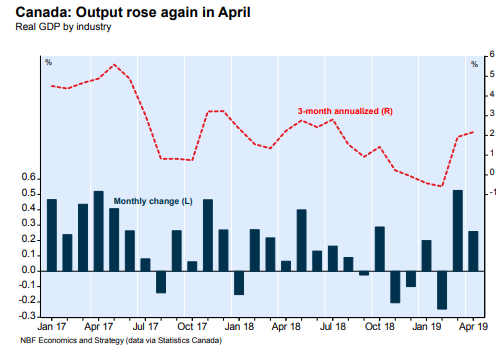
We are also highlighting monthly GDP data for March and April, which provide a more up to date sense that the economy is in a modest bounce back phase. Monthly GDP essentially focuses on industrial production trends, and as such does not illustrate the direct impact of foreign trade.
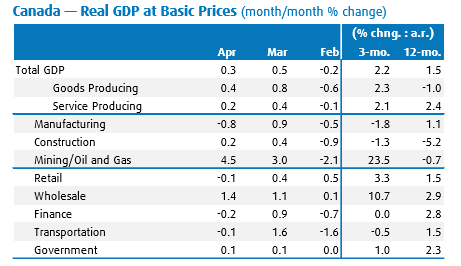
Canada’s monthly GDP expanded 0.3% in April after an even stronger 0.5% advance in March.
The goods-producing industries expanded 0.4% in April and the service industries generated 0.2% growth. 16 of Canada’s 20 industrial sectors expanded in March and 11 industries also advanced higher in April.
The recent two months of solid GDP growth certainly underscore a more promising expansion in the second quarter of this year.
The reversal of Alberta's oil production curtailment accounted for much of the improvement in Canada’s monthly GDP in March and April. As the following table illustrates, the goods production rebound was much stronger in March than in April.
Finally, following a half year of consecutive monthly declines, the mining, quarrying, and oil and gas extraction sector increased 3% in March and 4.5% in April. The rebound in this broad industrial group was clearly led by the oil and gas industries in Alberta.
In closing, the March and April rebound in GDP growth sets up the Canadian economy for a stronger expansion in the second quarter.
Growth in Canada’s economy over the next eighteen months should average about 1.7% assuming the foreign trade environment does not deteriorate any further.
(Click on image to enlarge)
(Click on image to enlarge)


Comments
Log in or sign up to join the conversation.