

Up to very recently, the Canadian economy seemed to outperform consensus expectations.
Indeed, Canada led the G7 group of countries with 3% growth in 2017 and appeared to grow at a brisk pace in the first half of last year. This prompted the Bank of Canada to press ahead last year with higher borrowing costs.
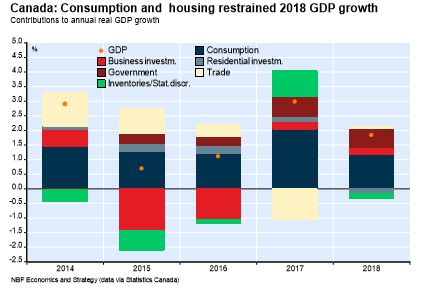
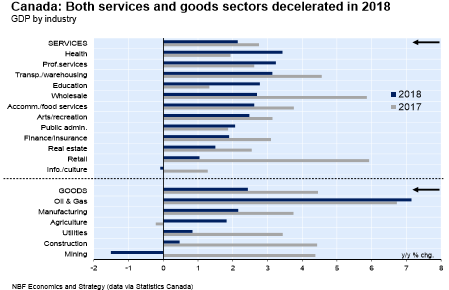
However, annual growth in the first half of 2018 was revised lower by Statistics Canada and the economy came in with only 1.8% growth in all of 2018, somewhat below the Bank of Canada’s earlier projection of 2%. In comparison, the American economy expanded 2.9% in 2018.
Canadian consumer spending growth in 2018 was only 2.1%, its weakest performance in six years. Canada’s housing sector, which had a rough time in 2018, is unlikely to perform any better in 2019.
In the fourth quarter of 2018, the Canadian economy slowed to a crawl, with real GDP expanding at a very slow 0.4% annual rate.
The slowdown in the fourth quarter was associated with a sharp 1.6% drop in final domestic demand and business investment also declined.
The only thing that kept Canada’s economy from contracting in the fourth quarter was a build-up in inventories as orders weakened.
Obviously, the uncertainties relating to the impact of higher interest rates, the impact of a potential trade war, and the oil-sector woes are hurting consumer and business sentiment. The question now is how much further will the economy slow and when will it be able to bounce back to more normal growth?
Canada’s economy is currently heading for only 1.5% growth in 2019 primarily because of the weakness in the energy sector together with a projected slowing in housing and consumer spending activity.
A reasonable assumption about oil prices is that they will remain roughly in the current range through all of 2019 and then slowly increase into 2020.
This suggests that oil energy investments will likely continue to be a negative for the economy this year and perhaps next, although non oil investment activity is expected to improve as firms take advantage of the government’s accelerated depreciation allowance and invest to overcome some of the capacity constraints.
As well, assuming the USMCA trade deal finally passes it could also release some pent-up investment activity even though the global trade environment continues to be uncertain.
Optimistically one might assume a resumption of 2% trend-like GDP growth in 2020 combined with accelerating wage growth and some upward pressure on prices.
Against this backdrop, the Bank of Canada is likely to move its policy rate closer to its neutral level with a possible rate hike in the fourth quarter of this year and a further possible rate increase in 2020.
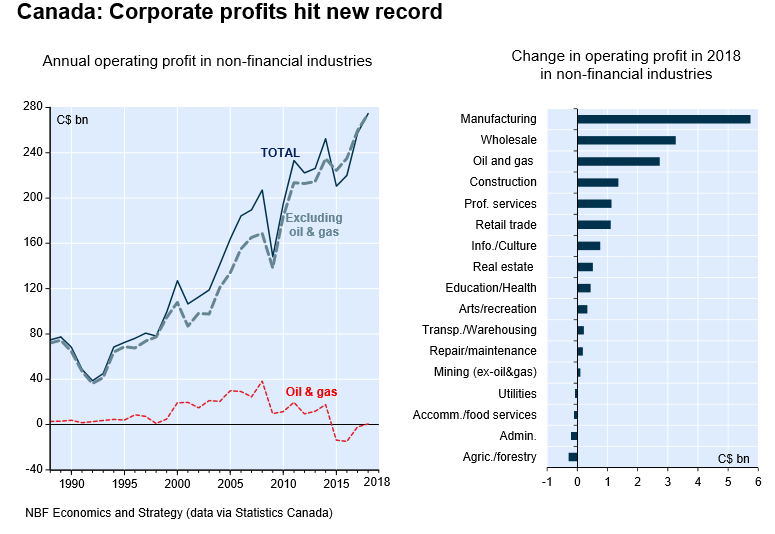
Despite the sharp slowdown in the economy in the fourth quarter of 2018, Canadian corporations posted strong profits last year. The operating profits of non-financial firms were $17 billion higher (or 6.7% stronger) than in 2017 due to strong gains in manufacturing, the wholesale sector and surprisingly, oil and gas.
Normally strong profits foreshadow improving business investment, but in this uncertain environment, one cannot easily draw that conclusion.


Comments
Log in or sign up to join the conversation.