

“Today’s job report is a classic case of “nice headlines, shame about the details”. While we would still give the overall result a passing grade, it’s tough to get overly enthusiastic given 1) the highly suspect spike in education jobs, 2) the weakness in manufacturing, 3) the concentration of the gains in Ontario, and 4) the cooling in wages. Still, the labor market remains robust and there is easily enough here to convince the Bank of Canada to maintain its gradual tightening campaign --- there’s just not enough to get it to accelerate the schedule.” BMO, Econofacts, August 10, 2018)
“Adjusted to the concepts used in the United States, the unemployment rate in Canada was 4.8% in July, compared with 3.9% in the United States. In the 12 months to July 2018, the unemployment rate declined by 0.5 percentage points in Canada and by 0.4 percentage points in the United States.” (Statistics Canada, Labour Force Survey, August 2018)
Canada’s labor force survey often misleads about the true state of the job market. With its July employment figures, perhaps confusion is a better description than misleading.
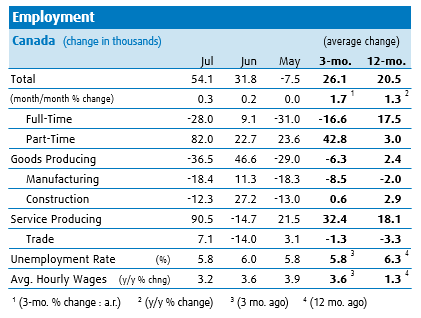
In July, Canadian employment soared by 54,199 net new jobs, a very hefty monthly increase. The unemployment rate also declined in July to 5.8%, the lowest level in about a decade. The previous month’s gain of nearly 32,000 new jobs was also quite strong.
Over the 12 months ending in July, Canada’s employment increased by 246,000 (+1.3%), and on this longer run basis, the job gains were largely in full-time work (+211,000) or +1.4%).
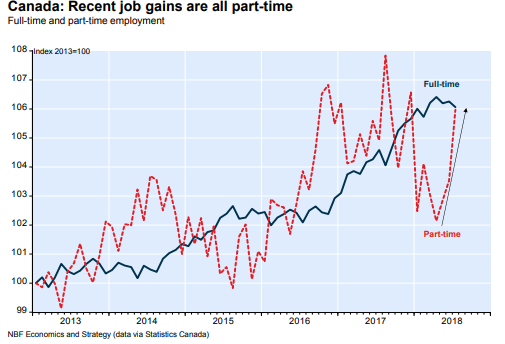
From a short-term perspective, virtually the entire July job growth came from part-time work. Full-time employment declined by 28,000 in July and only rose a tiny 9,000 in June. There was a sharp pullback in factory employment in manufacturing in July. Indeed, a glance at the accompanying table indicates that employment in manufacturing has been declining for a full year.
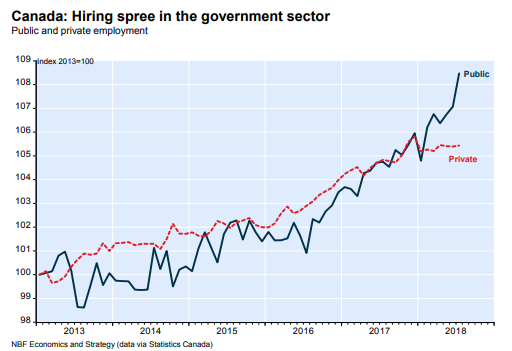
The service sector employment gain in July was largely in the government sector, particularly in education. Indeed, Statistics Canada reports that in July, “employment increased by 37,000 in educational services, mainly in Ontario and Quebec. At the national level, the gain was mainly in employment in post-secondary institutions, particularly universities, and was largely in part-time work. Compared with 12 months earlier, employment in educational services increased by 80,000 (+6.3%).”
Despite the appearance of a strong job market in July, hourly wage earnings cooled to a 3.2% year-on-year pace, a decline from the June rate of increase.
The confusing array of labor data underscores a serious problem with Canada’s household survey.
The month to month changes in virtually all categories tend to be very erratic. For example, as of July the standard error in monthly employment was nearly 30,000. In other words, the monthly jobs gain in July could be anywhere between 84,000 and 24,000.
This writer’s guess is the lower figure for job growth presents a far more accurate picture.


Comments
Log in or sign up to join the conversation.