

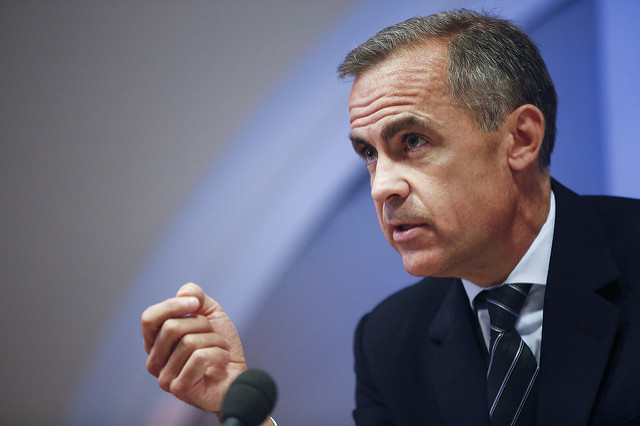
Following the footsteps of Mario Draghi, the central bank chief, the Bank of England governor, Mark Carney delivered a hawkish statement to the markets last week. In under a week, the central bank chief switched from being dovish to hawkish.
Carney’s comments were made at the central banking forum in Portugal over the week, which also saw participation from other central bank chiefs including ECB president Mario Draghi, BoC governor Poloz, BoJ governor Kuroda.
The comments from Carney were surprising considering that the BoE governor had just told the markets a week before that “now was not the right time to raise interest rates”.
The hawkish comment from Carney comes after the BoE had a split vote on interest rate hike. There were three dissenters from the MPC who voted for a 25 basis point rate hike.
Carney: Monetary policy stimulus removal required
In his comments, the BoE Governor said: "an overshoot of inflation above the target can only be temporary." He was speaking in reference to the current inflation rate which stands firmly above the central bank's 2% inflation target rate.
The central bank had previously reiterated that it would tolerate an inflation overshoot but only temporarily.
The BoE governor also said that the central bank would need to keep a close track on the inflation trade-offs. Noting that “spare capacity is eroding,” the governor said that the MPC has been clear on its tolerance for the inflation overshoot.
Among a host of BoE members who has been speaking last week, it was the BoE Chief, Andy Haldane who was more hawkish just a week before. His comments came a day after Carney's dovish speech.
The chief economist said that interest rates should rise during the second half of the year.
Speaking about the MPC meeting, Carney said that although different MPC members had their views on the outlook, any changes will be limited in scope. Carney suggested that the central bank's MPC will continue to debate about rate hikes. This goes in line with Carney's earlier comments that now was not the right time to hike rates.
"When the MPC last met earlier this month, my view was that given the mixed signals on consumer spending and business investment, it was too early to judge with confidence how large and persistent the slowdown in growth would prove," Carney said clarifying his stand on interest rates.
Will the BoE start to tighten monetary policy?
While it is too early to tell, the central bank policymakers will no doubt discuss in detail about timing for tightening the monetary policy. The BoE's interest rate currently stands at 0.25%, while it continues to maintain its asset purchase program as 435 billion British pounds.
On Friday, 30 June the Gfk consumer climate for the UK showed a strong decline. The forward looking indicator fell eight points to -10 in June.
Joe Staton from Gfk said, "We have falls this month, reflecting negative sentiment about our personal financial situation and expectations for the wider economy."
The ongoing uncertainty about the Brexit negotiations also makes the decision on monetary policy a bit more complex for policy makers.
As a result, traders can expect to see some continued volatility. Inflation is likely to remain a key point alongside wages in the UK. A deteriorating trend in wage growth could, however, put policy makers in a fix due to the divergence between consumer prices and wages.
The UK’s economy has already shown a significant decline in the first quarter. Later in July, the preliminary estimates for the second quarter will be released. A continued weaker trend could potentially upset the policy makers’ plans for tightening rates.
If any changes are expected from the Bank of England, it is most likely that we will get to see some changes around September. By then, the policy makers would have gotten a clearer picture on the state of the UK economy.

Comments
Log in or sign up to join the conversation.