
Real-time market data has a reputation for being expensive, and historically it was: exchange licensing fees alone could price out a small team before they'd written a line of code. That's less true today. Here's how a lean team can get genuinely useful real time stock market data api access without the enterprise price tag, and when a free stock market data api plan is actually enough.
Why Market Data Used to Be So Expensive
Traditional market data access involved direct exchange agreements, licensing fees per data feed, and infrastructure to normalize formats across multiple exchanges. That model made sense for trading firms processing millions of transactions, not for a two-person team building a portfolio tracker as a side project.
Third-party APIs changed the economics by aggregating exchange data once and reselling access at a fraction of the cost, spread across many customers instead of one enterprise contract.
What "Real-Time" Actually Costs Now
Pricing today generally breaks into three tiers of need:
End-of-day data: closing prices only, often available on generous free tiers. Fine for historical analysis, backtesting, and apps that don't need live pricing.
Delayed real-time (15-20 minutes): a middle tier, usually inexpensive, suitable for dashboards where a slight lag doesn't matter.
True real-time: live tick-by-tick or near-instant pricing, which costs more because it requires higher infrastructure throughput on the provider's end.
Most consumer-facing apps (portfolio trackers, research tools, hobby dashboards) don't actually need true real-time data. Delayed data is often indistinguishable to an end user checking their portfolio on their phone.
When a Free Tier Is Genuinely Enough
A free stock market data api plan works well for:
Prototyping before you commit budget
Personal finance tools with light, non-commercial usage
Backtesting strategies against historical EOD data
Learning projects and demos
It stops being enough once you have real users making frequent requests, or once your product depends on accuracy and uptime you can't verify on a free plan.
How marketstack Fits Both Ends
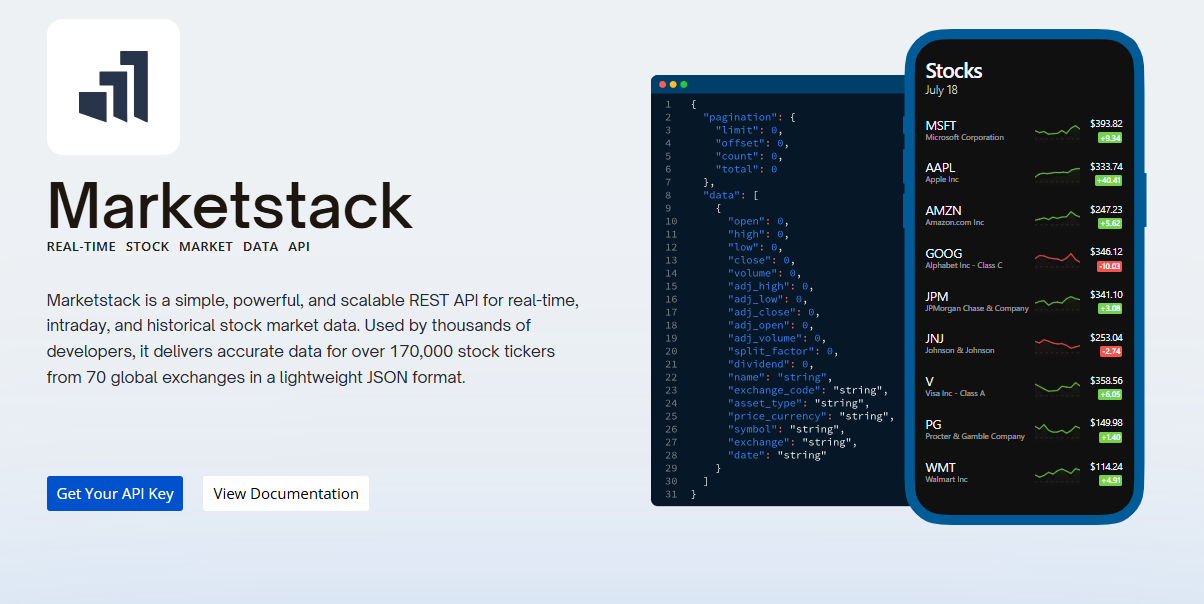
marketstack offers a free tier for exactly this kind of early-stage validation, alongside paid plans that unlock real-time and intraday data, higher request volumes, and broader exchange coverage as your product grows. Because the JSON structure stays consistent across tiers, moving from prototyping to production doesn't require rebuilding your integration.
A Simple Framework for Choosing a Tier
Does your product genuinely need live pricing, or would end-of-day data serve the same purpose?
How many exchanges do your actual users care about? Global coverage matters less if you're US-only.
Estimate real request volume at your expected user count, not a worst-case guess.
Start on the cheapest tier that meets those three answers, and scale up only when usage data tells you to.
Frequently Asked Questions
Is delayed data actually usable for a real product?
For most consumer apps, yes. Delayed data (15-20 minutes) is common even in well-known finance apps and is rarely noticeable to end users checking portfolio values casually.
Do free tiers include historical data?
This varies by provider. Some free plans include limited historical depth, while full multi-year history is often reserved for paid tiers, so check this specifically if backtesting is your use case.
What's the biggest hidden cost in market data APIs?
Underestimating request volume. A dashboard that refreshes every few seconds for every active user can burn through a rate limit far faster than expected, so model your actual usage pattern before picking a plan.
Start Small, Scale When You Need To
Test your idea on a free plan before committing budget to real-time infrastructure you might not need yet.
Get started here: https://apilayer.com/products/marketstack/
Comments
Log in or sign up to join the conversation.