

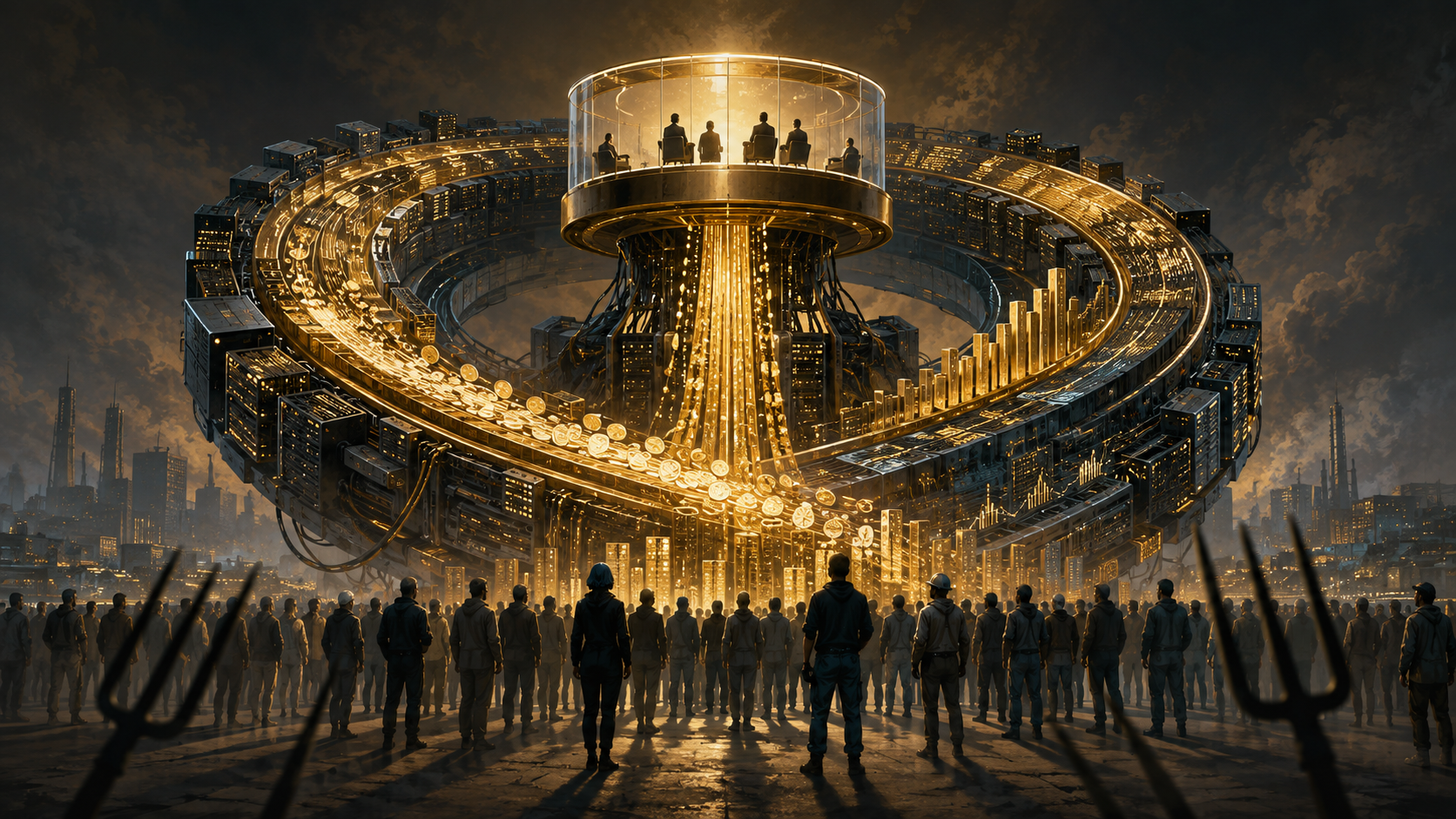
Paul Krugman recently returned to an old economic question that suddenly feels very new: how national income is divided between labor and capital. His concern is that since 2000 the share going to labor has declined while the share going to owners of capital has risen, and that AI could accelerate the process. Let’s explore.
AI is unusual in that it requires enormous amounts of capital—datacenters, chips, power, software and infrastructure—while at the same time potentially reducing the amount of labor needed to produce a given level of output. Now imagine that AI succeeds quite nicely. Productivity rises, profits increase, margins expand and economic output grows. Voila! By almost every traditional measure, capitalism has succeeded.
In such a world, however, the benefits of that success could accrue disproportionately to those who already own the capital. And therein lies an additional element Krugman’s income-distribution framework does not fully capture: those expected future profits can be capitalized into present-day wealth. In other words, unlike labor, capital does not have to wait for tomorrow’s income to enjoy tomorrow’s value today. Tomorrow’s promise is today’s reality—and that reality creates the possibility of a powerful AI-enhanced feedback loop:
Capital finances AI
AI increases productivity and profits
Expected future profits increase present market values
Rising market values create additional wealth and financing capacity
That wealth can finance the next round of investment
Labor has no comparable capitalization mechanism. A worker cannot ordinarily take twenty years of expected wages and convert them into millions of dollars of liquid wealth today. An owner of capital routinely can. And present wealth brings with it more than additional economic power. It can also bring political power—not necessarily through the crude image of a billionaire buying a politician, but through something much more familiar to the way human beings actually operate: a guy who knows a guy who knows a guy.
Wealth produces access, relationships, introductions, institutions and networks through which interests and ideas travel. The surface story may consist entirely of legitimate and independent actors. The deeper truth may be the network through which concentrated economic power becomes political influence without anyone ever having to issue an explicit order. This then raises a question larger than inequality: Can capitalism survive its own success?
Then and Now
Nearly a century ago, Keynes confronted a different version of the problem: an economic system that needed to change if it was going to preserve itself. As Adam Tooze and Stefan Eich recently describe it, Keynes’s project was both radical and preservative—reinventing liberal capitalism rather than abandoning it.
The great challenge of the AI age may not be that capitalism fails to produce enough wealth. It may be that AI-enhanced capitalism becomes too successful at producing wealth while concentrating an increasing share of the ownership claims on that wealth—and the economic and political power that accompanies them—in progressively fewer hands. The danger to capitalism, in other words, may not be that AI capitalism does not work. It may be that it works too well...for capital. And therein lies the rub.
When you don’t know a guy who knows a guy who knows a guy, when capital gets tomorrow’s value today while labor waits for tomorrow’s paycheck, and when this goes on long enough and on a large enough scale, eventually the pitchforks come out.
For further reading: Zuckerberg’s AI Future Is For Everyone—But Who Owns It?


Comments
Log in or sign up to join the conversation.