

Every part that flows through the defense and aerospace supply chain carries a paper trail — and at the center of that trail is a small but powerful identifier: the CAGE code. If you've ever paused on a drawing or spec sheet wondering what that five-character code actually means, this guide will clear it up, and show you how to put a good CAGE code listing and CAGE code lookup to work for your next purchase.
Breaking Down the CAGE Code
CAGE, short for Commercial and Government Entity, is a standardized code issued by the Defense Logistics Agency (DLA) to companies and organizations that do business with the U.S. government. It's always five characters, always alphanumeric, and always tied to one specific entity at one specific location — no duplicates, no overlap.
Companies outside the U.S. use a parallel system called NCAGE, administered through the NATO Codification System, so the same identification logic applies internationally. Together, these codes create a consistent way to track who's who across a massive, global supply base.
The Real-World Problem CAGE Codes Solve
Here's the challenge anyone in parts procurement eventually runs into: a National Stock Number (NSN) doesn't always tell you the whole story. Over a part's lifecycle, multiple manufacturers may produce components under the same NSN, sometimes with meaningful differences in quality, tolerances, or certification history.
CAGE codes close that gap. Instead of relying on the NSN alone, you can pinpoint the exact manufacturer tied to a specific part, which is critical when:
You need to confirm a part matches its original certified source
Your program requires sourcing from an approved or historically reliable manufacturer
You're validating a supplier before onboarding them
You're troubleshooting a discrepancy between documentation and delivered parts
Making CAGE Code Lookup Part of Your Sourcing Workflow
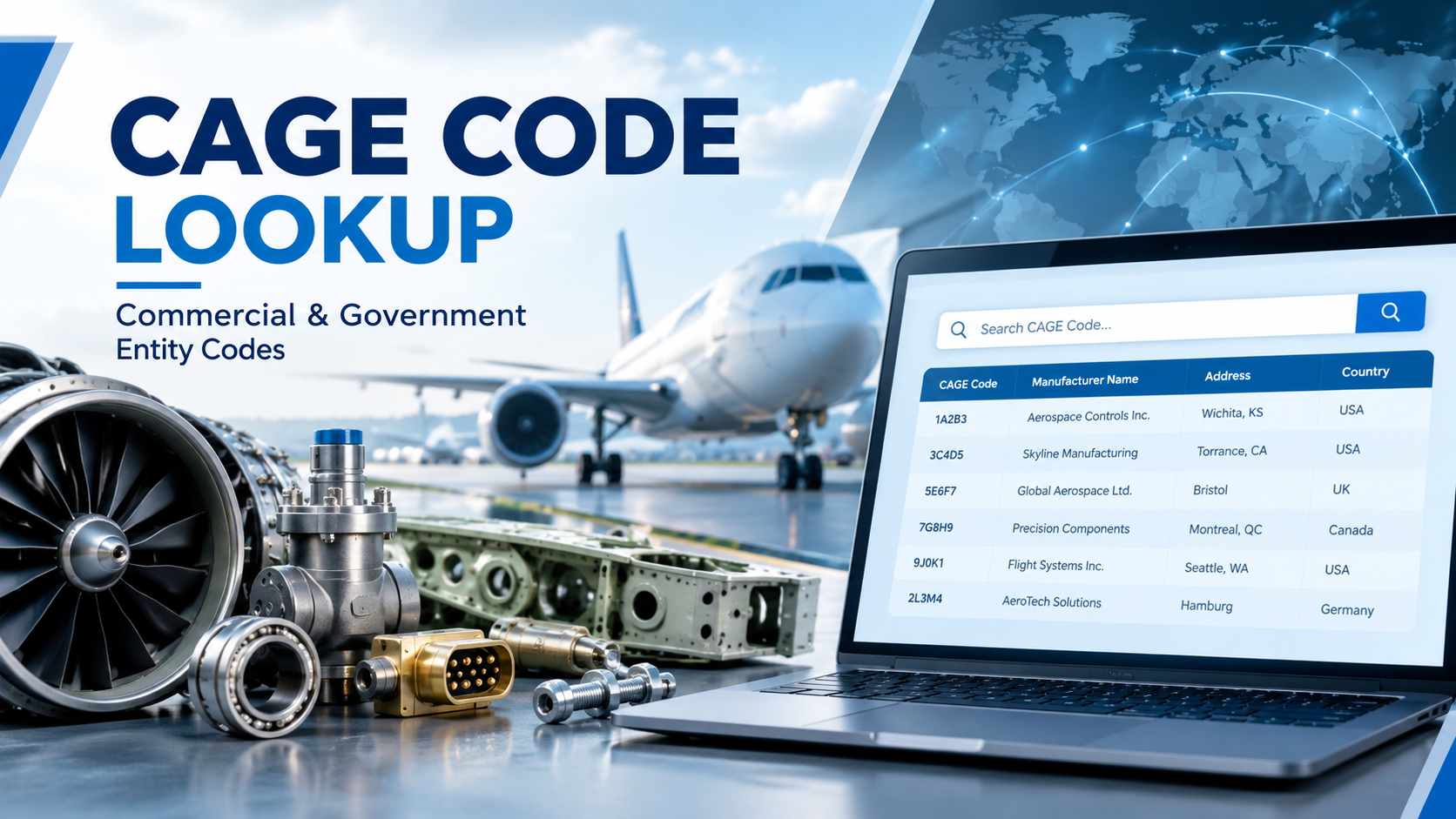
A CAGE code lookup should never feel like extra work — it should be a quick, built-in step of your sourcing process. The best lookup tools let you go in either direction: search a code to find the manufacturer, or search a manufacturer to confirm their code, location, and current standing.
Speed matters here. Procurement teams working against tight deadlines can't afford to bounce between multiple government portals just to confirm a supplier's identity. A fast, accurate lookup keeps sourcing decisions moving instead of stalling them.
Why a Strong CAGE Code Listing Changes the Game
A scattered search process is slow by nature. A centralized CAGE code listing, on the other hand, puts verification and sourcing in the same place — so once you've confirmed a code, you're already looking at available parts instead of starting a second search from scratch.
That's the approach behind Distribution 3Sixty CAGE code listing. Search by code, part number, NSN, or manufacturer name, and you'll land directly on in-stock inventory tied to that supplier — no extra steps between verification and getting a quote.
Every part ships with manufacturer trace documentation, and our facility holds AS9120B, ISO 9001:2015, and FAA AC-56B accreditation. We're also proud to operate under a strict no-China-sourcing pledge, so the suppliers behind every CAGE code you find here meet a consistent standard.
Wrapping Up
Understanding CAGE codes isn't just background knowledge — it's a practical safeguard for anyone responsible for sourcing defense, aerospace, or government parts. A quick CAGE code lookup paired with a trustworthy CAGE code listing means fewer sourcing headaches and more confidence in every purchase.
Comments
Log in or sign up to join the conversation.