

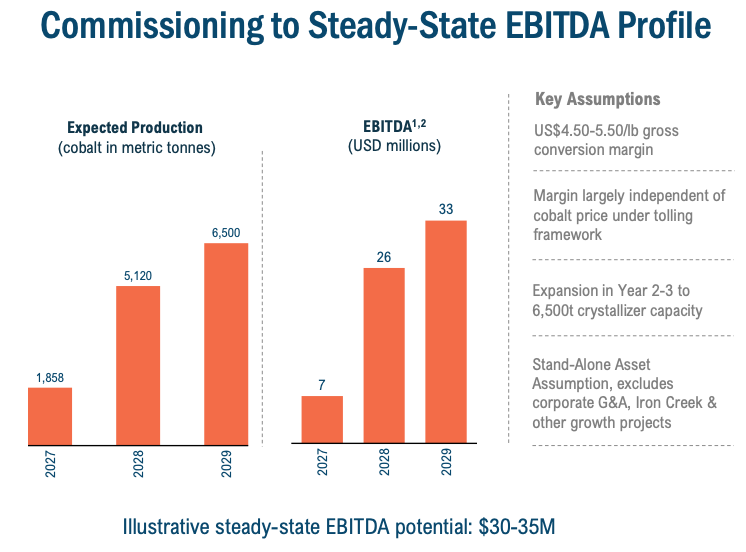
Electra Battery Materials (TSX-v: ELBM) / (NASDAQ: ELBM) is 100% owner of a strategic and valuable refining complex in NE Ontario, a facility that will produce 100% of N. America’s cobalt (“Co“) sulfate (up to 6,500 tonnes/yr.). Production is expected to start in 2H/27.
The IEA projects Co demand will rise from 213,000 tonnes in 2023 to 344,00 by 2030. The Co sulphate market specifically is forecast to grow ~5%/yr. through the mid- 2030s. That’s half or a third the rate of Li demand, but better than copper.
Electra’s Battery Materials Complex (“BMC“) has a third-party (Hatch) estimated replacement cost of US$250M, (in my view, it might be closer to US$300M, as the assessment is approaching three years old, and inflationary pressures have been significant).
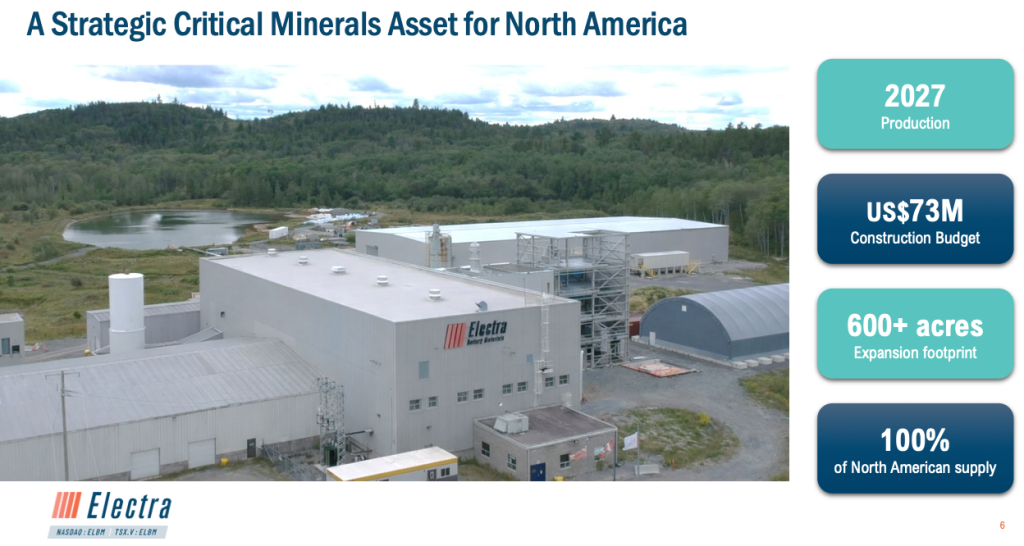
Importantly, it would take over five years to find a site, plan, fund, PERMIT, build, and commission a new facility like Electra’s. Compare Hatch’s US$250M valuation to Electra’s market cap of ~US$74M (US$0.57/shr.).
All eyes have been on the Middle East, but a critically important second-order effect is deteriorating relations between China & the West. As the bifurcation between East & West grows, having strategic assets in safe, prolific jurisdictions like Canada & the U.S. is increasingly important.
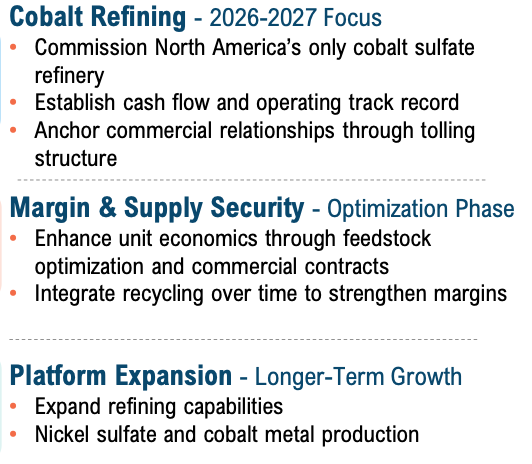
Electra’s BMC is on a sizable industrial site that could (subject to more studies & investment capital) host other operations, most notably black mass recycling and nickel sulfate production. That’s likely 2028 or 2029 business, for now the main focus is Co sulfate.
In my opinion, the optionality of being able to expand into new cash flowing segments has tangible value. These segments, if deemed attractive and viable, are not 6-8 years away, more like 2-4 years. In the following interview of CEO Trent Mell, I ask about the latest happenings at Electra, and the significant interest in the Company’s refinery.
Trent, you travel regularly to Washington D.C. and elsewhere in the U.S. What are the primary goals of these visits?
Our focus is on building relationships with policymakers, government agencies, strategic partners and other key stakeholders in the critical minerals space.
Electra is developing infrastructure that directly supports North American supply chain resilience. It’s essential that we stay engaged with decision-makers in both Canada and the U.S. Our visits help us communicate the strategic importance of domestic refining, understand policy priorities, and explore potential partnerships.
On June 8th a PR announced a study looking into a nickel refinery in the southeastern U.S. Please explain this initiative.
The nickel refinery study is part of Electra’s longer-term growth pipeline. The work will evaluate the technical requirements, capital intensity, and potential development pathways for a domestic nickel refining operation in the southeastern U.S.
The proposed facility is an opportunity to leverage expertise gained through the development of our cobalt refinery. Importantly, this is a study-stage initiative, not a final investment decision. Our cobalt refinery remains the Company’s top priority.
For the past few years, your team has said Electra’s cobalt sulfate refinery will be the first in North America. Is that still the case? Has the outlook for cobalt sulfate changed?
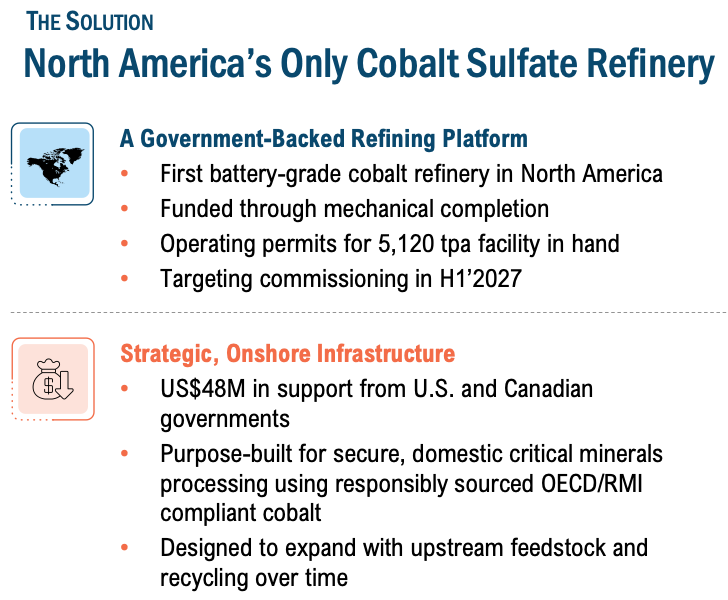
Yes. Electra continues to describe the Ontario refinery as N. America’s first, and currently only, cobalt sulfate refinery. The strategic rationale remains intact; North America still has limited domestic refining capacity for battery-grade cobalt sulfate.
Yet, demand for secure, responsibly-sourced critical minerals remains crucial for batteries, energy storage, defense and advanced manufacturing.
Can you comment on funding status? Is Electra fully funded through initial production, but will need to raise US$15M for commissioning? Could some of the US$15M come from non-equity sources?
Electra has a defined construction plan and has secured significant funding support, including government backing, to advance the cobalt refinery. The Company has also disclosed that additional capital may be required for commissioning plus working capital.
Future funding could potentially include government or other financial support. We will continue to evaluate the most attractive funding sources, including non-equity sources where appropriate, while remaining focused on minimizing dilution and advancing the refinery toward commissioning.
At a 30,000-foot level, what is your impression of relations between the U.S. and China? How serious is the U.S. about sourcing critical materials outside of China?
Good question. Critical minerals have become a strategic priority for the U.S. The issue is no longer only about EVs, it’s about energy security, defense readiness, advanced manufacturing and economic security. The U.S. is taking supply chain diversification seriously because processing capacity for many critical minerals remains highly concentrated offshore.
From Electra’s perspective, that creates a clear need for North American refining infrastructure that can provide secure, transparent and allied sources of battery materials.
LG Energy Solution has secured 60% of the refinery’s output for the initial five years. What type of end users might care on the remaining 40%? Auto OEMs? Battery makers? Defense companies? The U.S. government?
The remaining capacity could be relevant to several categories of customers and stakeholders. Battery manufacturers and automotive OEMs are obvious candidates because cobalt sulfate remains an important input for certain lithium-ion battery chemistries.
We also see potential interest from energy storage, defense and advanced manufacturing supply chains where secure, traceable, North American-refined material will be in high demand. The 40% uncommitted capacity gives Electra commercial flexibility and potential exposure to market upside.
What’s the latest thinking on black mass recycling, a business segment that’s been carefully studied by your team?
Black mass recycling remains part of Electra’s longer-term strategy, but the cobalt refinery is the priority. Electra completed a Feasibility-level Class 3 engineering study for a modular battery recycling facility adjacent to the Ontario refinery, designed to recover lithium, nickel, cobalt, manganese and graphite from manufacturing scrap and end-of-life batteries.
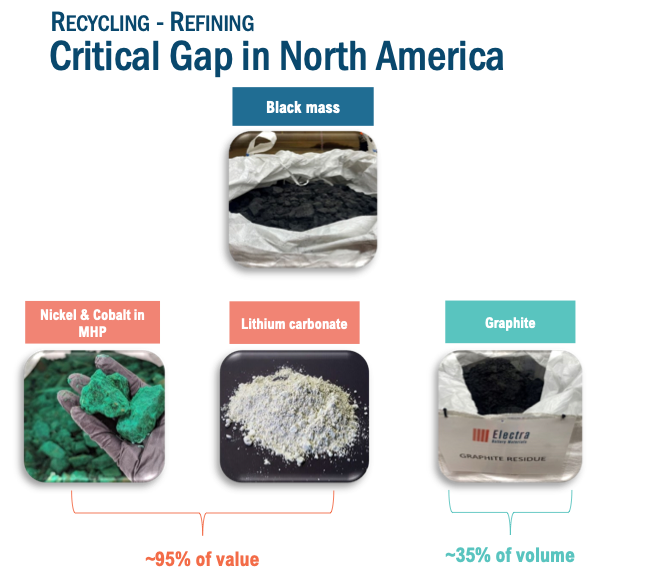
The next phase involves further technical work to simulate commercial-scale throughput, supported in part by Natural Resources Canada. The strategic value is clear: recovered cobalt could feed directly into the adjacent cobalt refinery, creating a more integrated domestic battery materials loop.
Why should readers consider buying shares of Electra Battery Materials, why not wait for further de-risking?
Electra has a permitted refinery under construction, a strategic customer in LG Energy Solution, backed by the Canadian and U.S. governments, and a defined role in North America’s critical minerals supply chain. Investors who wait for further de-risking may get more certainty, but may miss part of the value creation opportunity.
Value derived by construction progress, commissioning, commercial execution and future growth opportunities in recycling and nickel refining. Electra is building strategic refining infrastructure at a time when North America is actively trying to reduce reliance on offshore processing.
Thank you Trent, as always very insightful commentary on battery materials. The strong demand and urgent need for long-term, secure N. American supply of cobalt sulfate and other key materials is becoming more clear by the day. Canada will be a leader.
Owing hard assets, highly strategic ones that are very difficult (time + cost) to replicate, should serve Electra Battery Materials well. I look forward to reporting on further de-risking of the Company!
Disclosures/disclaimers: The content of this article is for information only. Readers fully understand and agree that nothing contained herein, written by Peter Epstein of Epstein Research [ER], (together, [ER]) about Electra Battery Materials, including but not limited to, commentary, opinions, views, assumptions, reported facts, calculations, etc. is not to be considered implicit or explicit investment advice. Nothing contained herein is a recommendation or solicitation to buy or sell any security. [ER] is not responsible under any circumstances for investment actions taken by the reader. [ER] has never been, and is not currently, a registered or licensed financial advisor or broker/dealer, investment advisor, stockbroker, trader, money manager, compliance or legal officer, and does not perform market-making activities. [ER] is not directly employed by any company, group, organization, party, or person. The shares of Electra Battery Materials are highly speculative, not suitable for all investors. Readers understand and agree that investments in small-cap stocks can result in a 100% loss of invested funds. It is assumed and agreed upon by readers that they will consult with their own licensed or registered financial advisors before making investment decisions.
At the time this article was posted, Electra Battery Materials was an advertiser on [ER]. Peter Epstein owned shares in the company.
Readers understand and agree that they must conduct due diligence above and beyond reading this article. While the author believes he’s diligent in screening out companies that, for any reason whatsoever, are unattractive investment opportunities, he cannot guarantee that his efforts will (or have been) successful. [ER] is not responsible for any perceived, or actual, errors including, but not limited to, commentary, opinions, views, assumptions, reported facts & financial calculations, or for the completeness of this article or future content. [ER] is not expected or required to subsequently follow or cover events & news, or write about any particular company or topic. [ER] is not an expert in any company, industry sector or investment topic.
Comments
Log in or sign up to join the conversation.