

There have been a number of recent articles/reports across Substack newsletters regarding Western countries, most notably the U.S., becoming more resilient in NdFeB permanent magnets + associated alloys. Security of supply requires a full ecosystem — separation, metal/alloy production, magnet manufacturing, qualification, recycling — not just mining.
Mining is not the bottleneck, the real chokepoints are downstream — separation (especially for heavy REEs), metal/alloy conversion, and magnet manufacturing — these things require decades of know-how, one can’t simply throw money at the problem…
Alternative magnets (some without REEs in them) will gain market share, but only in less-demanding end uses. There will be segmentation, but not wide scale NdFeB replacement. Power density matters! Critical end markets, like National Defense, never settle second best, governments will stick with NdFeB…
Most end markets are critical now – robotics, drones, aerospace, data centers, EVs + hybrids, wind power, medical devices, industrial motors/automation. Notably, the 2025 Defense bill (“One Big Beautiful Bill Act”) set aside US$7.5B for critical minerals. If 10% were to go to [NdPr + NdFeB magnets], that would amount to the government buying roughly 7,500 tonnes.
Adamas Intelligence put out a now famous thought piece on the potential demand for NdFeB magnets from humanoid robots alone. Suffice it to say, it could be massive. Elon Musk says there will be 10,000,000,000 humanoids in 20 years. Even if two orders of magnitude less, (a much more likely 100 million, not 10 billion), that would require 200,000-300,000 tonnes of NdFeB.
In the past few years, the U.S. has gone from essentially zero, to real (but still modest) commercial NdFeB magnet production. However, announced capacity additions, of which there are plenty, do not equate to qualified production.
The ecosystem for Western countries is getting better by the month, but there’s a long way to go before the West is self-sufficient. That means every REE magnet produced in the U.S. will be in high demand for years to come, especially if companies like MP Materials, USAR or Vulcan Elements face delays in ramping up.
In the following table, note that the stated (estimated) production numbers are not for 2026-27 or even 2028… I have estimated 2030 production levels. To be clear, no company in the table is anywhere near its 2030 potential. Notice that 3 of the 6 companies are privately-held. The private company valuations are derived from recent funding rounds.
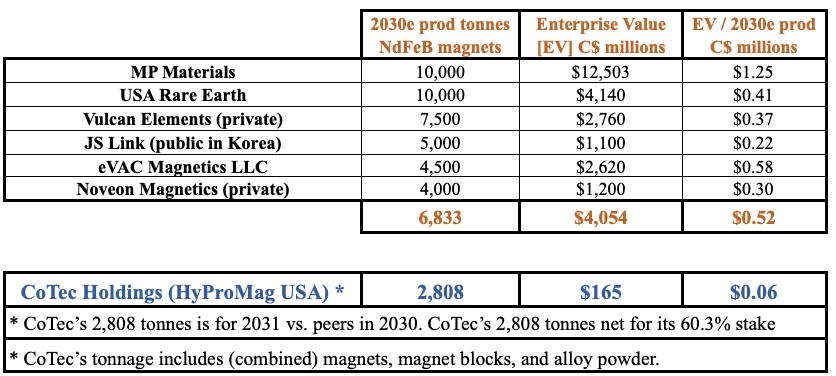
All three private firms are valued at or above C$1.1B. Leaving out Vulcan with an estimated 7,500 tonnes/yr planned, the average of eVAC, Noveon and JS Link is ~C$1.6B. I find this fascinating. The implications for CoTec Holdings’ (TSX-v: CTH) (OTC: CTHCF) HyProMag USA segment are clearly positive.
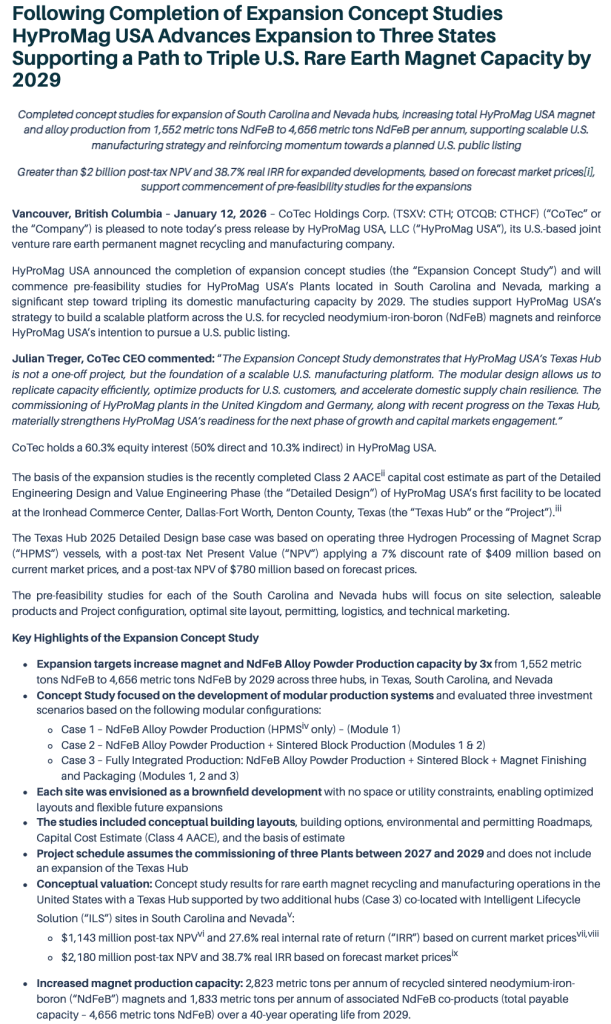
In commercial production by 2028, by 2031 HyProMag USA could be delivering an annual run-rate of 4,656 tonnes of NdFeB magnets + blocks + alloy powder. That’s based on this January-2026 press release…
This suggests CoTec’s 60.3% share in HyProMag USA could be meaningfully undervalued on an [EV/2031e tonne of production] basis {see above table}. PLEASE NOTE –> These estimates, especially for the private companies, are educated guesses based on AI research.
Actual production levels in 2030-2031 could be materially different due to challenges in funding, equip./feedstock procurement, construction/permitting delays, etc. Therefore, the above table is NOT a definitive comparison, it’s merely a frame of reference.
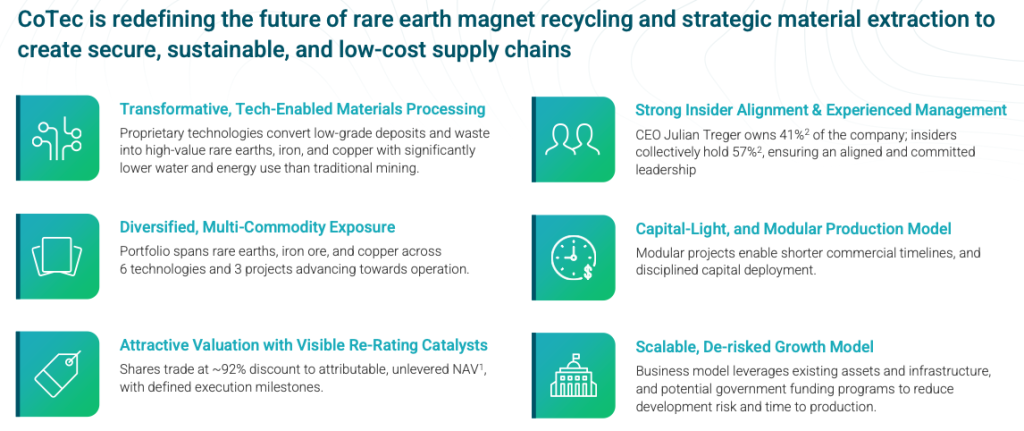
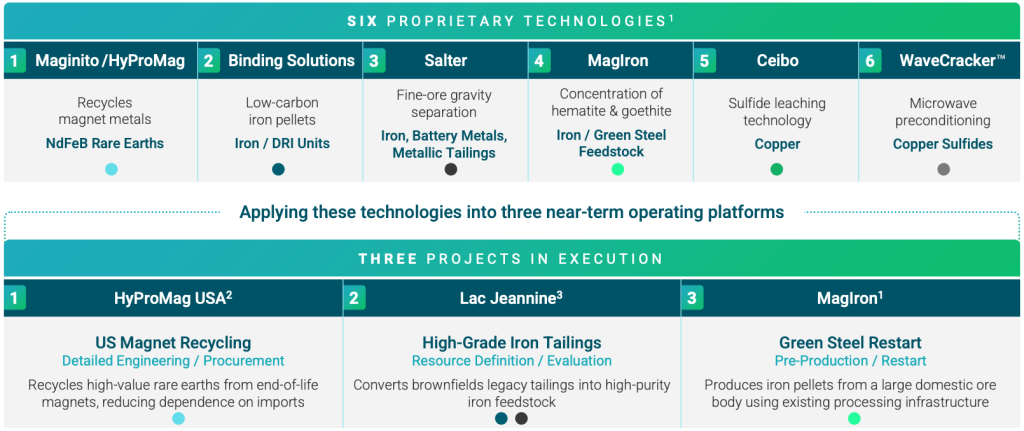
CoTec is not ONLY a REE magnet company through HyProMag USA, it also has a valuable 17% stake in green steel champion MagIron LLC (a pure-play iron ore – and possibly pig steel – opportunity, the 17% was valued at ~C$130M in its latest funding round) and other technologies/assets including promising copper recovery initiatives.
While CoTec is not valued like the others at this time, there’s good reason for readers to think twice about that. CoTec mgmt., led by CEO Julian Treger, plans to spin out the HyProMag USA segment to shareholders.
How does HyProMag USA compare to the three companies expected to produce 4,000-5,000 tonnes/yr? JS Link, eVAC and Noveon have an average valuation of C$1.6B.
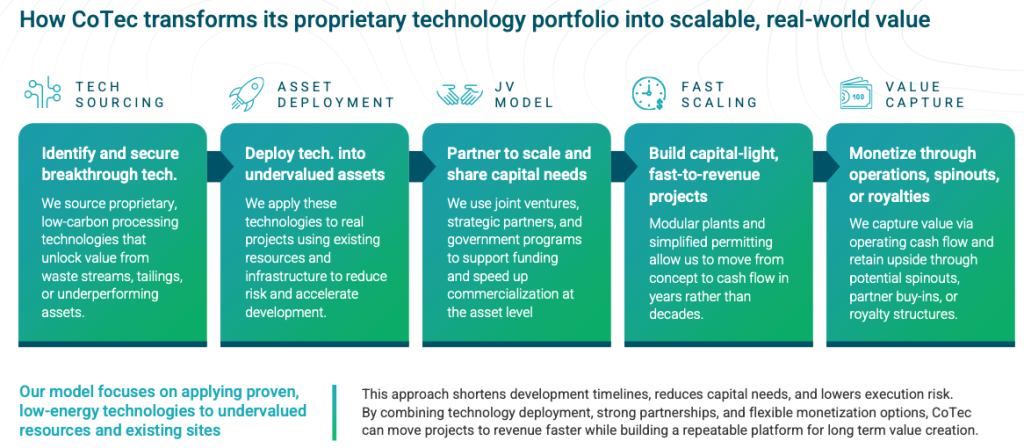
Yet, HyProMag USA stands out on cost, energy use, and pollution avoided vs. eVAC Magnetics, Vulcan Elements, JS Link & Noveon Magnetics. It’s the low-cost, green recycler, while the others are mainly conventional sintered-magnet makers. (Noveon can also recycle).
HyProMag USA pulls magnet powder from scrap products, then remakes sintered magnets. Noveon remakes sintered magnets from magnet scrap or virgin powder. eVAC, JS Link and Vulcan melt metals into alloys, then press and heat them into new magnets (energy intensive, and energy costs are rising lately).
HyProMag USA is the only entity with a published magnet cost estimate, ~$22/kg, quite low as operations skip mining, chemical refining, and metal-making. eVAC, JS Link and Vulcan sit on the primary-metal chain. Metal feedstocks (from MP Materials, Lynas, etc.) are more costly than end-of-life product scrap, so peers can’t beat HyProMag on unit cost.
HyProMag USA claims ~88% less energy use than mine-to-magnet methodologies. eVAC, JS Link and Vulcan run melt–cast–press–heat operations, so they carry the upstream energy of mining & metal-making. To be clear, once the feedstock powder exists, plant-floor sintering power use is similar across all operations. HyProMag USA benefits from multiple skipped upstream steps.
HyProMag USA has the cleanest third-party published carbon number at 2.35 kg CO₂ per kg of sintered block vs. typical primary “mine-to-magnet” figures cited in the 50–80+ kg CO₂ range. HyProMag USA avoids most or all acid, solvents, and mine waste.
Regarding end products, HyProMag USA produces slightly lower peak grade/quality magnets. However, if a cost/benefit analysis deems further upgrading steps commercially attractive, management will be able to do that.
Bottom line. Compared to eVAC, JS Link and Vulcan, HyProMag wins on cost, energy, carbon emissions, and avoided chemicals. Compared to Noveon, which can recycle, the ESG/energy story is more similar.
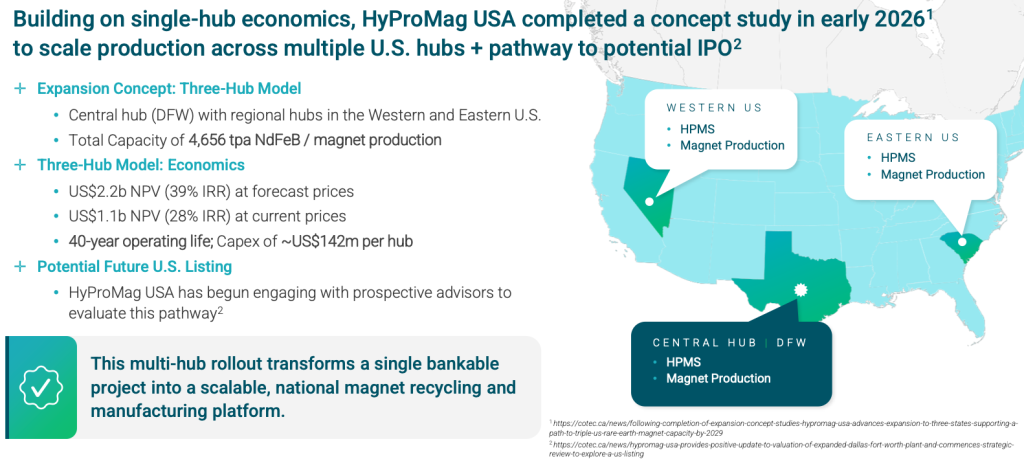
Does that mean a standalone HyProMag USA company listed in the U.S. could be worth C$1.6B (based on CoTec’s 60.3% interest only)? Perhaps not, as it’s earlier stage and carries incremental ramp up & funding risks. Having said that, all the peers have significant ramp up risks ahead. None are anywhere near my estimated 2030 levels.
HyProMag USA’s edge is pulling magnets out of end-of-life products at the lowest (estimated) unit cost. All else equal, recycling any material or product is always better for the world than new production. It seems that HyProMag USA compares favorably to peers in most respects, albeit being a few years behind in terms of production ramp up.
Even a prospective value of a quarter of C$1.6B for HyProMag USA would be a huge win for CoTec shareholders. And, would readers be surprised to see eVAC, Noveon or Vulcan go public in 2027 at meaningfully higher valuations? I think it’s reasonable to compare HyProMag USA to these players and apply appropriate haircuts due its earlier stage.
In my view, it’s hard to imagine a publicly-listed HyProMag USA valuation (exact timing unknown) that’s not meaningfully higher than CoTec’s entire C$160M valuation today (assuming HyProMag USA ramps up reasonably as planned, and reasonably on budget)…
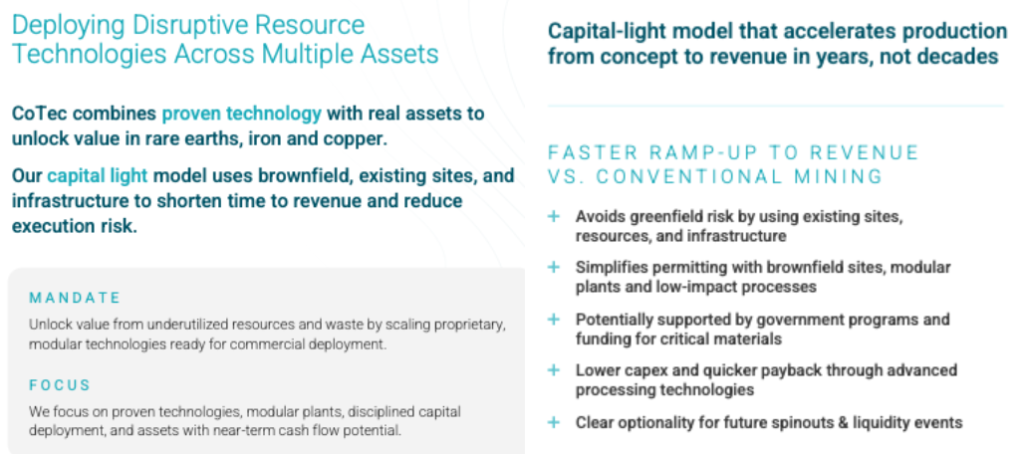
There are multiple ways to win with an investment in CoTec Holdings. If/when a re-rating happens (not a sure thing), I believe it could happen prior to HyProMag USA being spun off. Exciting headlines about public & private NdFeB magnet peers should continue to attract favorable attention to HyProMag USA.
Disclosures/disclaimers: The content of this article is for information only. Readers fully understand and agree that nothing contained herein, written by Peter Epstein of Epstein Research [ER], (together, [ER]) about CoTec Holdings, including but not limited to, commentary, opinions, views, assumptions, reported facts, calculations, etc. is not to be considered implicit or explicit investment advice. Nothing contained herein is a recommendation or solicitation to buy or sell any security. [ER] is not responsible under any circumstances for investment actions taken by the reader. [ER] has never been, and is not currently, a registered or licensed financial advisor or broker/dealer, investment advisor, stockbroker, trader, money manager, compliance or legal officer, and does not perform market-making activities. [ER] is not directly employed by any company, group, organization, party, or person. The shares of CoTec Holdings are highly speculative, and not suitable for all investors. Readers understand and agree that investments in small-cap stocks can result in a 100% loss of invested funds. It is assumed and agreed upon by readers that they will consult with their own licensed or registered financial advisors before making investment decisions.
At the time this article was posted, CoTec Holdings was an advertiser on [ER] and Peter Epstein owned shares in the company, acquired in the open market.
Readers understand and agree that they must conduct due diligence above and beyond reading this article. While the author believes he’s diligent in screening out companies that, for any reason whatsoever, are unattractive investment opportunities, he cannot guarantee that his efforts will (or have been) successful. [ER] is not responsible for any perceived, or actual, errors including, but not limited to, commentary, opinions, views, assumptions, reported facts & financial calculations, or for the completeness of this article or future content. [ER] is not expected or required to subsequently follow or cover events & news, or write about any particular company or topic. [ER] is not an expert in any company, industry sector or investment topic.
Comments
Log in or sign up to join the conversation.