

High-quality gold (“Au”) juniors with strong teams advancing projects in attractive jurisdictions can offer compelling risk/reward propositions. The lower the relative valuation on a metric such as enterprise value (“EV”) divided by resource ounce, the more potential upside.

However, projects differ on resource confidence level (proportion of measured, indicated, inferred), depth, grade, growth prospects, etc. One can take haircuts to a junior’s valuation to account for these factors. Importantly, a company that screens cheaply can remain cheap for months or quarters.
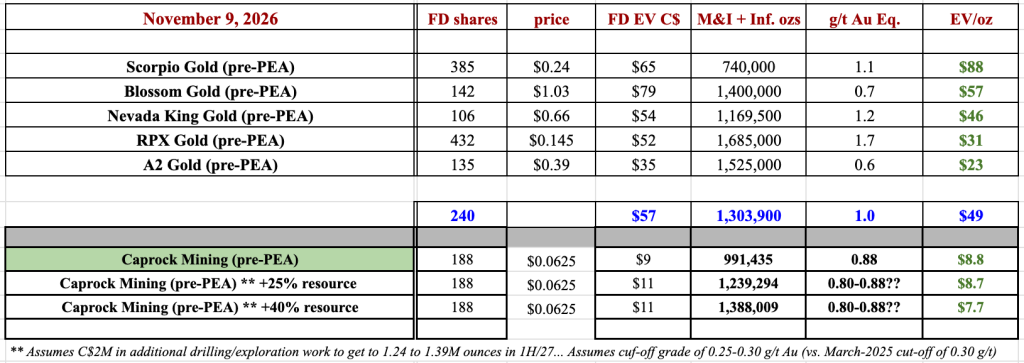
If one’s bullish on Au, and believes a tsunami of M&A will wash ashore in the coming years, then promising juniors valued at under C$30 per in-situ oz are worth a closer look. The following table shows early-stage companies with average resource size, grade, and EV/oz figures of 1.3M, 1.0 g/t, and $49/oz.
Notice that Caprock Mining has roughly a million ounces, including some in the Indicated category, in a world-famous mining district in Quebec, Canada, surrounded by producers, other meaningful projects and regional infrastructure. Caprock checks a lot of investment boxes, yet is valued at just C$9/oz.
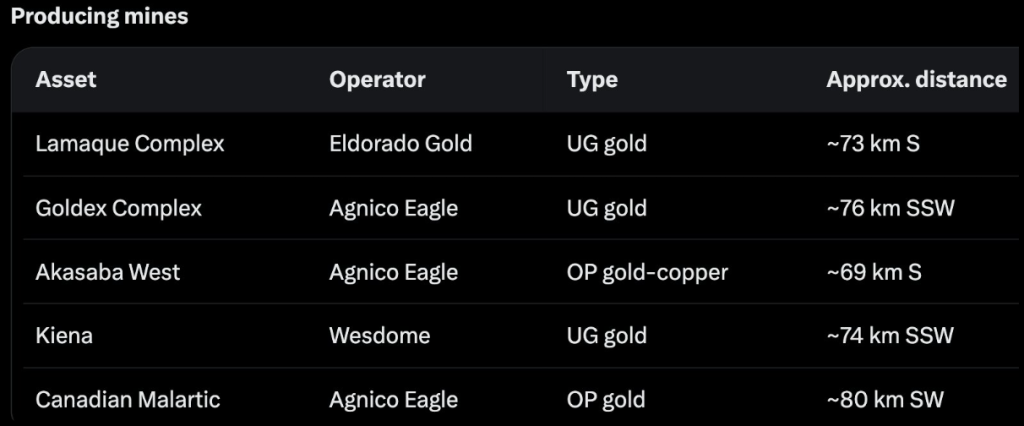
Caprock’s Destiny project is ~75 km north of Val-d’Or, which is the heart of the Abitibi Greenstone Belt. It lies along a major deformation corridor in the Belt that includes the prolific Cadillac-Larder Lake, Destor-Porcupine and Casa Berardi fault zones. The following operations are within 80 km of Destiny…
Readers should note that Caprock’s cut-off grade on its 991.4k Au-only ounces is 0.30 g/t. Four recent open pit resources reported by others used cut-off grades of 0.15 to 0.24 g/t Au Eq. I don’t know if CEO Vishal Gupa plans to lower the cut-off grade due to much higher Au prices, but I imagine there’s room to do so.
Insiders, led by prominent Quebec mining entrepreneur Frank Guillemette, have made dozens of open market purchases this year at up to C$0.145 vs. today’s $0.0625.
Admittedly, some juniors are cheap for a reason, but I can’t find any red flags here. Investors take haircuts on valuation based on various risk factors. It’s not clear which meaningful risks investors are overly concerned about.
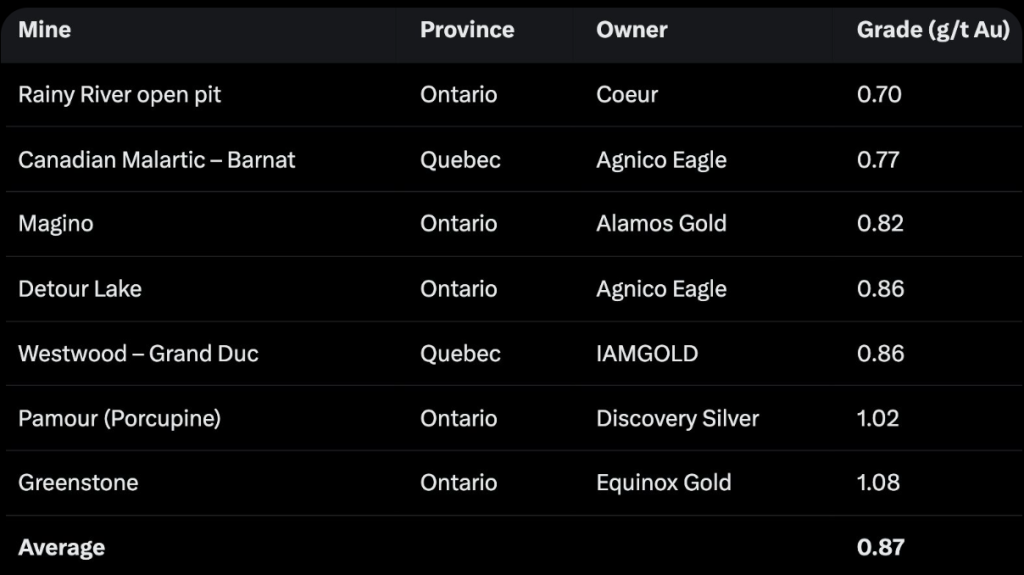
The peers in the above table are all pre-PEA, with similar grades and resource sizes. Caprock’s flagship Destiny project is in Quebec, and is not remote. Ontario & Quebec have plenty of sub-1 g/t Au (or Au Eq.) mines generating huge cash flows.
Look no further than Agnico Eagle, but also IAMGOLD, Equinox Gold and others, see below. These are mines that operated profitably when Au was under $2,000/oz!
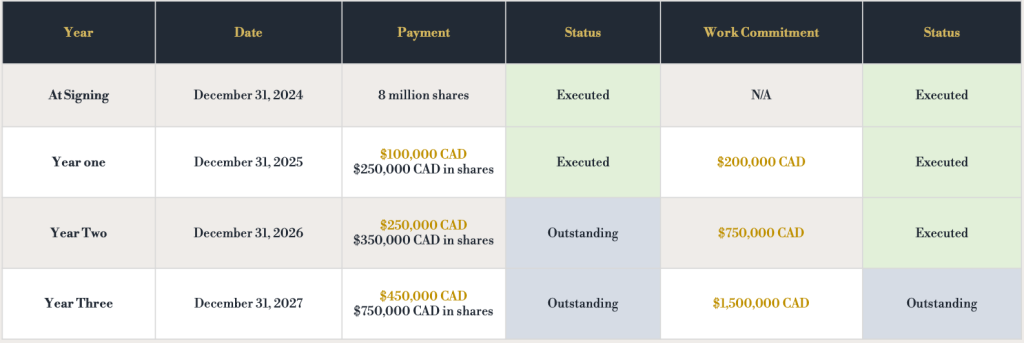
Caprock’s resource is shallow and growing. The management team/board is strong. A risk factor worth noting is that the Company is earning into the Project, they don’t own it yet, but the earn in is for 100% and the remaining requirements are not onerous.
By the end of next year, the Company needs to invest an additional C$1.5M into exploration (which it would anyway), pay cash totaling C$700k, and issue C$1.1M in shares.
If readers adjust the C$9/oz for equity dilution + cash outlays to achieve full 100% ownership, the pro forma valuation is ~C$11/oz., still meaningfully undervalued. In my view, this is not a major risk. Earning a 100% interest is key, sometimes juniors earn 60%-90% stakes.
Daniel Cohen – Executive Chairman of Caprock Mining commented exclusively for this article,
“Caprock is trading at one-third the value of peers in Quebec on a per ounce basis. With an extensive drill program planned this winter targeting a material increase in the resource inventory at Destiny, we believe Caprock could be positioned for a significant revaluation over the next 6-12 months.”
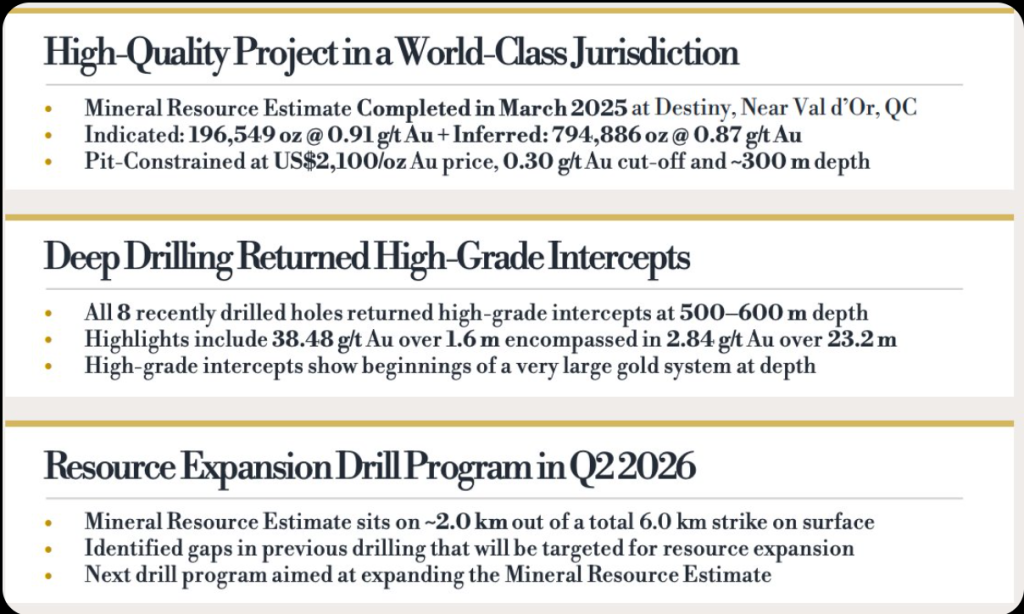
I agree with Mr. Cohen. Management believes the resource could grow closer to ~1.2M to ~1.4M ounces in 1H/27, without lowering the cut-off grade much, or at all.
Longer-term there’s potential for 2M+ ounces, as the current footprint covers just 2 of 6 km in strike length. The potential for 2M+ ounces is supported by historical deep drilling beneath the existing resource (none of which is included in the 991K oz total).
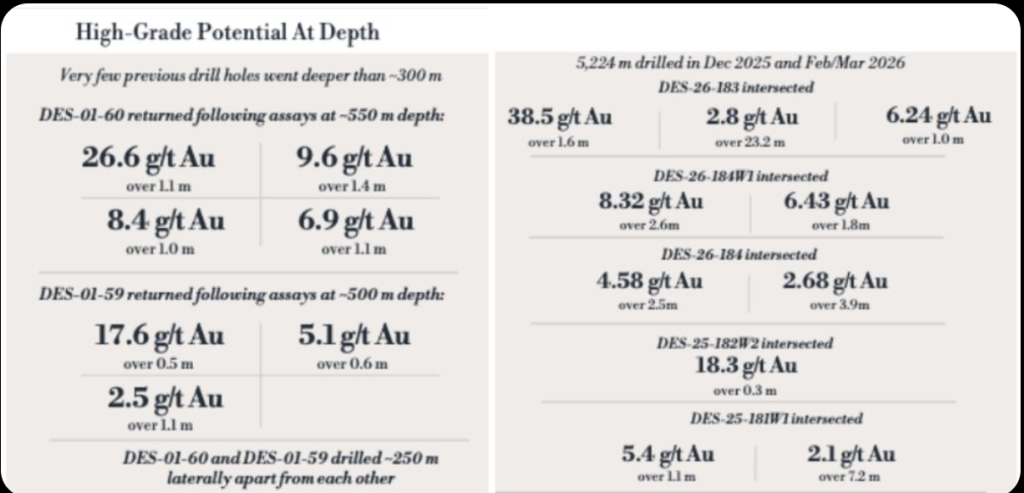
The deeper holes were too far apart from each other, not enough continuity, to be counted in a resource estimate. There was good success at depth. In Abitibi orogenic systems, even a well-aimed hole can miss narrow high-grade shoots.
However, having 8 of 8 holes hit Au around 500–600 m depth in a large, previously untested block was a notable success. See table below.
Although an important aspect, as much larger strategic investors should care about the high grades at depth, the near-term focus is on growing Destiny’s shallow endowment and drawing attention to the meaningful undervaluation of the Company.
Instead of chasing the deposit deeper, the Company is prudently taking the lower risk approach of building open-pitable ounces under ~325 meters.
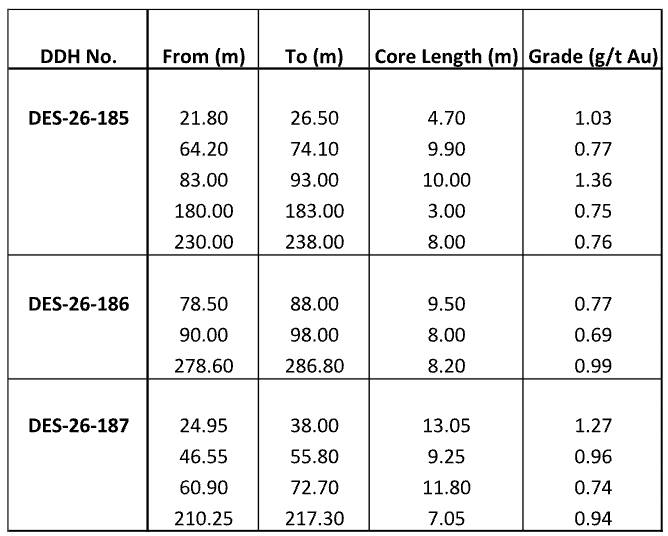
On November 10th, management released assays for three drill holes. The modest program consisted of NQ-sized diamond drill holes totaling ~1,007 meters. Good grades were delivered at relatively shallow depths.
These were not step outs or drilled on high profile targets, they filled a largely barren gap and therefore are valuable additions. The campaign was designed to better establish continuity across a gap in prior drilling within the current open pit-constrained MRE. Mission accomplished.
The grades are not sexy high-grade, but again they are shallow, open pitiable. How good are they? The true comparison is to the existing Indicated + Inferred resource grade of ~0.88 g/t Au-only. The holes delivered very nice intervals like; 10.0 m of 1.36 g/t, 9.25 m of 0.96 g/t, and 13.05 m of 1.27 g/t.
Readers are reminded that 0.90 g/t Au today is like 1.80 g/t three years ago when the Au price was half today’s level. With gold at $4,100/oz –> 0.88 g/t Au is C$162/tonne rock. Copper mines in B.C. are mining C$30/t rock.
President & CEO, Mr. Vishal Gupta, stated,
“Destiny’s overall mineralized package is comprised of a series of multiple stacked gold-bearing domains extending along an east-west strike and dip to the north… The recently concluded 3-hole drill campaign was designed to fill a gap in drilling within the south-SW portion of the resource. Each of the three achieved its objective of intersecting the gold-bearing domains that constitute the mineralized package and establishing continuity of mineralization in an area where there was no, or very little, previous drilling. These results should not only help increase the confidence level at Destiny, but also expand the MRE in its next iteration, planned for Spring, 2027.”
Management is planning an extensive resource expansion program this Winter with one or two drill campaign(s). The first will consist of 10-12 short drill holes aimed at expanding the MRE westward. A second contemplated drill program would be an additional 10-12 holes to expand the MRE eastward.
If one’s bullish on Au prices over the next year, many (but not all) juniors will have great runs. The ones starting from the lowest relative valuation have strong potential to outperform the pack. Caprock Mining could be a top quartile performer upon further good drill results and next year’s resource estimate update.
Disclosures/disclaimers: The content of this article is for information only. Readers fully understand and agree that nothing contained herein, written by Peter Epstein of Epstein Research [ER], (together, [ER] ) about Caprock Mining, including but not limited to, commentary, opinions, views, assumptions, reported facts, calculations, etc. is not to be considered implicit or explicit investment advice. Nothing contained herein is a recommendation or solicitation to buy or sell any security. [ER] is not responsible under any circumstances for investment actions taken by the reader. [ER] has never been, and is not currently, a registered or licensed financial advisor or broker/dealer, investment advisor, stockbroker, trader, money manager, compliance or legal officer, and does not perform market-making activities. [ER] is not directly employed by any company, group, organization, party, or person. The shares of Caprock Mining are highly speculative, and not suitable for all investors. Readers understand and agree that investments in small-cap stocks can result in a 100% loss of invested funds. It is assumed and agreed upon by readers that they will consult with their own licensed or registered financial advisors before making investment decisions.
At the time this article was posted, Caprock Mining was not yet an advertiser on [ER] and Peter Epstein owned no shares in the company.[ER] fully expects Caprock to become an advertiser in the near future, so assume that [ER] is biased in favor of Caprock Mining.
Readers understand and agree that they must conduct due diligence above and beyond reading this article. While the author believes he’s diligent in screening out companies that, for any reason whatsoever, are unattractive investment opportunities, he cannot guarantee that his efforts will (or have been) successful. [ER] is not responsible for any perceived, or actual, errors including, but not limited to, commentary, opinions, views, assumptions, reported facts & financial calculations, or for the completeness of this article or future content. [ER] is not expected or required to subsequently follow or cover events & news, or write about any particular company or topic. [ER] is not an expert in any company, industry sector, or investment topic.
Comments
Log in or sign up to join the conversation.