

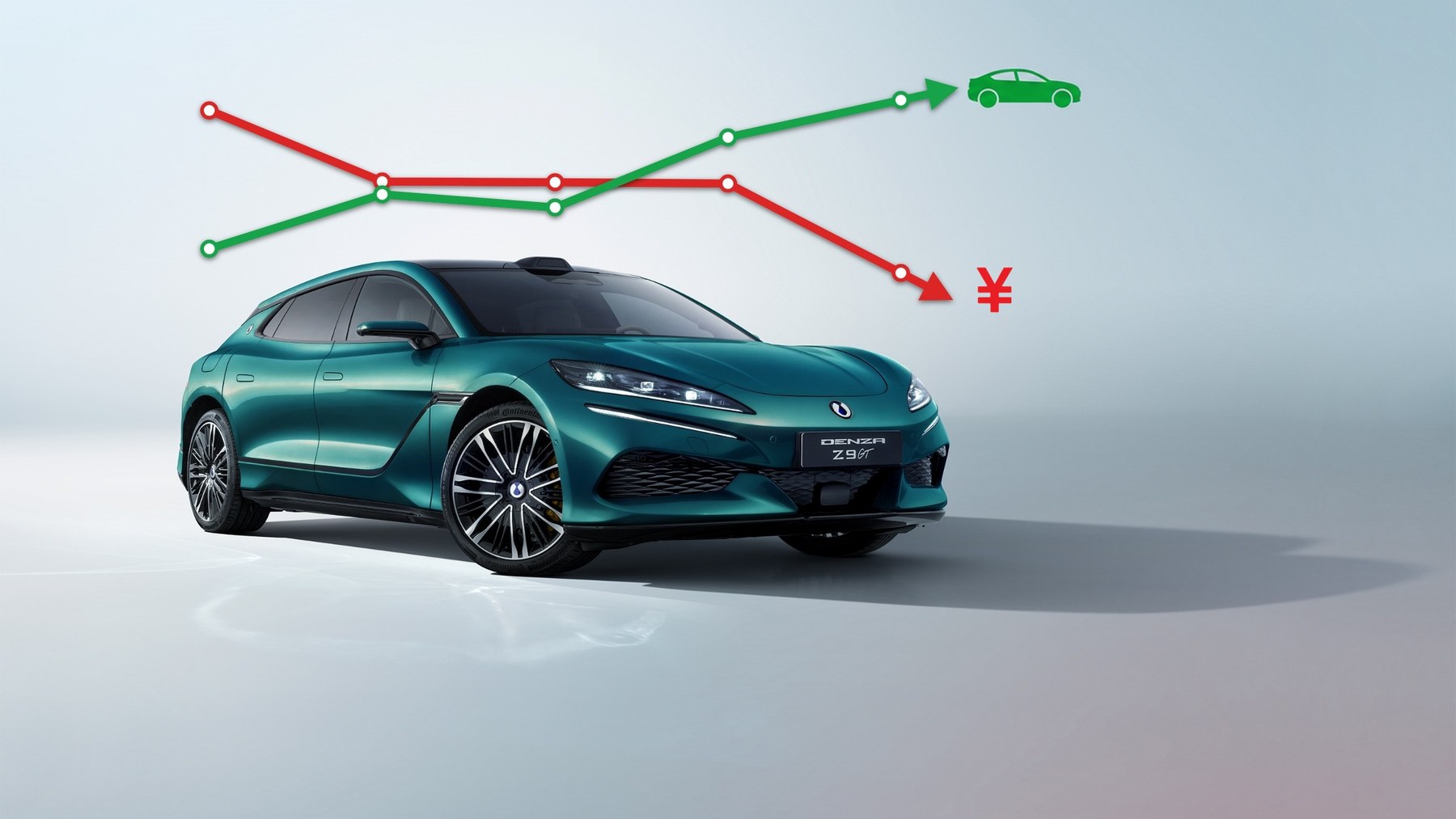
BYD (BYDDF) will sell close to 2 million cars outside China this year, about 900,000 more than in 2025 and nearly double. No other large carmaker is growing abroad at anything like that pace, and the third quarter was BYD's most profitable since late 2024.
What is more, BYD may be on the way to becoming a top-three carmaker by 2031. It also has the world's second-largest EV battery business, more than 3 million cars with its own driver-assistance system, and its own electronics and chips, in some regards ahead of Tesla (TSLA).
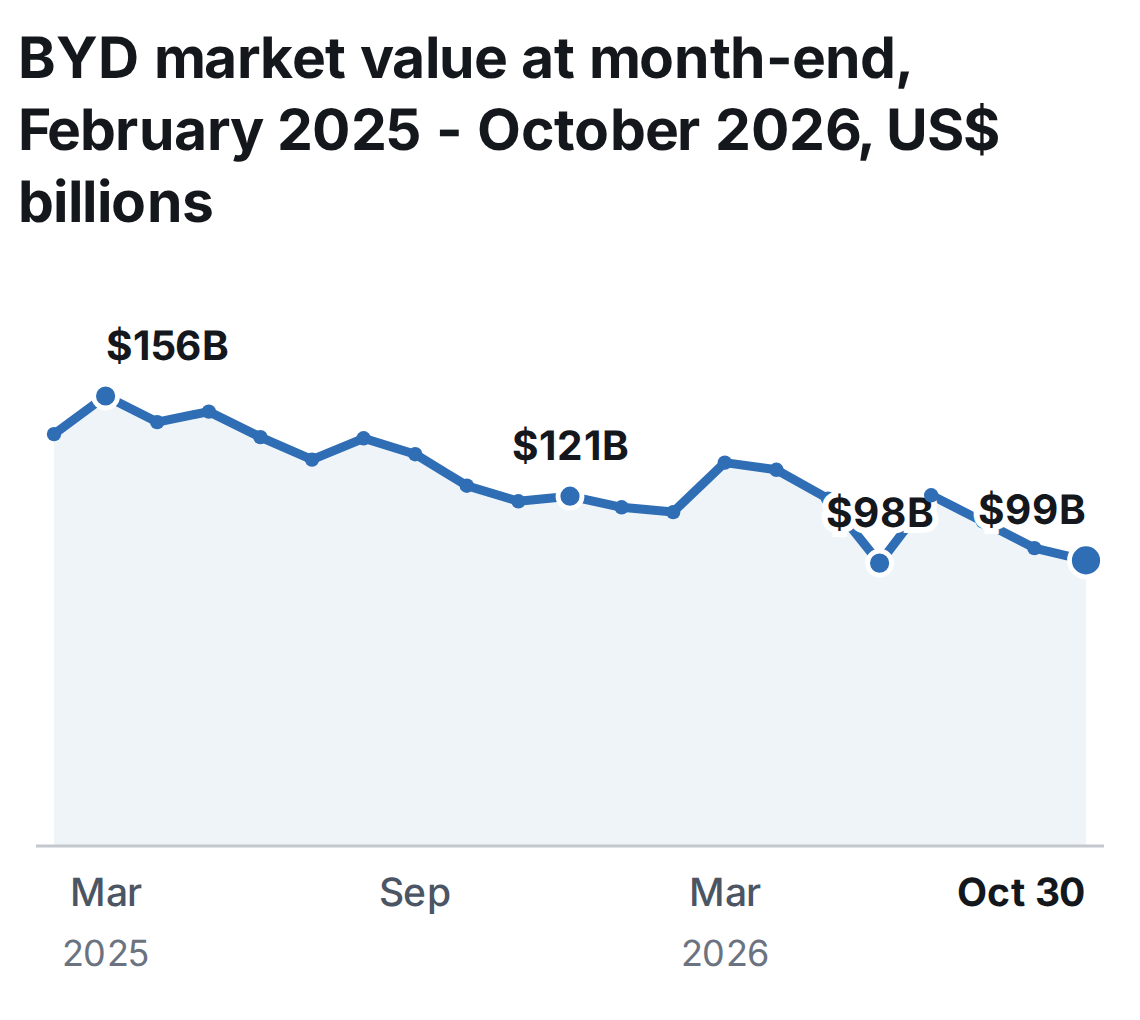
Yet the stock is down 22% this year and did not move on the results, and per car sold it is valued at about a fortieth of Tesla. Partly the reason is on the balance sheet: cash and liquid securities have fallen by ¥58 billion ($8.7 billion) since January, and BYD now owes its suppliers more in promissory notes than it holds in cash and securities.
Here is what the export record is worth, what it costs, and the three signals I would wait for before buying.
Summary
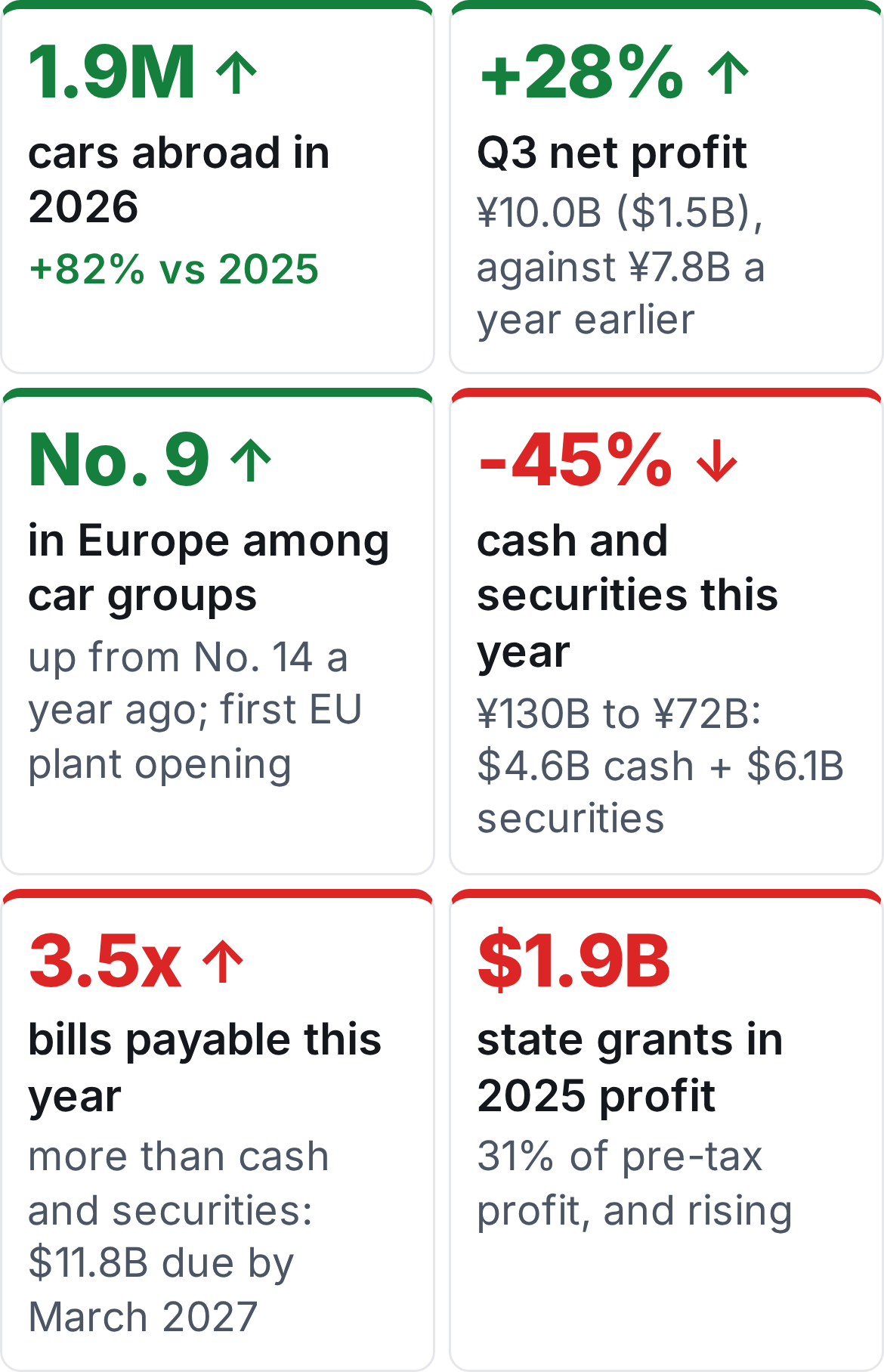
Outside China, BYD is heading for nearly 2 million cars this year, against about 1 million in 2025. Next year BYD targets more than 2.5 million car sales abroad. And its cars look both price-competitive and profitable: exports earn a 21.7% gross margin against 15.7% at home.
At home, 2026 was a rollercoaster for BYD: a crash from first to fourth place in January, then a quick comeback to first place overall by July, passing Toyota, Volkswagen (VWAGY) and Geely. Third-quarter net profit rose 28% to ¥10.0 billion ($1.5 billion).
In technology BYD is close to Tesla, if not ahead: it makes more EV batteries than LG, Panasonic and Samsung combined, has more than 3 million cars on the road with its own driver-assistance system, and makes electronics from smartphone parts to chips.
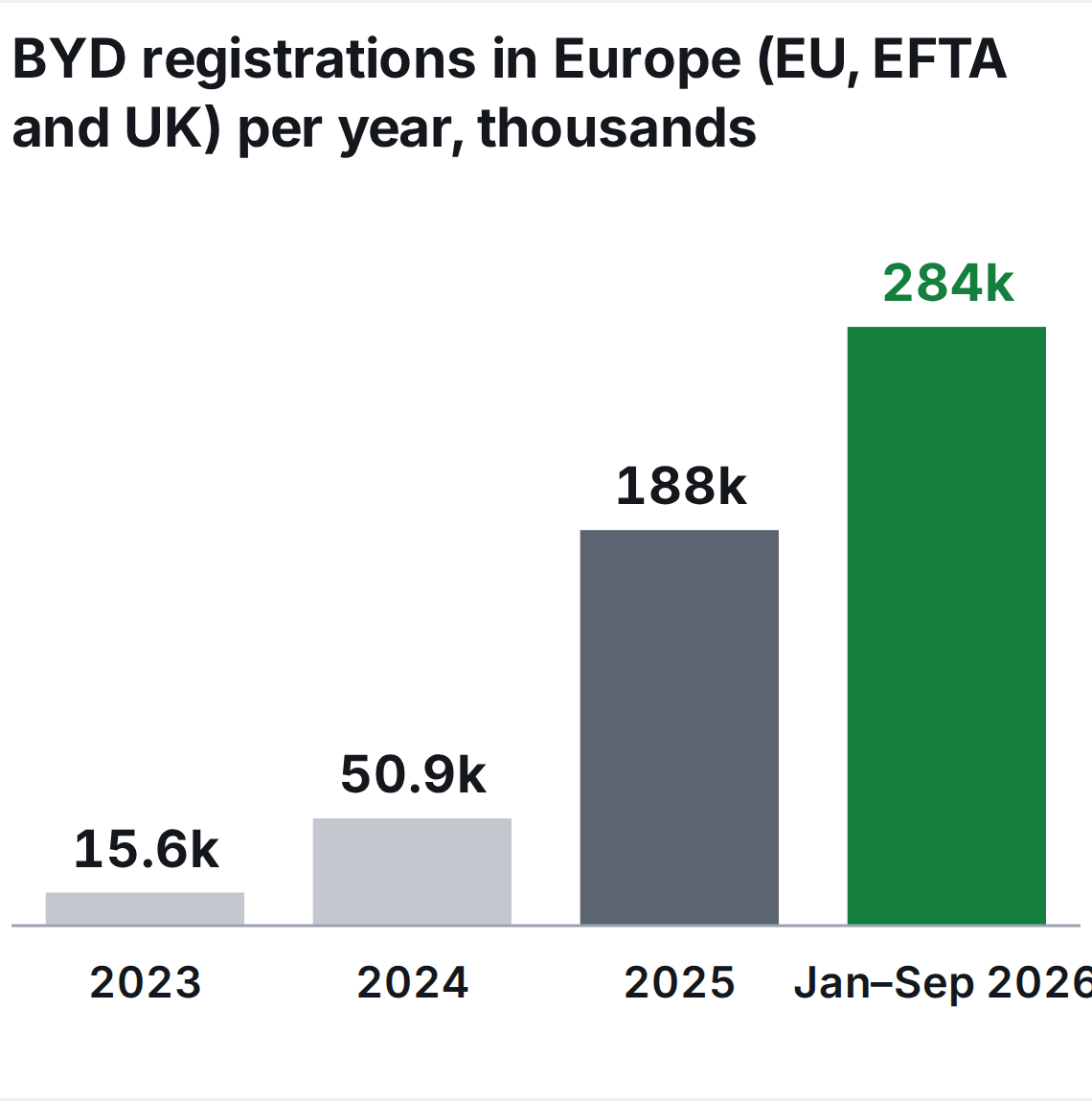
No longer mainly emerging markets: high-price Europe is now BYD's biggest market abroad, 284,000 cars in nine months, and BYD went from No. 14 to No. 9 among car groups there in one year.
BYD's European plant is ready to start, in addition to six operating abroad, including Indonesia's, launched in September: two major launches in four months.
The balance sheet has not healed, though: cash fell from ¥75.4 billion ($11.2 billion) to ¥31.0 billion ($4.6 billion) this year, and bills payable rose 3.5 times to ¥78.9 billion ($11.8 billion), more than cash and securities combined. At the current burn rate, without new loans or share sales, it could run out of cash in four to eight months.
State support remains crucial: ¥12.5 billion ($1.9 billion) of grants in 2025, 31% of pre-tax profit, and rising. Without it, pre-tax profit would still be ¥27.3 billion ($4.1 billion).
At the current pace, BYD would pass GM in 2028 and reach No. 3 by 2031, with about 6.9 million cars.
At $99 billion BYD is priced like Toyota per car sold, not like a tech company; Tesla is worth 15 times as much. Undervalued? Hard to tell, given its unusual finances, but traditional logic says yes.
The big idea: if BYD gets through the cash squeeze and keeps climbing, it could combine Toyota-like volume with Tesla-like technology, an option the share price does not reflect.
Rating: Hold. Over the next 2-5 months, watch whether monthly overseas sales top 200,000, whether the European plant starts, and whether BYD avoids a fall in China in January. If they confirm, buy for the long term.
Nearly 2 million cars abroad: the record that leads the story
Overseas sales are the number that matters most this year: nearly 2 million cars, about double the 1.046 million of 2025. By BYD's monthly sales announcements: 1.34 million in nine months; a 2026 target of 1.9 million, raised twice; more than 2.5 million for 2027. Of the world's top five carmakers, only Stellantis (STLA) is growing; Toyota, Volkswagen, Hyundai-Kia and GM are selling less.
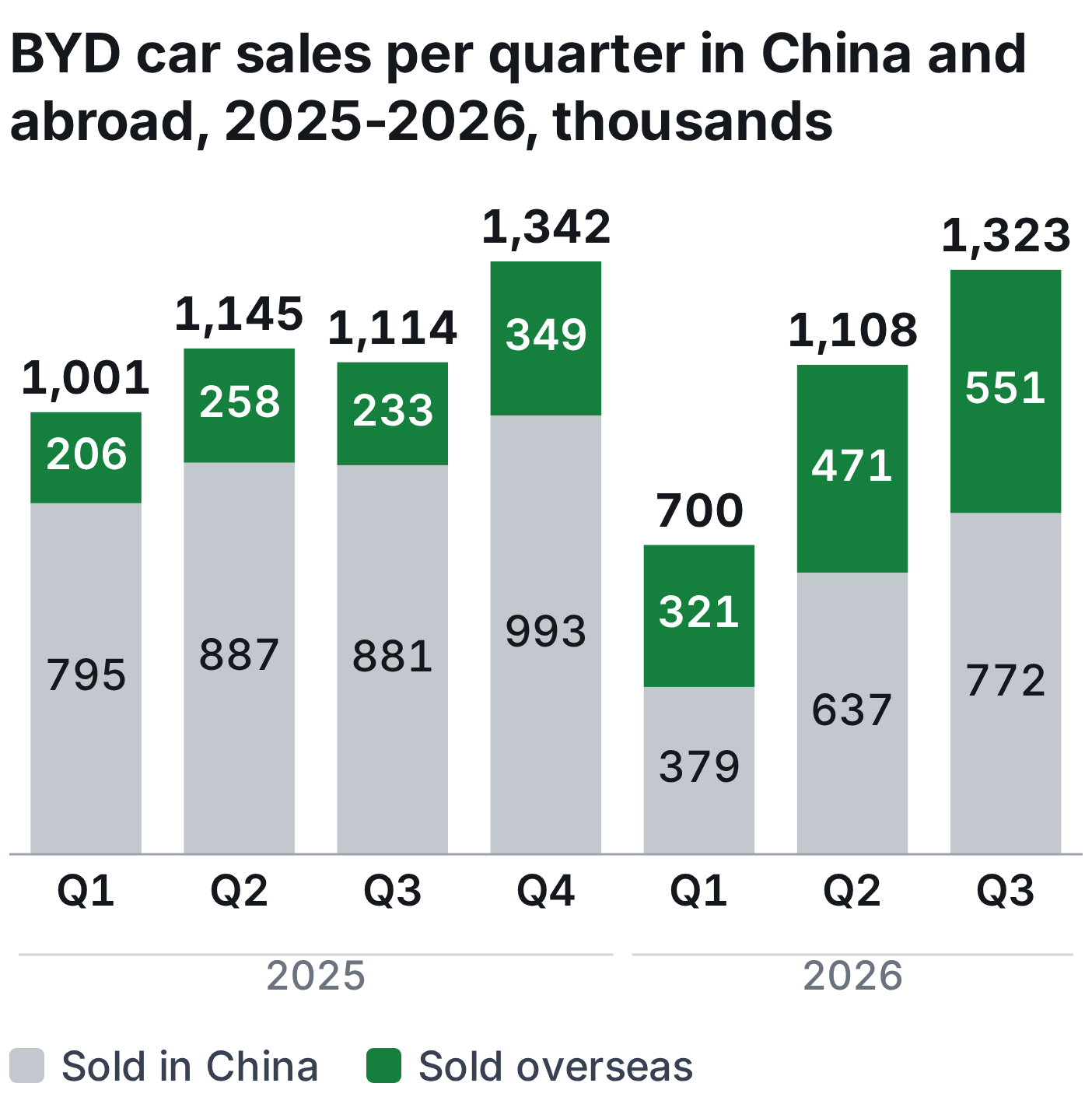
Exports also earn more, according to the interim report:
Gross margin outside China was 21.7% in the first half, against 15.7% at home.
The overseas business delivered about 60% of gross profit with 44% of the cars and 52.6% of revenue.
BYD dominates Chinese exports too: eight of the 20 models China exports most are BYD group cars (CPCA data).
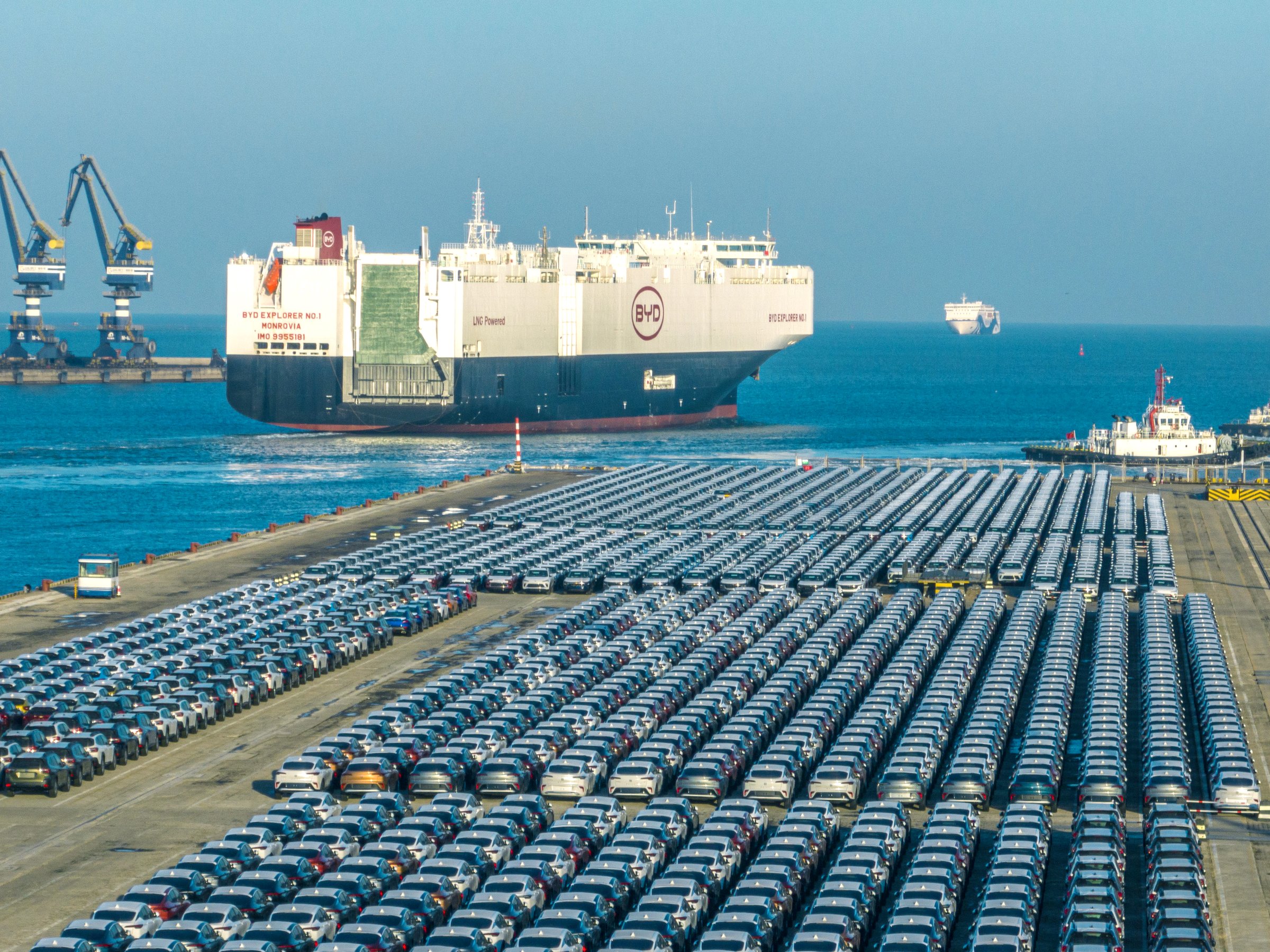
The biggest markets:
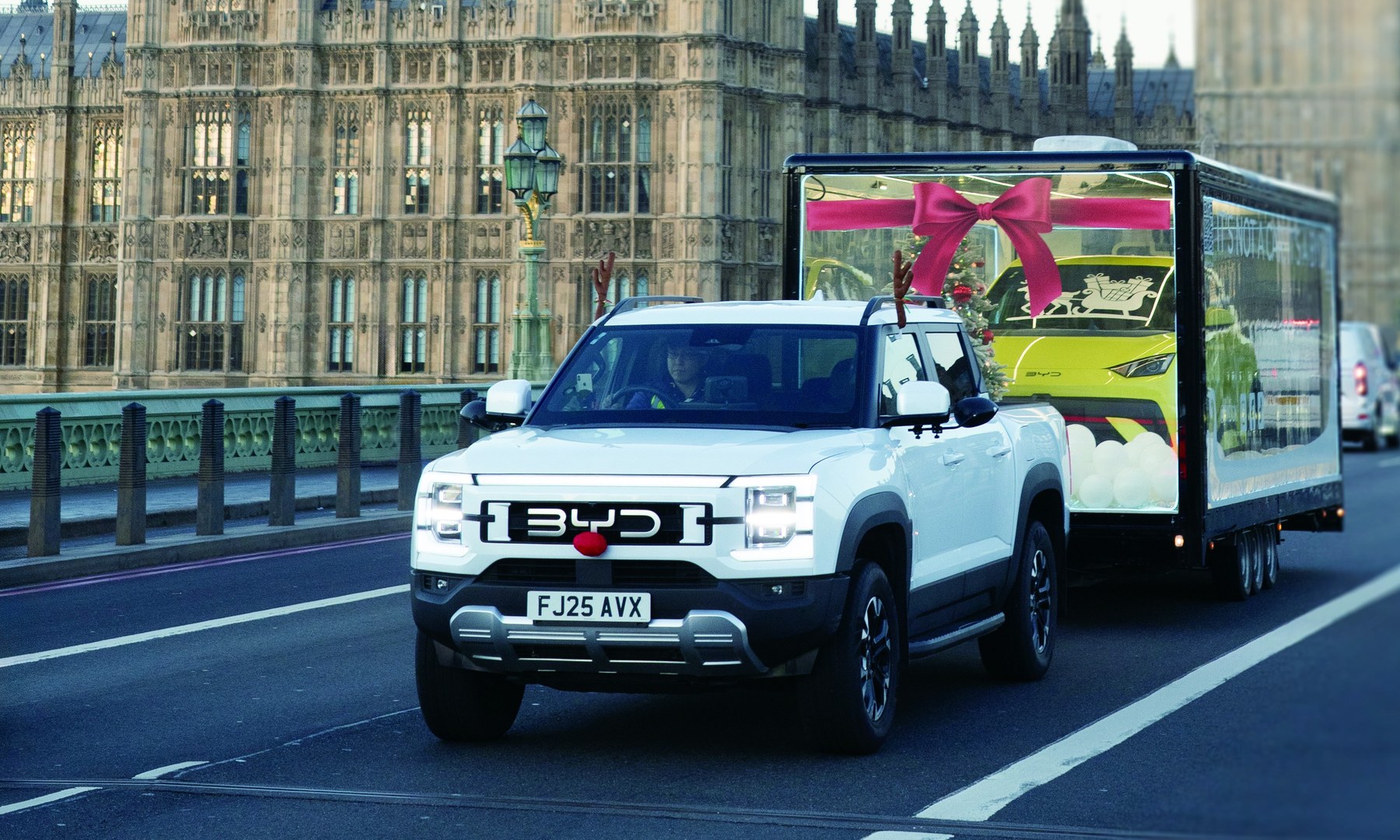
Europe: 284,000 cars in nine months, ninth among car groups.
Brazil: 169,000, fourth.
Australia: 77,000, second only to Toyota.
With six smaller markets they make up about half of overseas sales; the rest is spread across the 121 countries and regions where BYD sells.
At home: a crash from first to fourth place in January, first again overall by July
What happened. From January 1, China halved the purchase-tax exemption for electric cars and plug-in hybrids, and the trade-in bonus shrank for cheaper models. Demand fell, and in January-February BYD slipped from first to fourth place in China, behind Geely, Volkswagen and Toyota.
The recovery. BYD passed Toyota in March, Volkswagen in June and Geely in July, and leads the year-to-date retail ranking again.
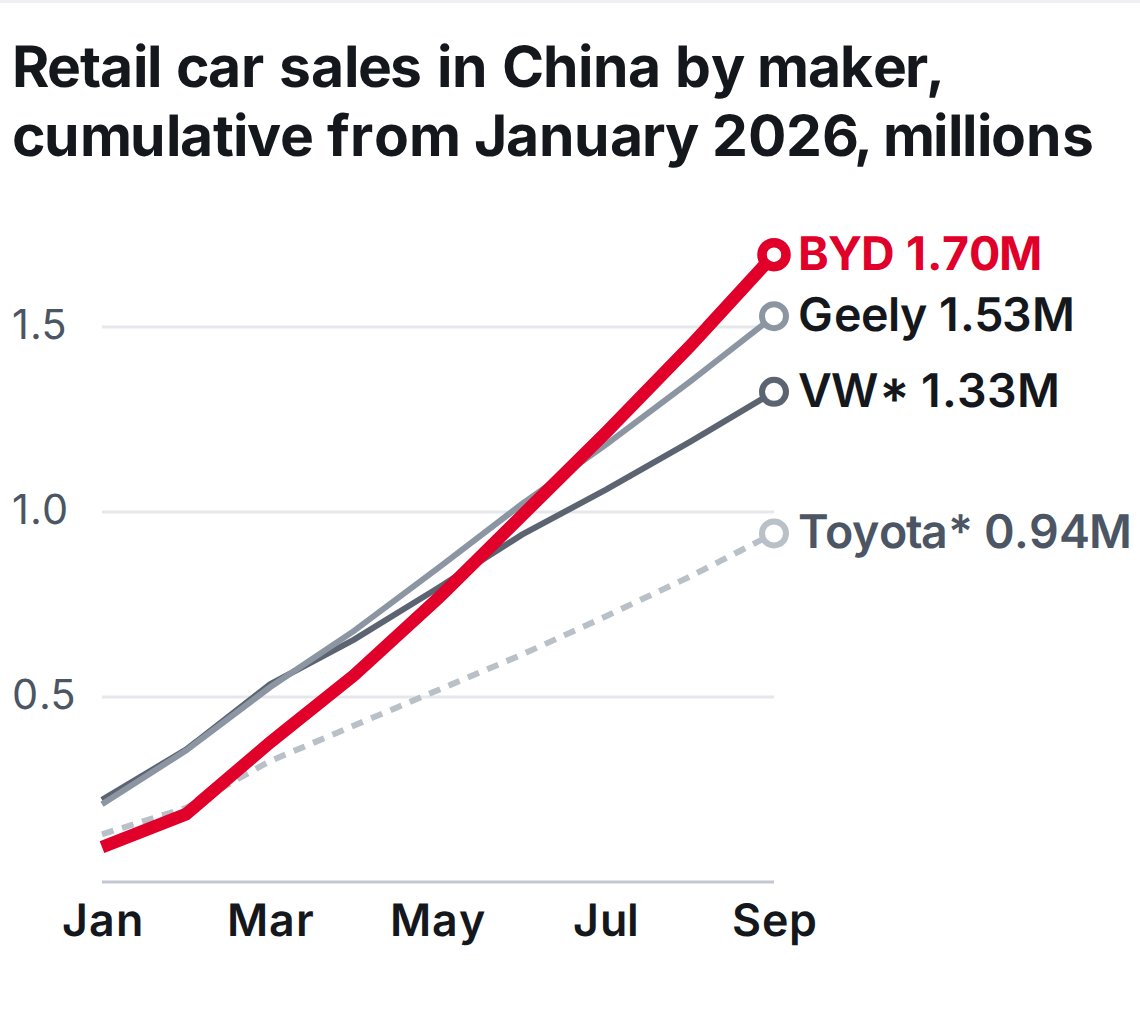
What it suggests.
On one hand, China's car market is in decline: retail sales fell 21.7% in nine months.
On the other, BYD's management has shown it can regain leadership at home even under fierce competition.
BYD in the third quarter of 2026: results and cars sold worldwide
Q3 2026 | Value | Change y/y |
|---|---|---|
Revenue | ¥221.5B ($33.0B) | +13.6% |
Net profit attributable | ¥10.0B ($1.5B) | +28% |
Net profit excluding one-offs | ¥8.6B ($1.3B) | +25% |
Cars sold worldwide | 1.32M | +19% |
of which in China | 0.77M | -12% |
of which abroad | 0.55M | x2.4 |
Source: BYD Q3 2026 report, BYD monthly sales announcements. Dollars at ¥6.70 per US$ (ECB reference rates, Sep 30, 2026), here and below.
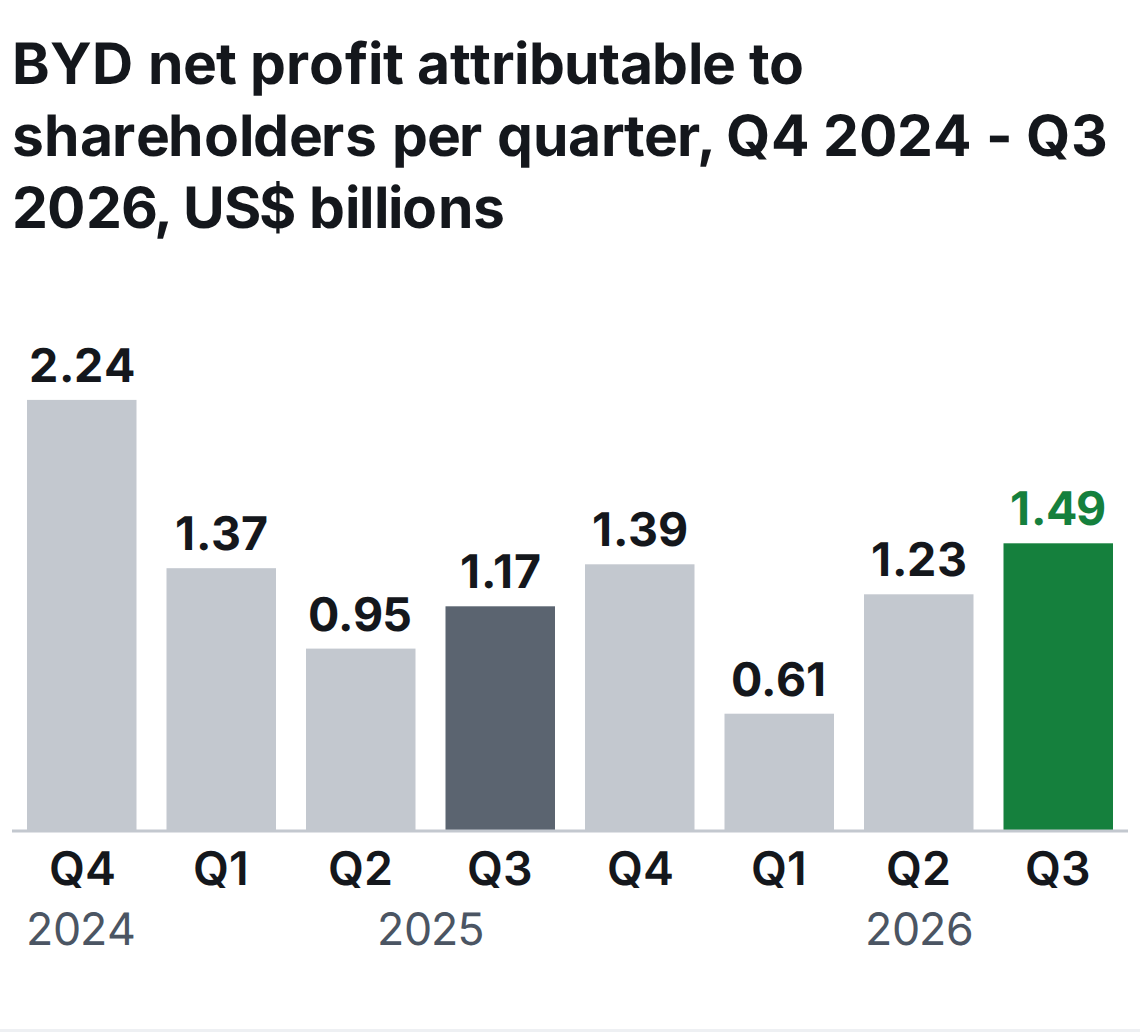
Three businesses in one: why BYD is more than a carmaker
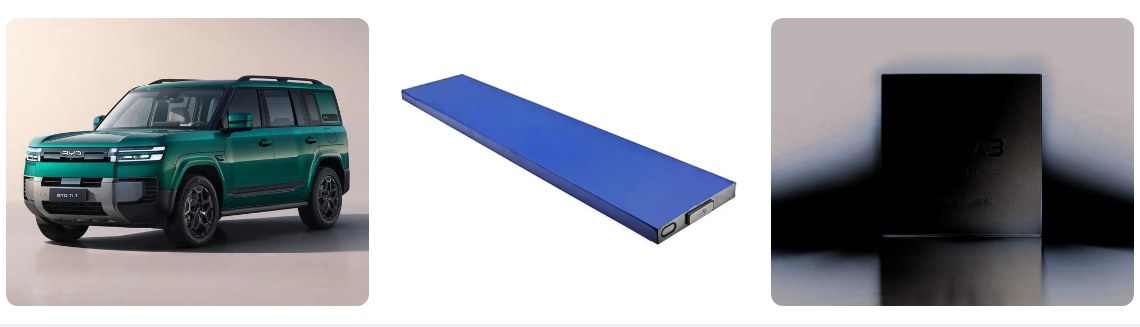
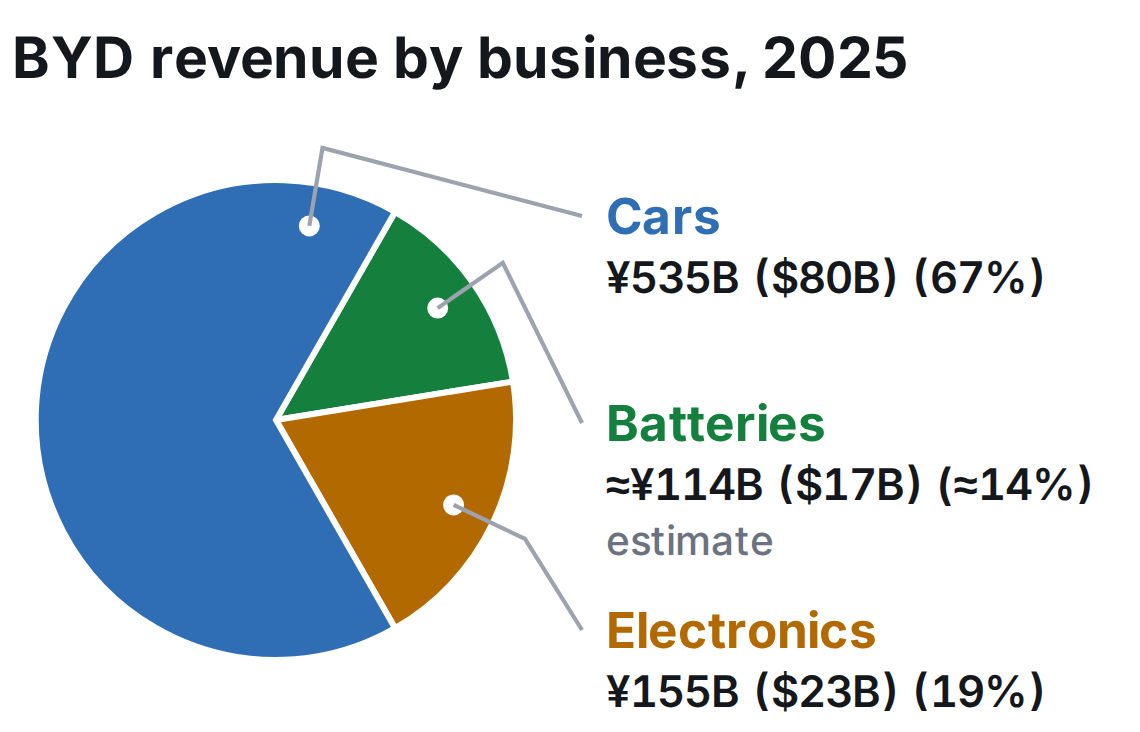
BYD reports two segments, cars and electronics, but it runs three businesses. Two of them make the Tesla comparison fair: it designs and makes its own batteries, its own driver-assistance system and the chip behind it.
1. Cars: four brands, 48 models
In China BYD registered 48 models in nine months under four brands, priced from ¥69,800 ($10,400) to ¥1.8 million ($268,000).
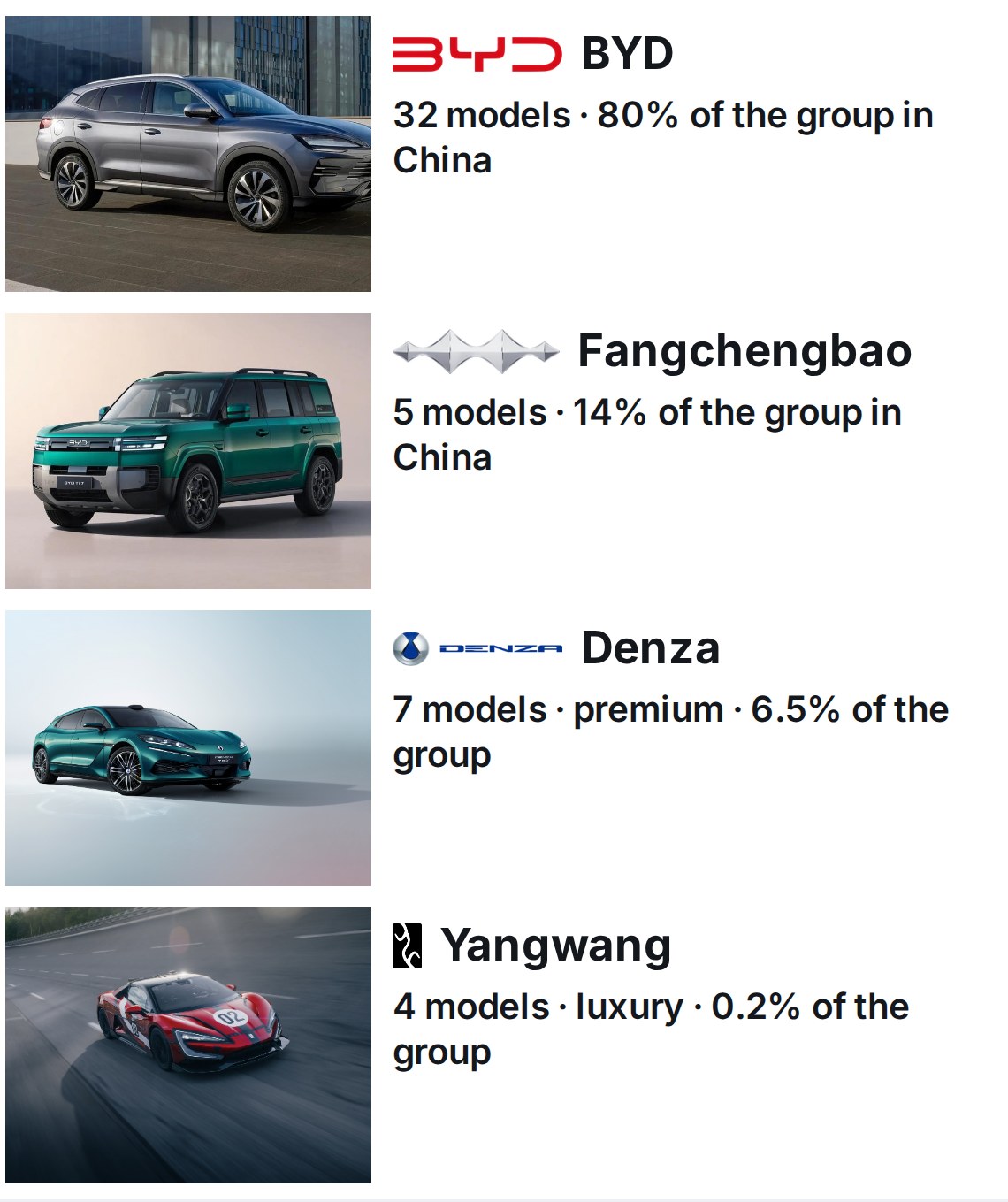
BYD, the volume brand, from ¥69,800 ($10,400). Example: the Seagull (sold abroad as the Dolphin Surf), a small hatchback about the size of a Mini Cooper.
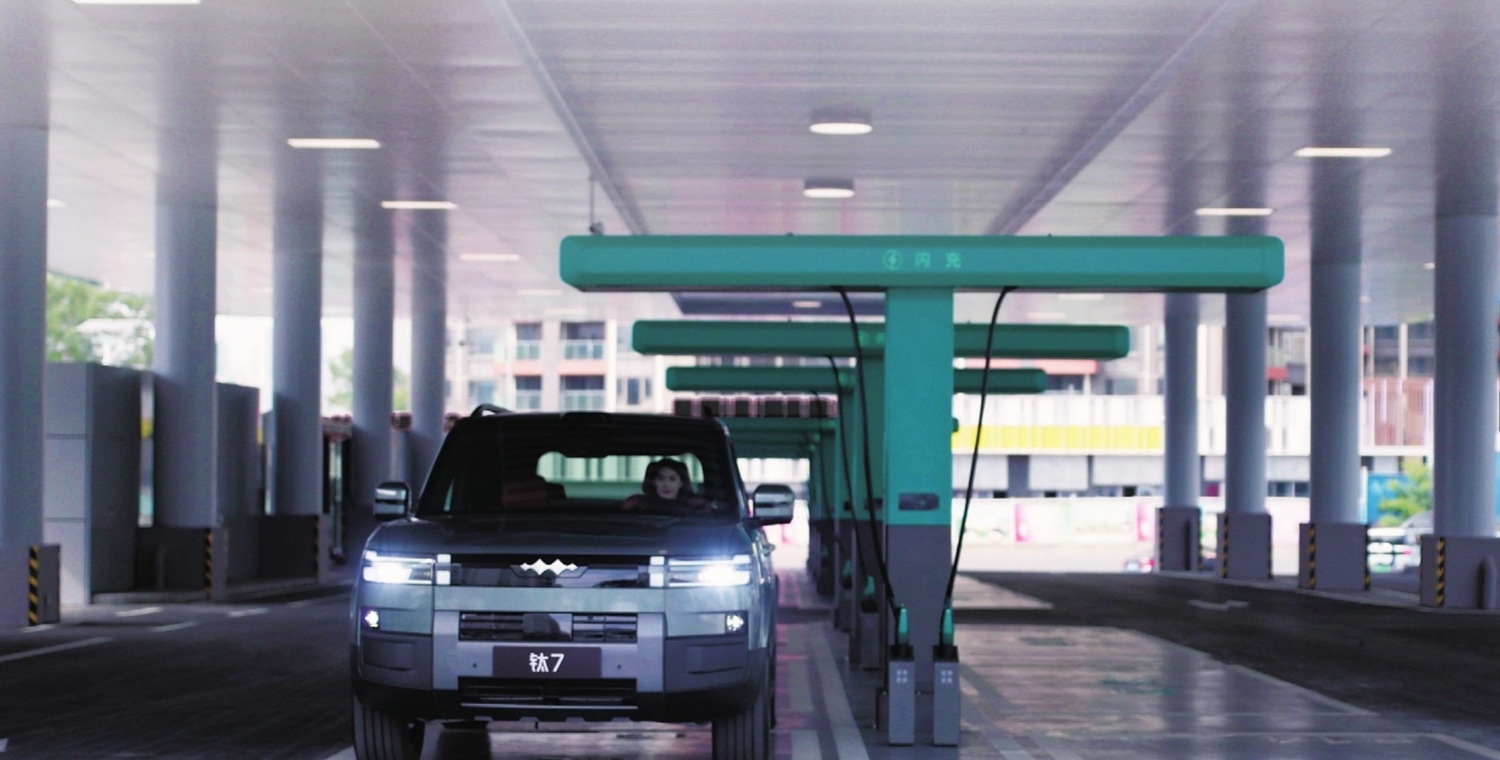
Fangchengbao: big SUVs and off-roaders. Its Tai 7, five meters long like a BMW X5, is the group's best-seller of 2026; abroad it is sold under the BYD brand, as the Ti7.
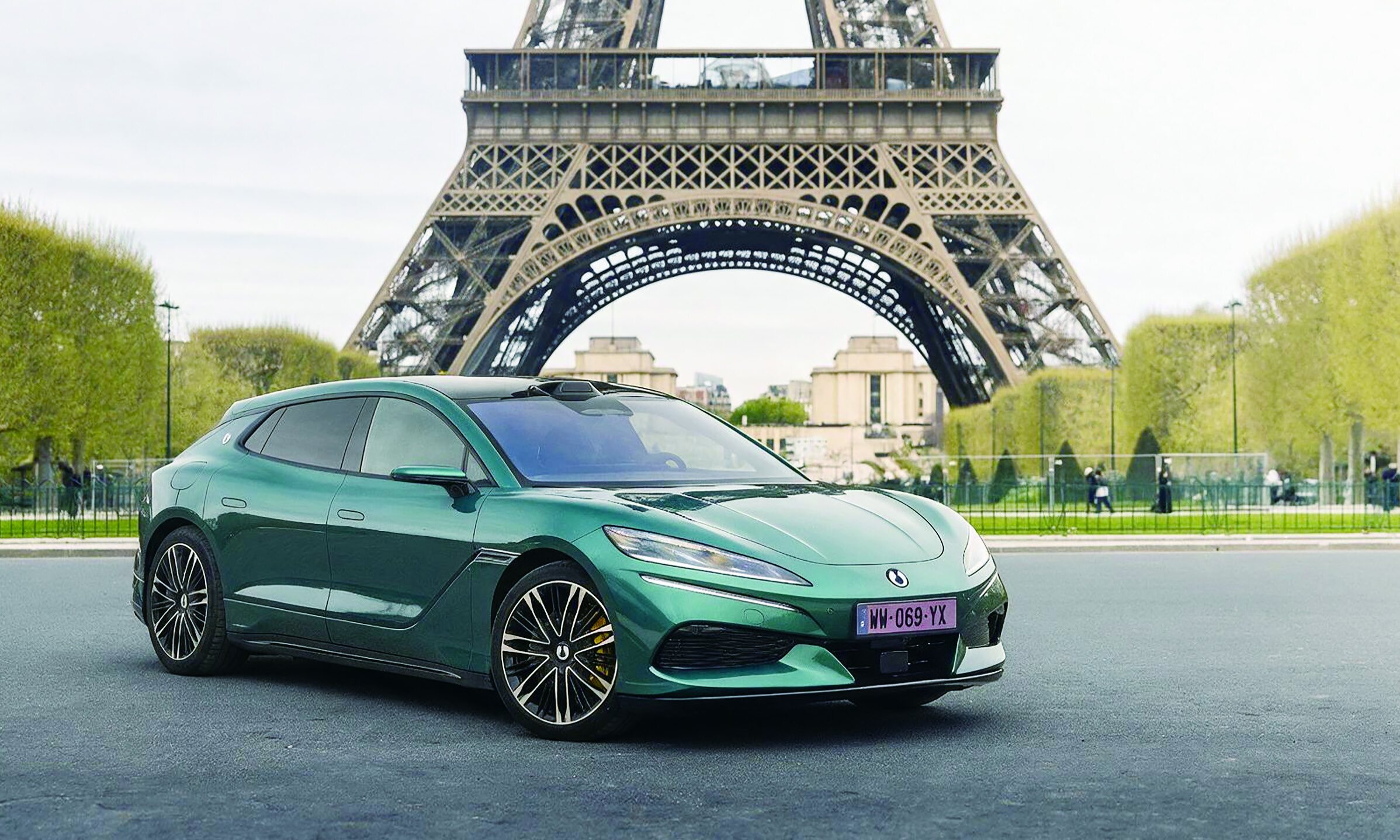
The brand's off-roaders go abroad under the Denza badge: the Bao 5, a 4.9-meter body-on-frame plug-in hybrid, is priced in Britain right on top of a Land Rover Defender 110 (£69,500), and the bigger Bao 8 is pitched against the Toyota Land Cruiser 300 and the Lexus LX.Denza: the premium brand. Its Z9 GT, a 5.2-meter shooting brake, is compared with the Porsche Taycan Cross Turismo; its D9 minivan, with the Mercedes-Benz V-Class and the Lexus LM.
Yangwang, the halo brand: the U7 luxury sedan, the U8 off-road SUV and the U9 supercar; 3,300 cars at ¥658,000 to ¥1.8 million ($98,000 to $268,000). Its track version, the U9 Xtreme, became the first road car past 500 km/h, at 503.16 km/h (312.65 mph) in Abu Dhabi on November 1, 2026, in a one-way run; only 30 are built, at more than ¥20 million (about $2.8 million) each.
2. Batteries: No. 2 in the world, and more than three rivals combined
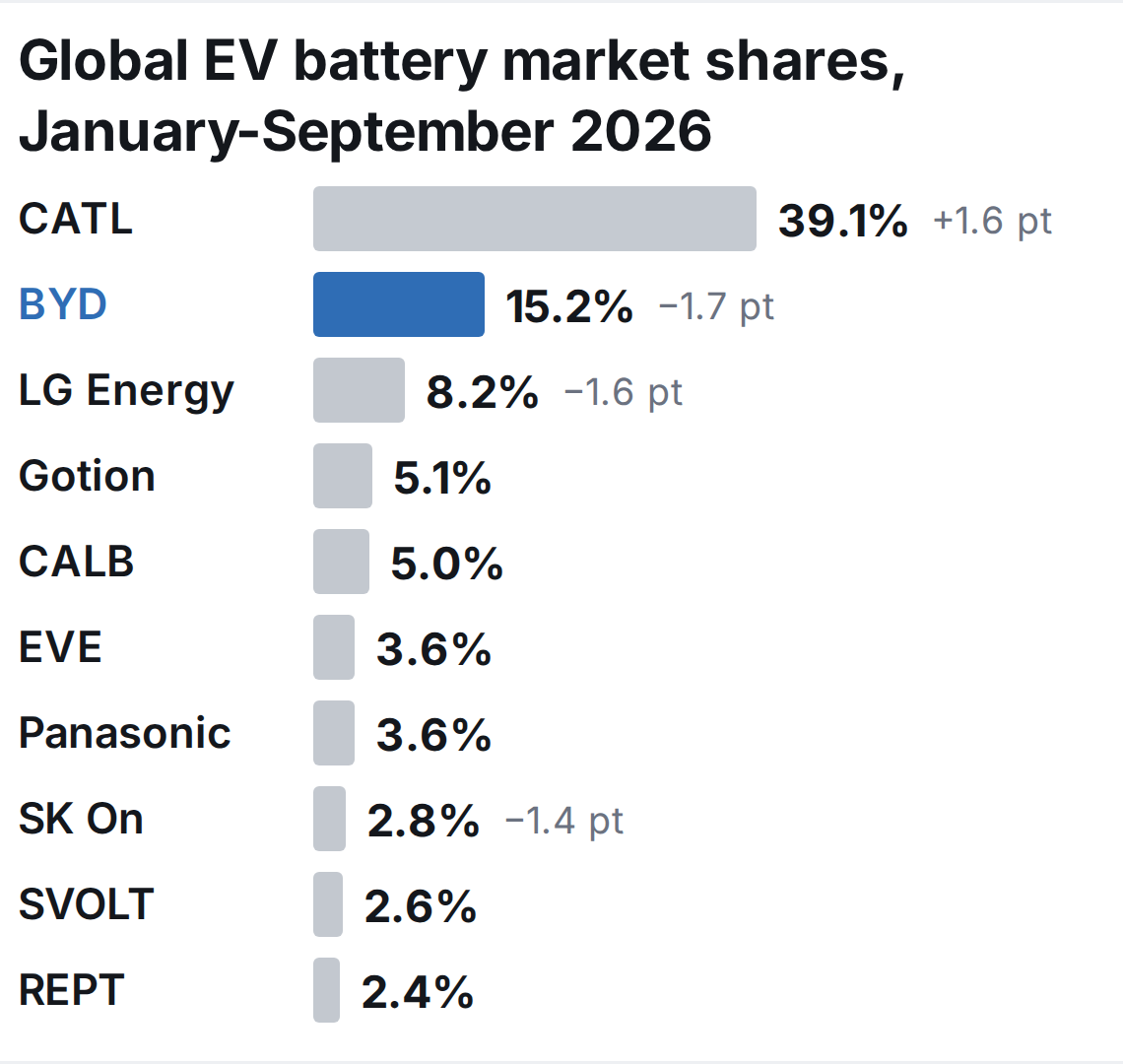
FinDreams Battery, BYD's subsidiary, is the second-largest EV battery maker after CATL, according to SNE Research:
16.4% of the world market, 194.8 GWh in 2025.
More than LG, Panasonic and Samsung combined (181.9 GWh).
And growing much faster: up 75% in two years, from 111.4 GWh in 2023, against 5% for those three together; only CATL grew as fast, by 79%, to 464.7 GWh.
Batteries are a hard business, and several Western players have been pulling back:
Northvolt went bankrupt, and Volkswagen reportedly wrote down a €693 million stake.
Ford spent $3.6 billion in six months dissolving its venture with SK On.
GM sold LG its stake in their third plant.
Tesla still relies on Panasonic and CATL, as its annual report says.
Against that background, BYD's No. 2 position and its growth stand out.
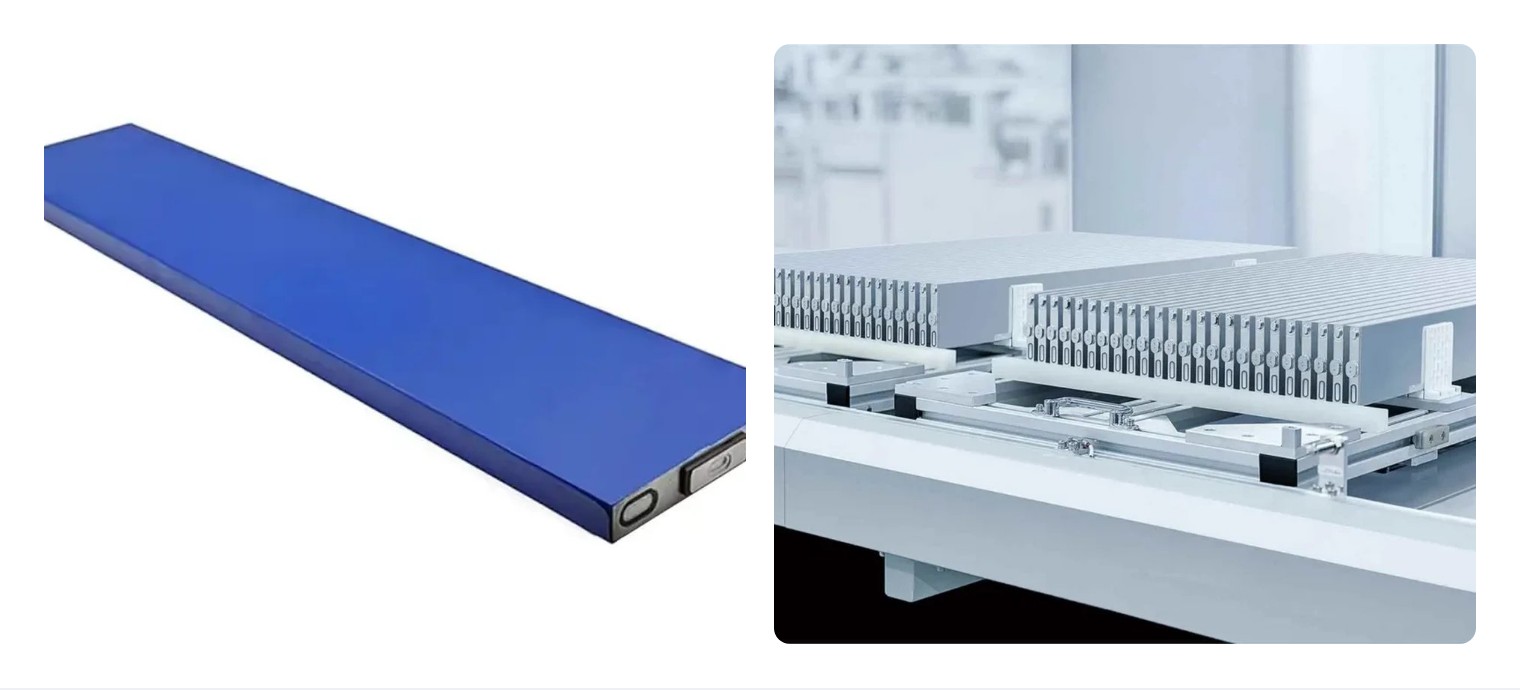
Since 2020 BYD has made its own cell format, the Blade: a long, flat lithium iron phosphate cell. This year came the second generation, which BYD says will not catch fire even when pierced with a nail during ultra-fast charging.
3. Driver assistance and chips: standard on every car
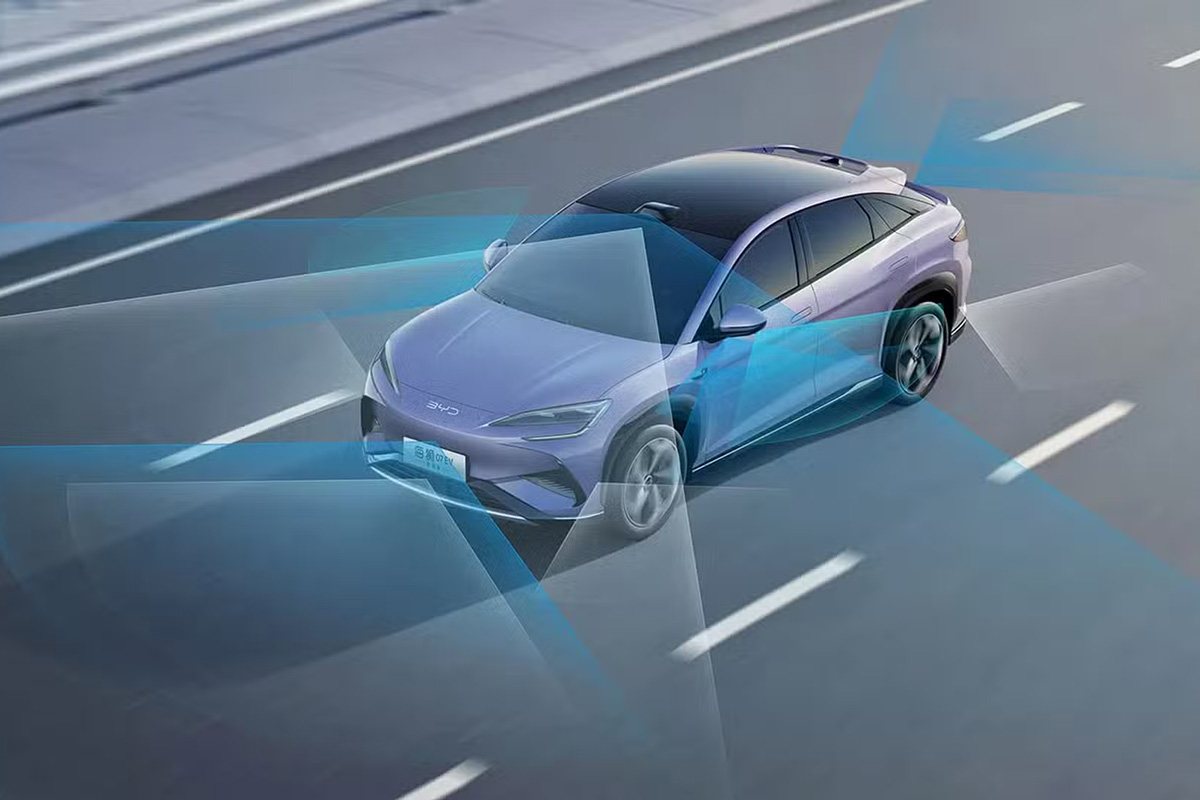
Since February 2025 the God's Eye system has been standard on every model, down to the ¥69,800 ($10,400) Seagull, a small city hatchback.
More than 3.3 million cars had it by June 30, and the fleet logs 210 million kilometers of driving data a day, according to the interim report. Tesla has more than 1.7 million paying customers of Full Self-Driving (Supervised) worldwide and since September has run driverless Cybercabs in Austin, still in the hundreds. GM has about 1 million cars with Super Cruise, which works only on mapped highways.
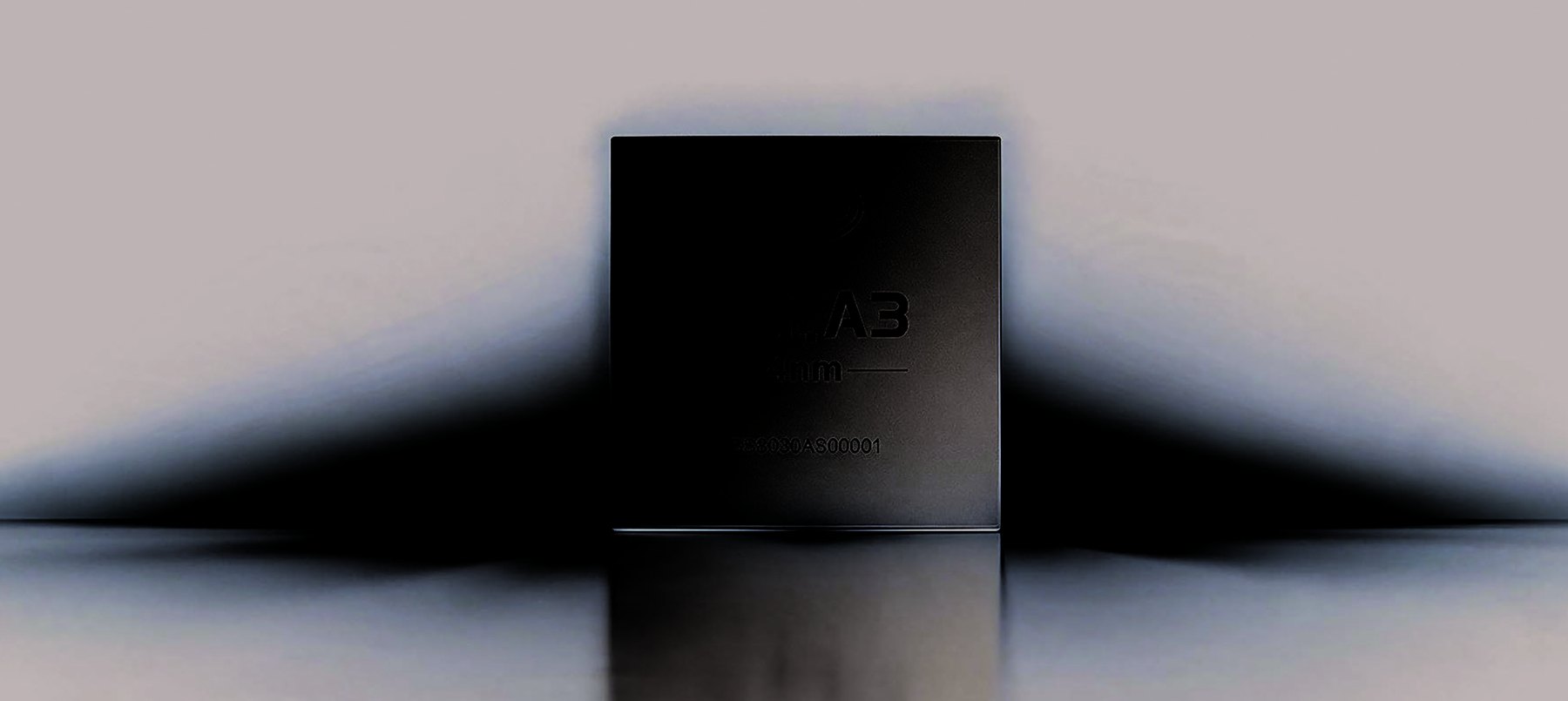
In May BYD unveiled XUANJI A3, an in-house 4-nanometer chip that it says natively supports Level 3 and 4 driving. Tesla's own next chip, AI5, made by TSMC and Samsung, taped out in April 2026, with volume expected around mid-2027.
BYD was confident enough in its system to guarantee it: on May 28, 2026 it pledged that if an accident happens in intelligent parking or urban Navigate on Autopilot in China, BYD will cover the damage. That is a step toward liability, which is what separates assistance from autonomy.
Potential breakthrough. BYD already has the parts of Tesla's story, its own batteries, driver-assistance software and chips, on far more cars, and sells more battery-electric cars than Tesla (2.22 million against 1.65 million in 2025).
What it lacks is recognition, especially in the West, and proof of autonomy: no Level 3 permit yet (Changan and Arcfox got China's first in December 2025) and no robotaxi. If it gets that proof, BYD might become the biggest supplier of autonomous cars in the world.
+ Electronics: 20% of revenue, about 5% of gross profit
BYD also makes smartphone parts, assembles devices for other brands and now builds AI computing hardware. Small money, but manufacturing capabilities few carmakers have.
Europe: more BYD cars in nine months than in all of 2025
Europe, home of Volkswagen, Stellantis and Renault, is the clearest test. According to ACEA:
BYD registered 284,000 cars in the EU, EFTA and Britain in January-September, 2.3 times a year earlier.
Its market share rose from 1.2% to 2.7%.
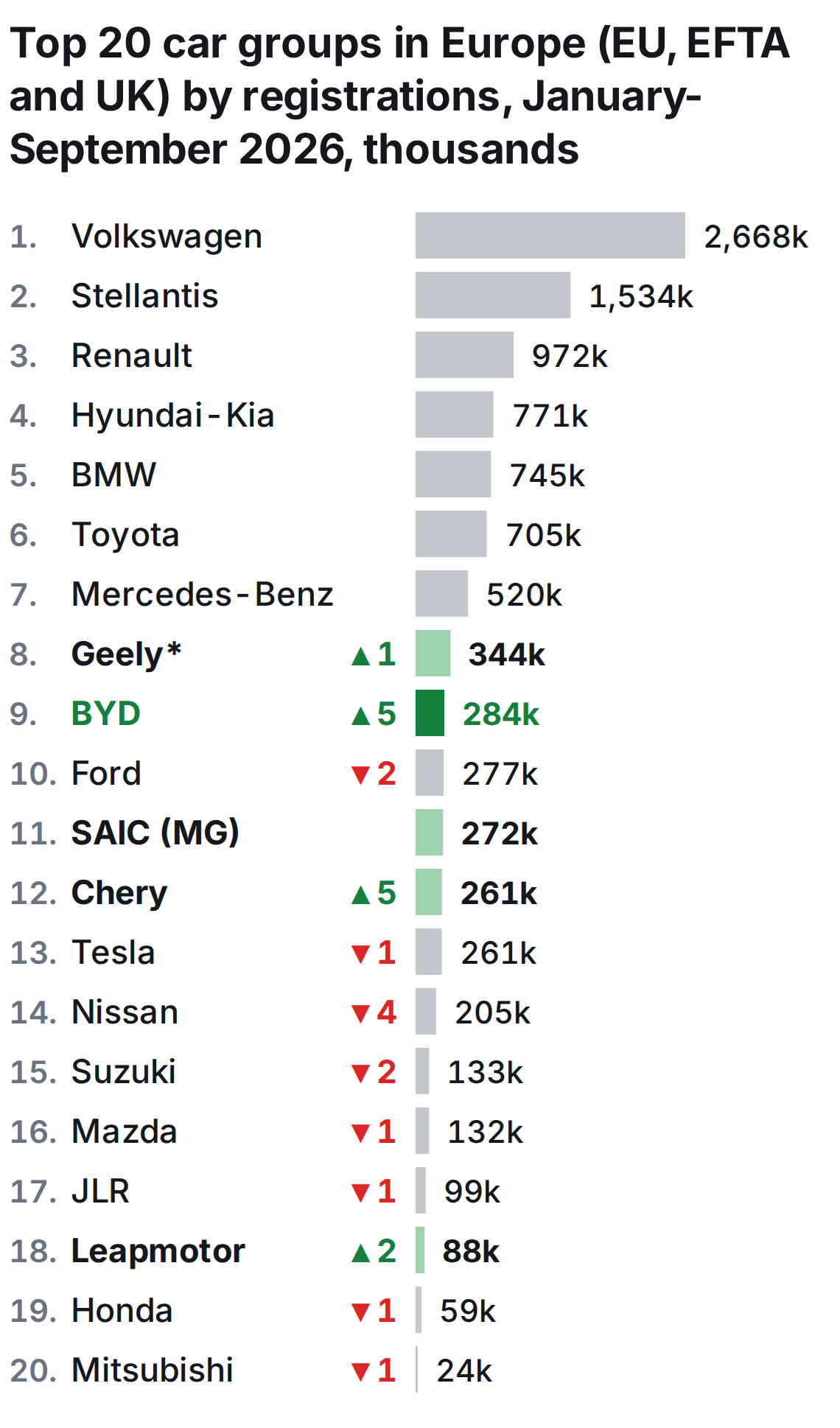
No. 9 among car groups, up from No. 14 a year earlier, passing Ford, Tesla, Nissan and Suzuki.
BYD is closing in on the leaders: in one year it jumped five places in the European ranking, to ninth. To reach the top seven, passing Mercedes-Benz, it would need nearly double its sales:
In Germany, Volkswagen's home market:
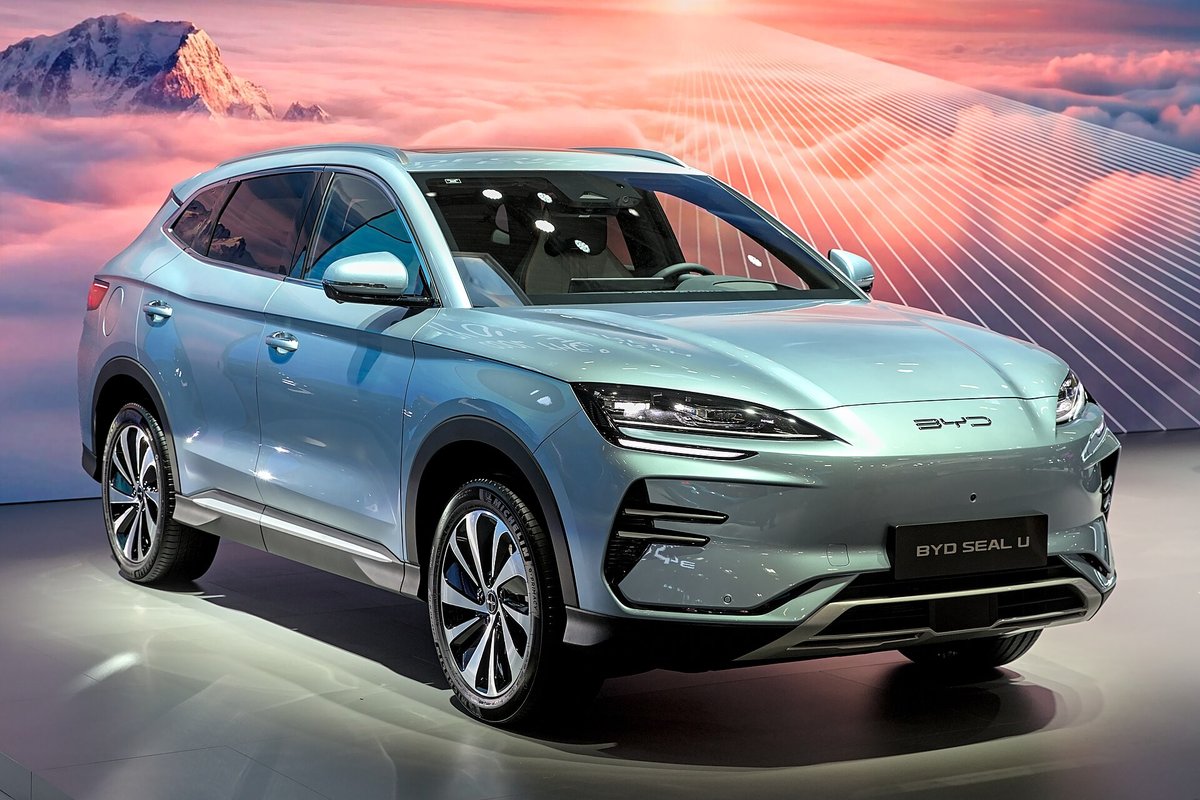
BYD registered 42,788 cars in nine months, led by the Seal U, a compact SUV the size of a Toyota RAV4 or a Volkswagen Tiguan, with 12,478, according to the KBA.
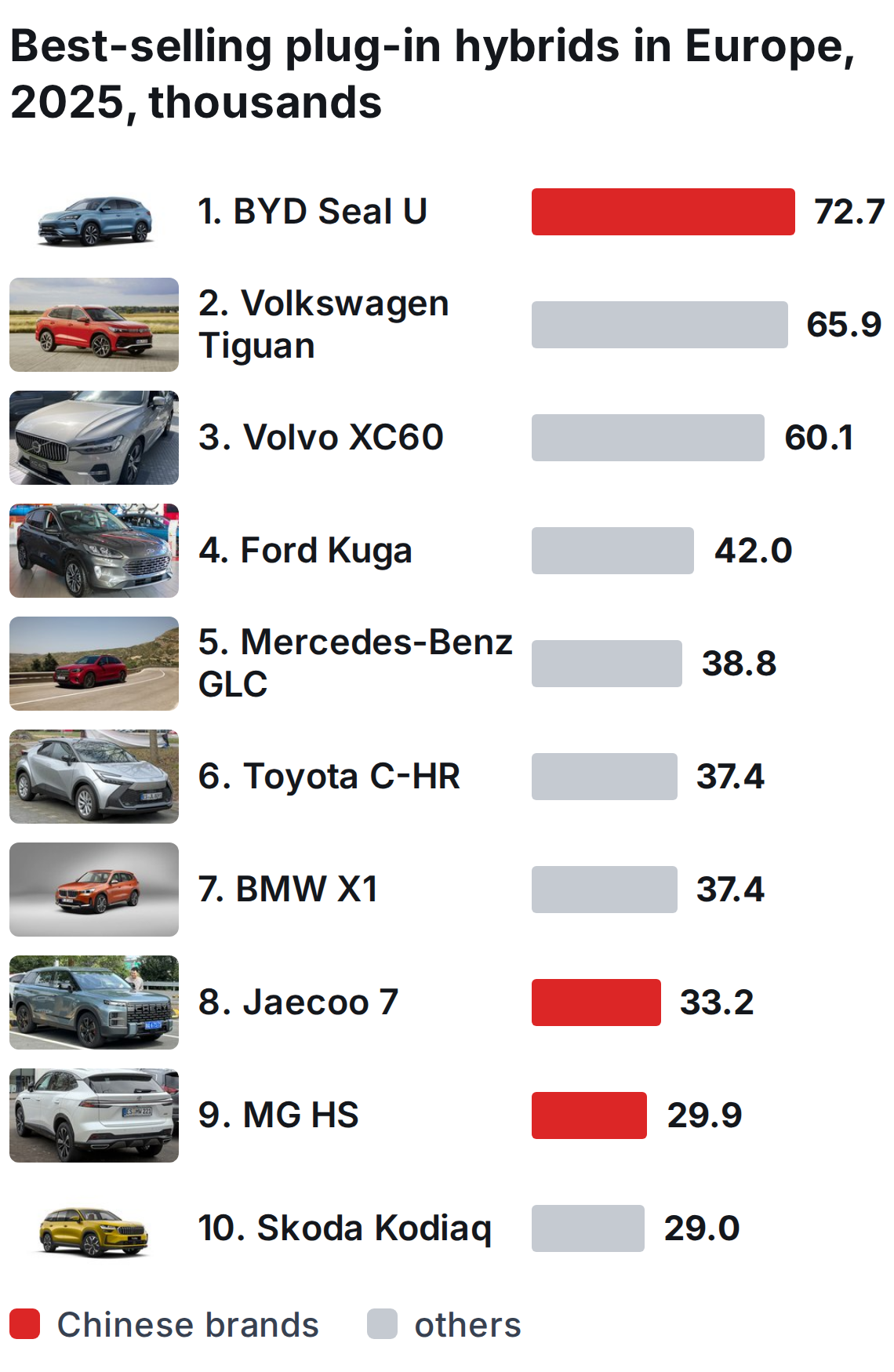
The Seal U was Europe's best-selling plug-in hybrid in 2025, 72,667 against 65,899 Tiguans, and still leads the segment, with the Atto 2, a subcompact crossover about the size of a Honda HR-V, second, according to Dataforce.
The premium brands follow. Denza opened orders in seven European countries in April, among them Germany, France, Italy and Spain, with the Z9 GT, a grand tourer from €101,000 that takes on the Porsche Taycan Cross Turismo, and the D9 minivan from about €80,000, a rival to the Mercedes-Benz V-Class. Yangwang's first export market is the UAE, and Britain follows in 2027.
Tariffs: the US is closed, Europe is half open, so BYD builds plants abroad
North America is closed to BYD for now:
United States. Chinese electric cars have paid a 100% Section 301 tariff since September 27, 2024. A 2025 Commerce rule bars Chinese companies' connected vehicles from model year 2027, US-built included.
Mexico. A 50% tariff on cars from countries without a trade agreement since January 2026.
Canada. BYD has a company registered in Markham, Ontario, and since a January 2026 deal Canada lets in up to 49,000 Chinese EVs a year at a 6.1% tariff instead of 100%. But BYD has announced no launch; reports of a late-2026 dealer rollout came from an impostor account. So far, all of North America is closed to BYD.
But Europe is half open: hybrids are exempt, and BYD's first EU factory starts next month.
Since October 30, 2024 BYD's battery-electric cars from China pay a 17.0% countervailing duty on top of the standard 10%, for five years; the rate reflects the subsidies found at each maker: 7.8% for Tesla's Shanghai cars, 18.8% for Geely, 35.3% for SAIC.
The loophole: the duties cover only battery-electric cars, plug-in hybrids pay the standard 10%, and Chinese brands switched, taking 28.3% of Europe's plug-in hybrid market in the first half of 2026 (Dataforce). Now Volkswagen's CEO asks Brussels to extend the duties to plug-in hybrids.
Hence the plants. BYD is building in six countries abroad:
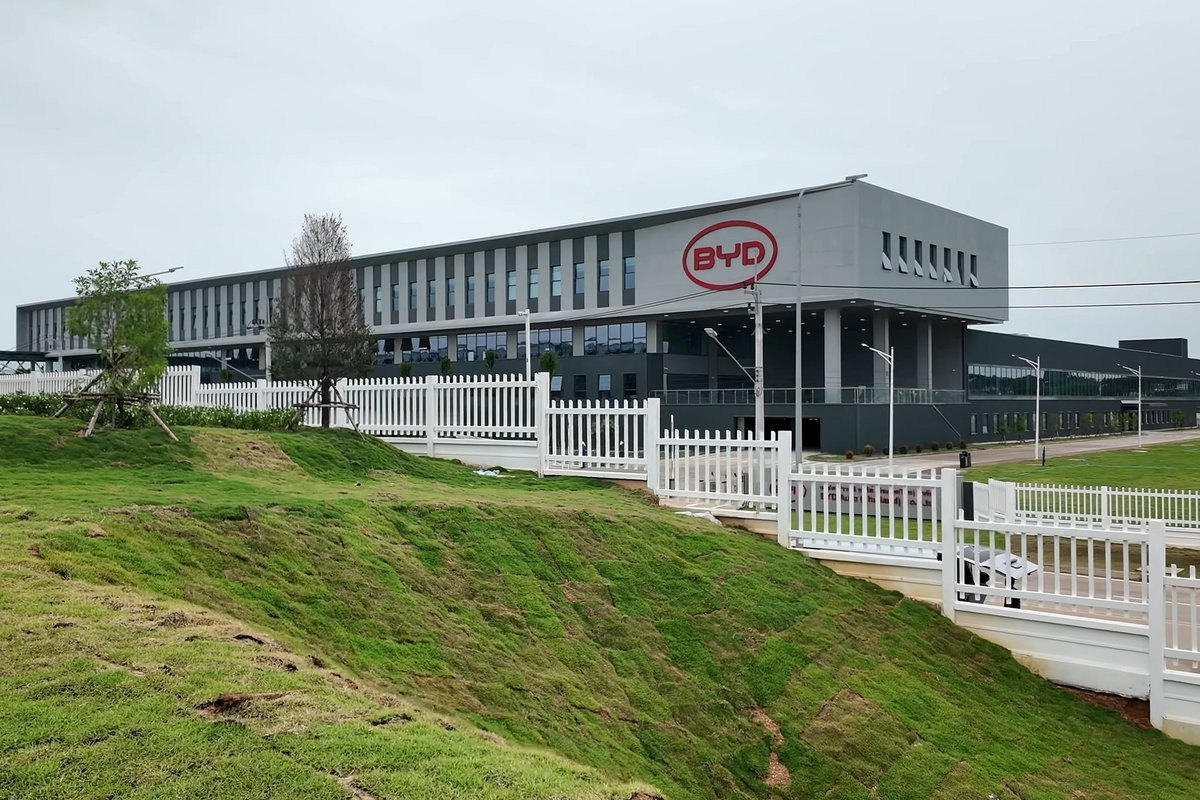
Europe first: the plant in Hungary (Szeged), in trial production since early 2026, is due to start series production next month, if the investigation around the former foreign minister does not affect it (see Controversies). Cars built there pay no countervailing duty.
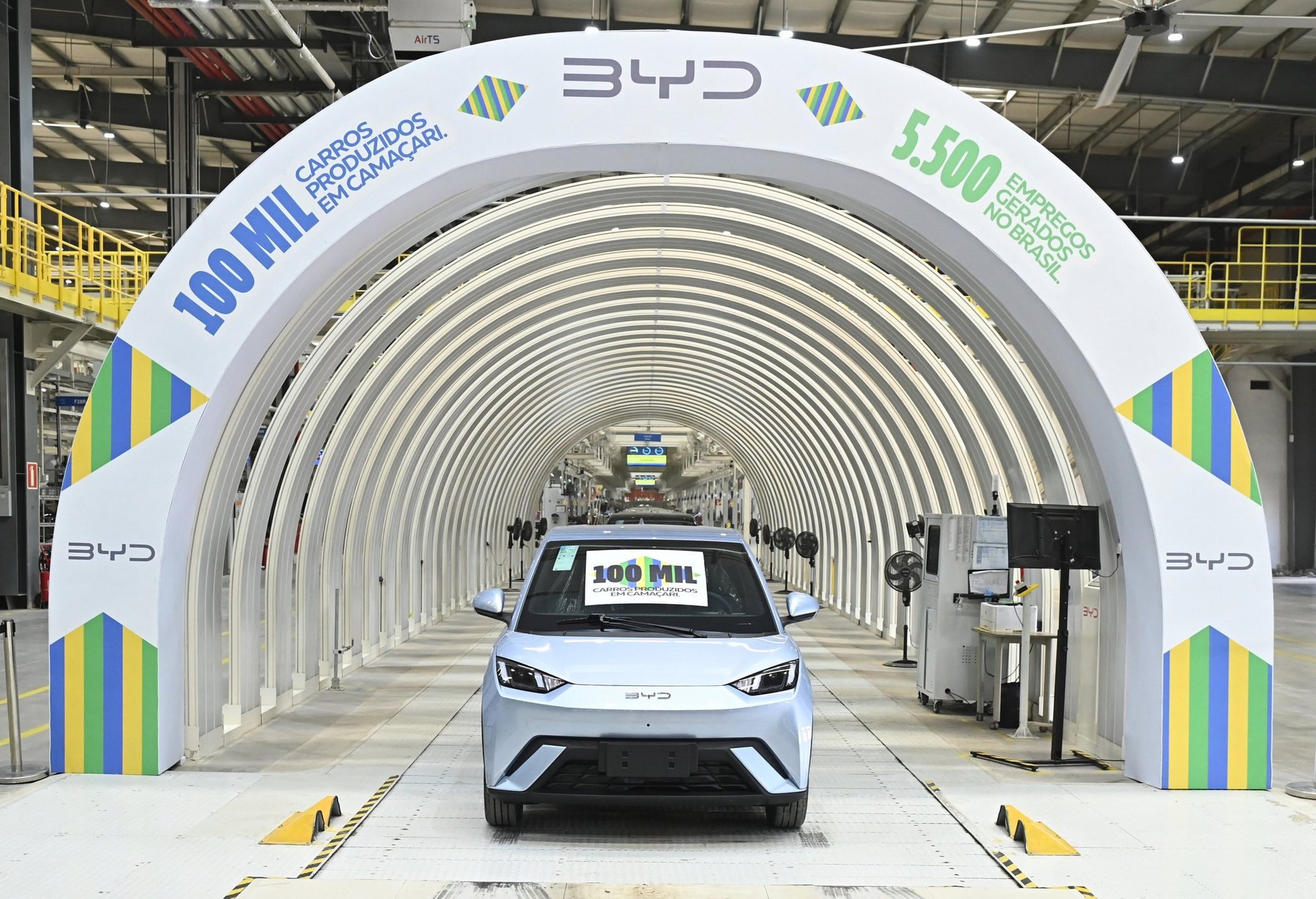
Brazil, the largest South American country, where BYD has a strong footprint: Camaçari built its 100,000th car in July 2026. It still assembles kits; full production is promised by year-end.
The others are in Asia, where BYD began: Thailand (Rayong, since July 2024), Uzbekistan (since June 2024) and Indonesia (Subang, opened in September 2026). Pakistan is under construction.
Subsidies: ¥12.5 billion ($1.9 billion) in 2025, almost a third of pre-tax profit
The EU duty is Brussels' estimate of Chinese state support. BYD's own accounts show it directly: government grants booked in profit were ¥12.5 billion ($1.9 billion) in 2025, 31% of pre-tax profit. In 2019 the share was 70%, according to its annual reports.
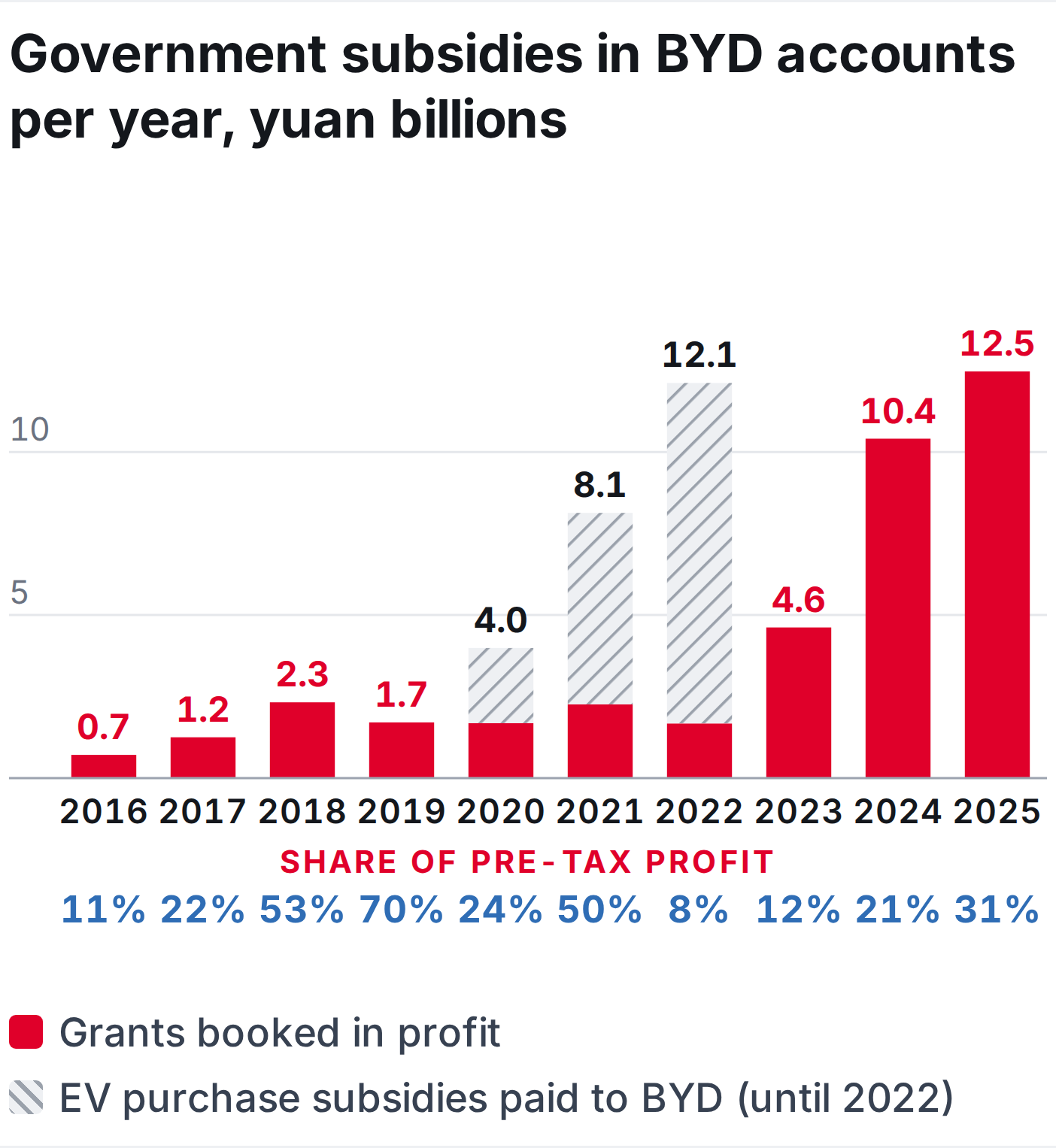
BYD receives more than it books, as grants for plants go through profit over the asset's life:
In 2022-2025 it received ¥69 billion ($10.3 billion); ¥44.3 billion ($6.6 billion) of that was still deferred at the end of 2025.
With the 2022 purchase subsidies, the state has put ¥79.4 billion ($11.8 billion) into BYD in four years, most likely spent long ago on the plants the grants were for.
Controversies
Brazil. A forced-labor case over the construction of the Camaçari plant ended in a R$40 million ($7.7 million) settlement in December 2025. In April 2026 BYD was put on the government's "dirty list" of employers for at least two years.
Hungary. The new government is reviewing the Szeged deal after the former foreign minister who negotiated it joined BYD; a parliamentary committee took up the case in September.
Design. Jaguar Land Rover says the BYD Ti7 copies its Defender. It sent bailiffs to seize BYD's business records in the Netherlands as evidence, and in October the two met in court in The Hague, where BYD asked to lift the seizure (Het Financieele Dagblad, The Times).
Turkey. In 2024 BYD promised a $1 billion plant there in exchange for skipping Turkey's extra 40% duty. Construction never started and the incentives were suspended. With EU tariffs looming, a plant inside the EU, in Hungary, was the obvious choice.
Expenses: where the money goes
Growth this fast costs money. Four things take it.
Research and development. ¥63.4 billion ($9.5 billion) in 2025, ¥28.9 billion ($4.3 billion) in the first half of 2026. This year, expensed R&D fell 17% in nine months as more development is capitalized (Electrek). Even so, BYD's bills payable now exceed its cash and liquid securities (see below).
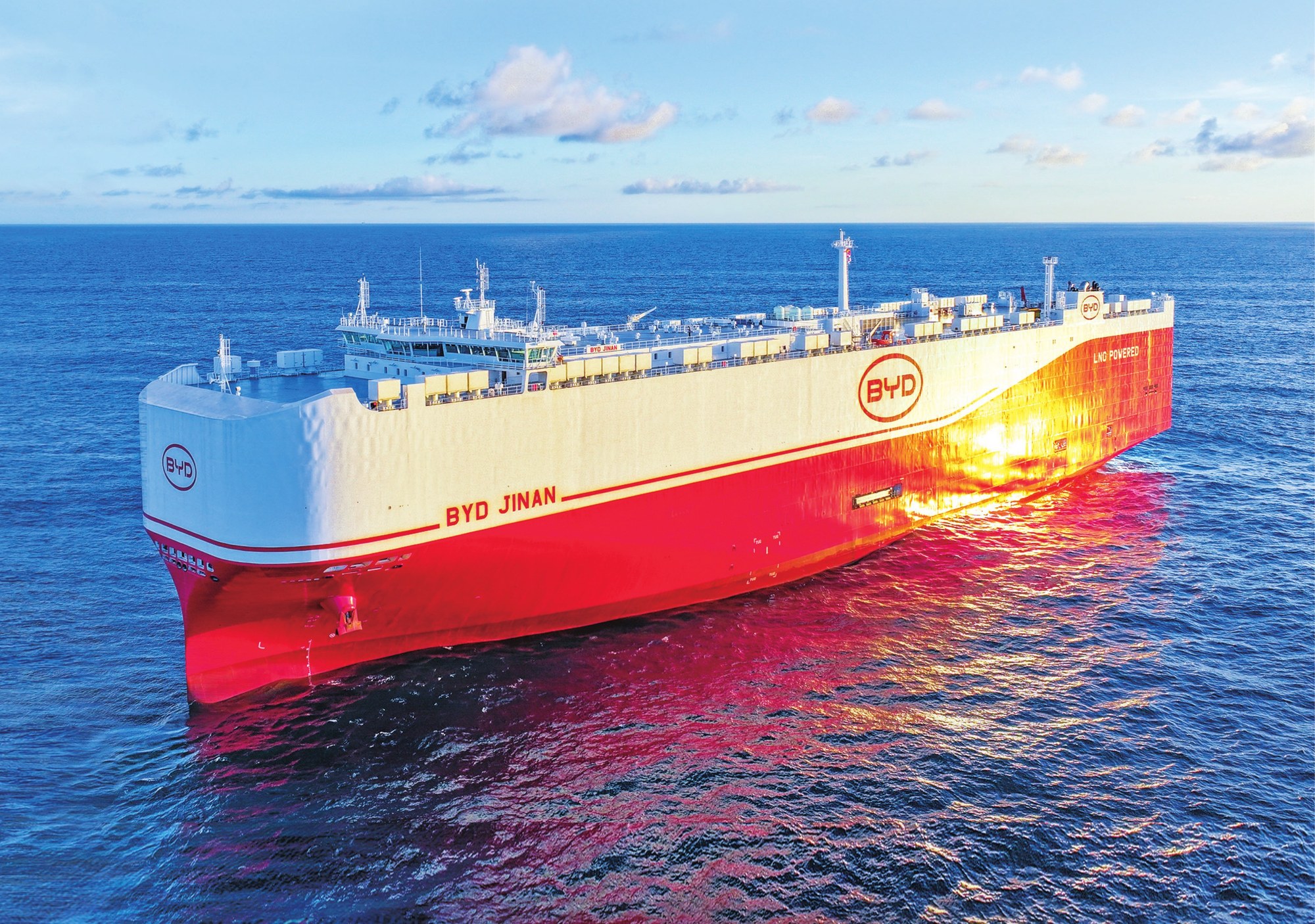
Its own fleet. To carry its exports, BYD built eight car carriers for over a million cars a year, with ten more ordered in September, 9,200 cars each.
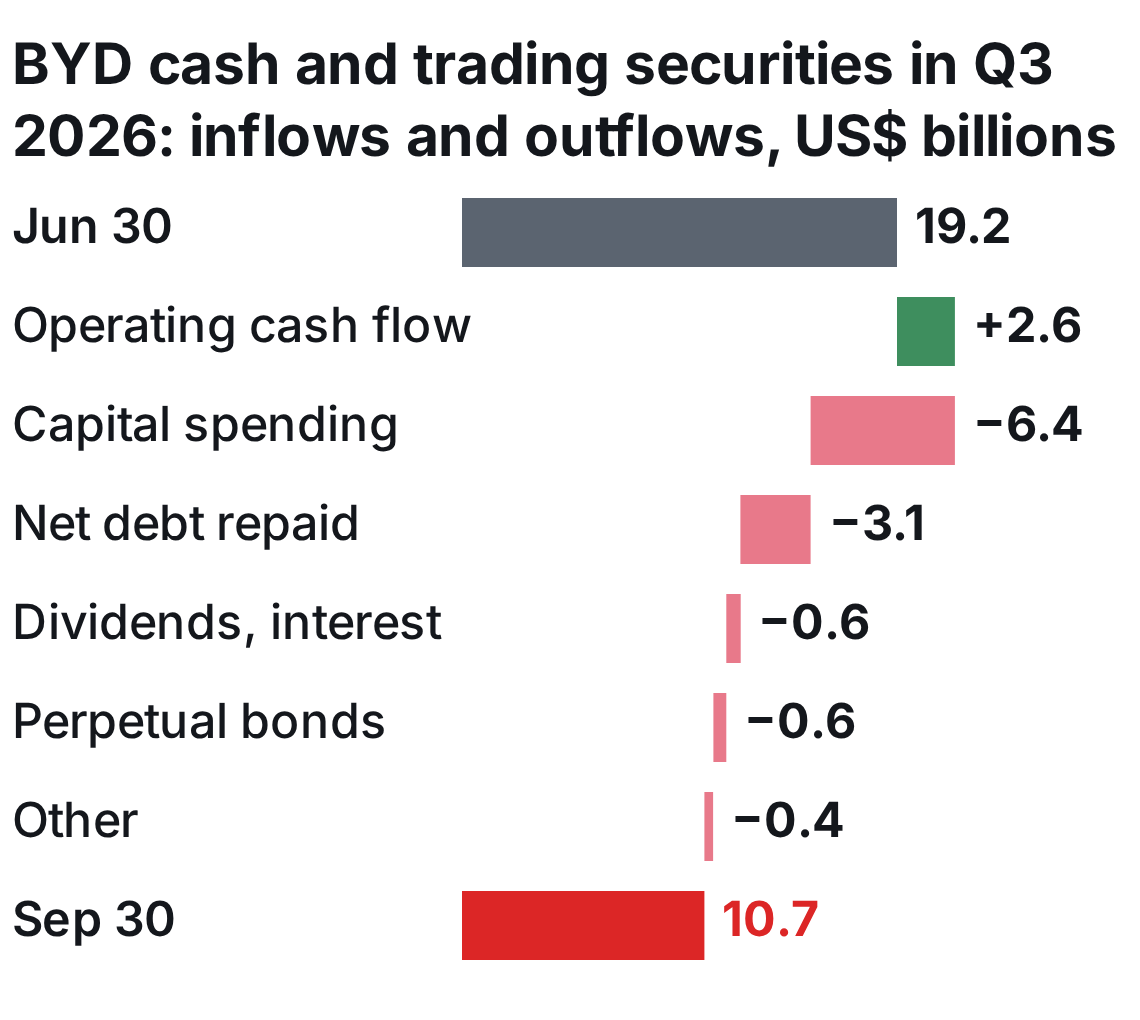
Plants and investment. Where did the third quarter's ¥57 billion ($8.5 billion) go? Into investment, by the first-half and nine-month cash-flow statements:
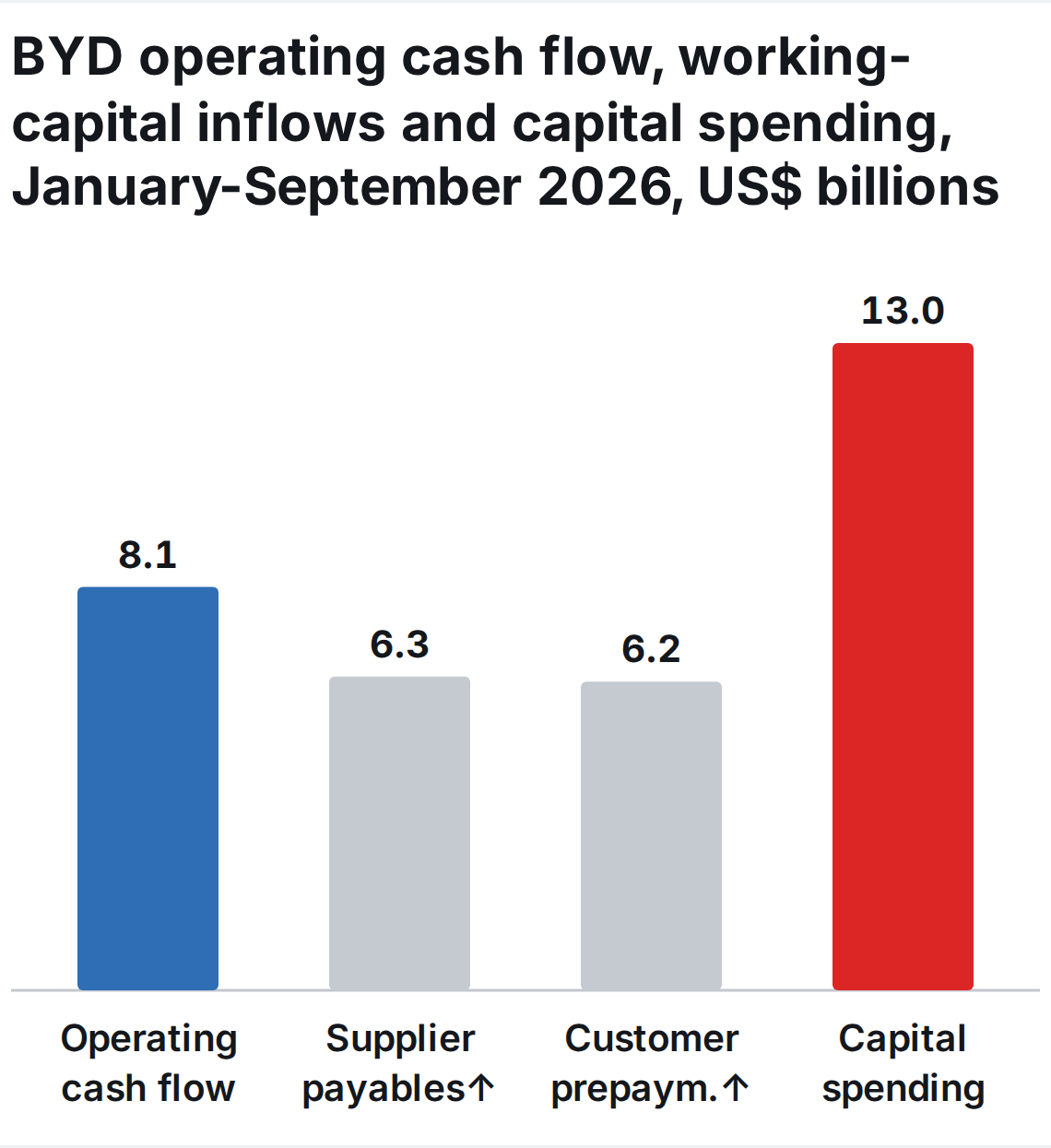
Operating cash flow was positive: it brought in ¥17.1 billion ($2.6 billion).
Capital spending took ¥42.7 billion ($6.4 billion), almost twice the first-half pace, leaving free cash flow at -¥25.5 billion (-$3.8 billion).
Another ¥28.8 billion ($4.3 billion) went out by choice: ¥20.8 billion ($3.1 billion) of net debt repayment, ¥4.2 billion ($0.6 billion) of dividends and interest, and ¥3.8 billion ($0.6 billion) to redeem perpetual bonds.
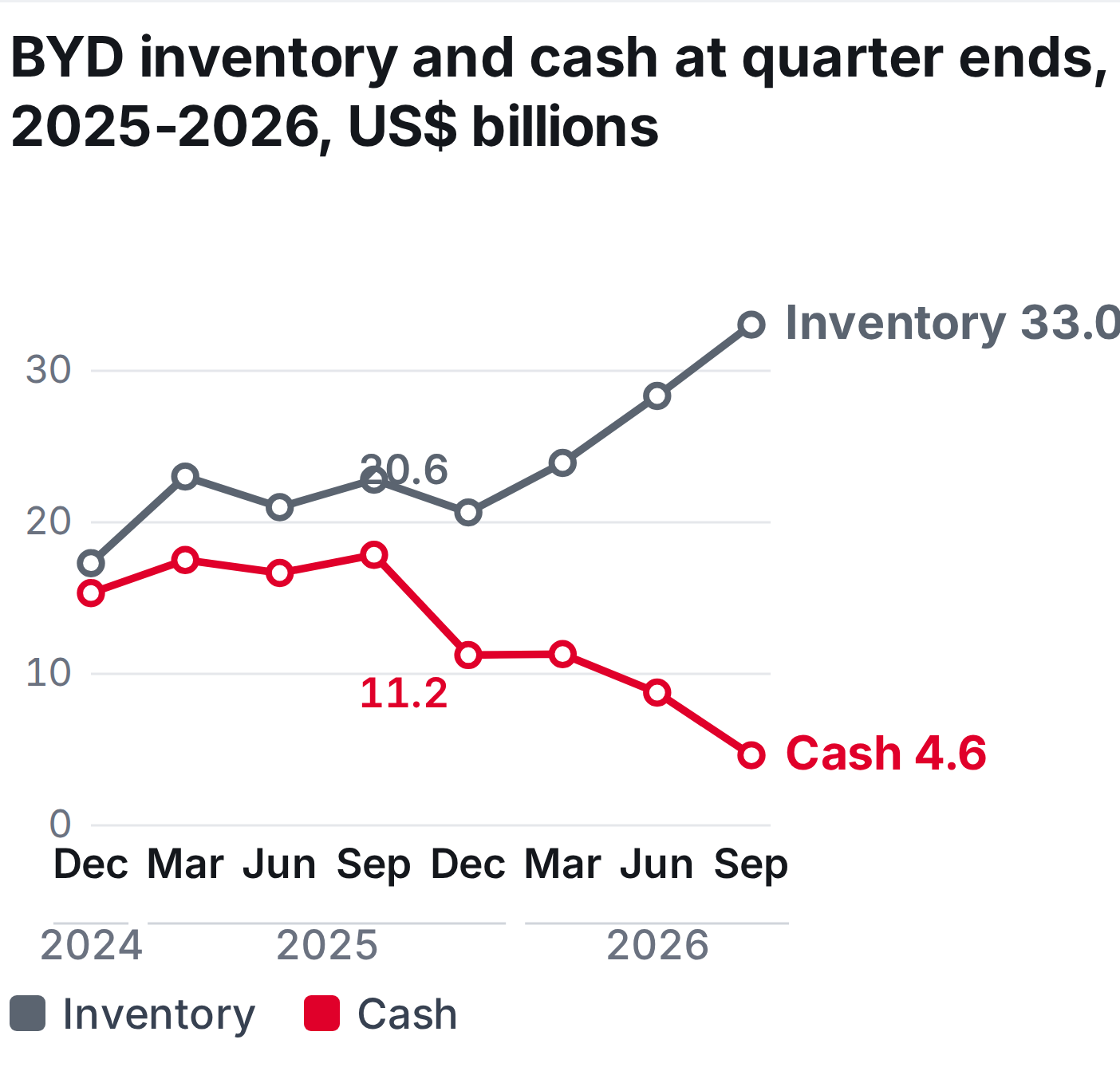
Cars in the pipeline. A lot of capital is tied up in inventory:
Inventory rose 60%, by ¥83.2 billion ($12.4 billion), to ¥221.6 billion ($33.1 billion), while combined sales in China and abroad fell 4%.
Mainly because of the overseas business, BYD says: a car shipped to Brazil or Europe spends months in the pipeline instead of days.
In the first half inventory turned in 109 days, against 79 a year earlier.
As a result, this year inventory and cash have gone different ways:
The balance sheet has not healed
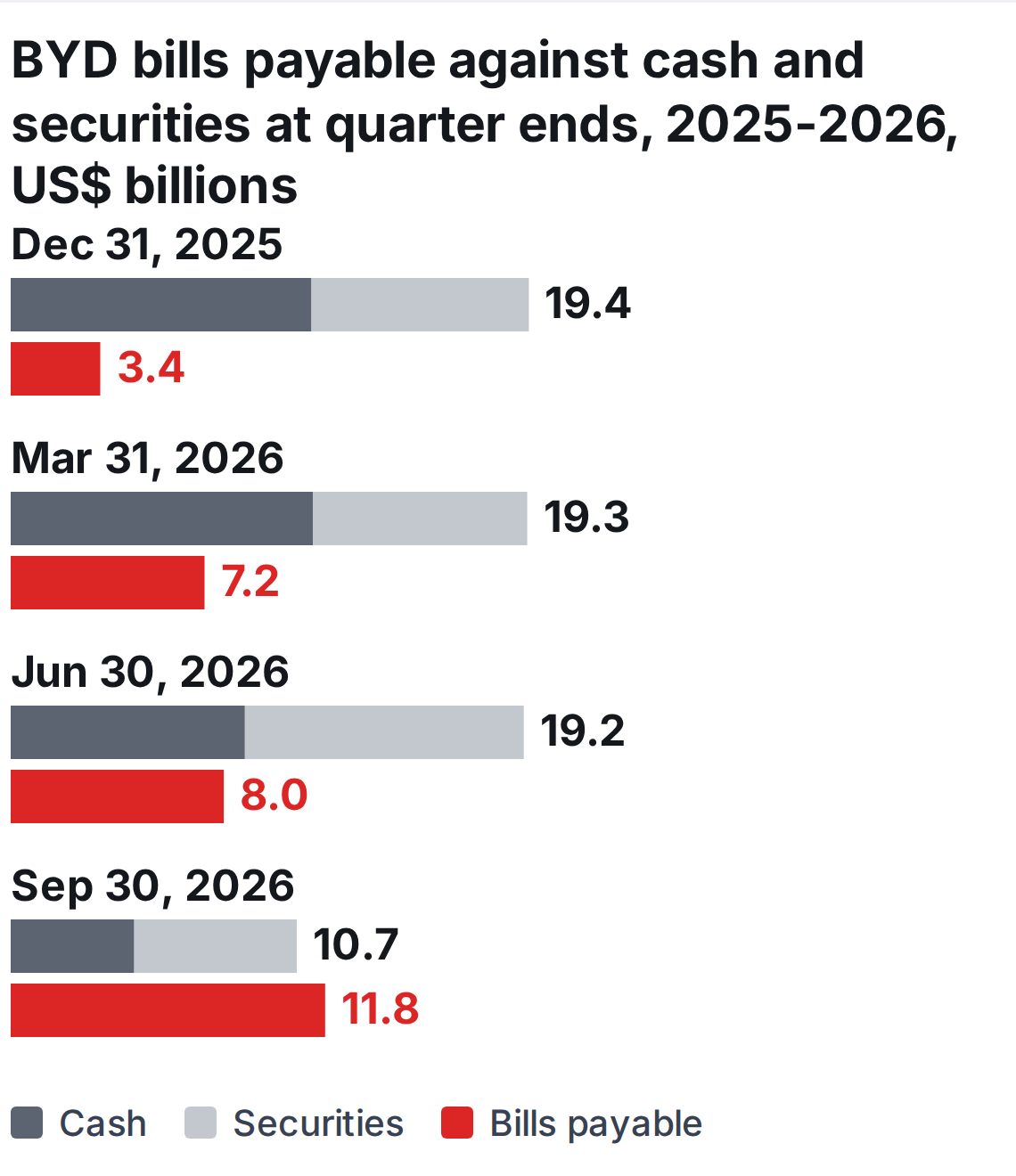
The income statement looks healed; the balance sheet does not. BYD's cash and liquid securities fell by ¥58.2 billion ($8.7 billion) this year. It now owes its suppliers more in bills than it holds in cash and securities.
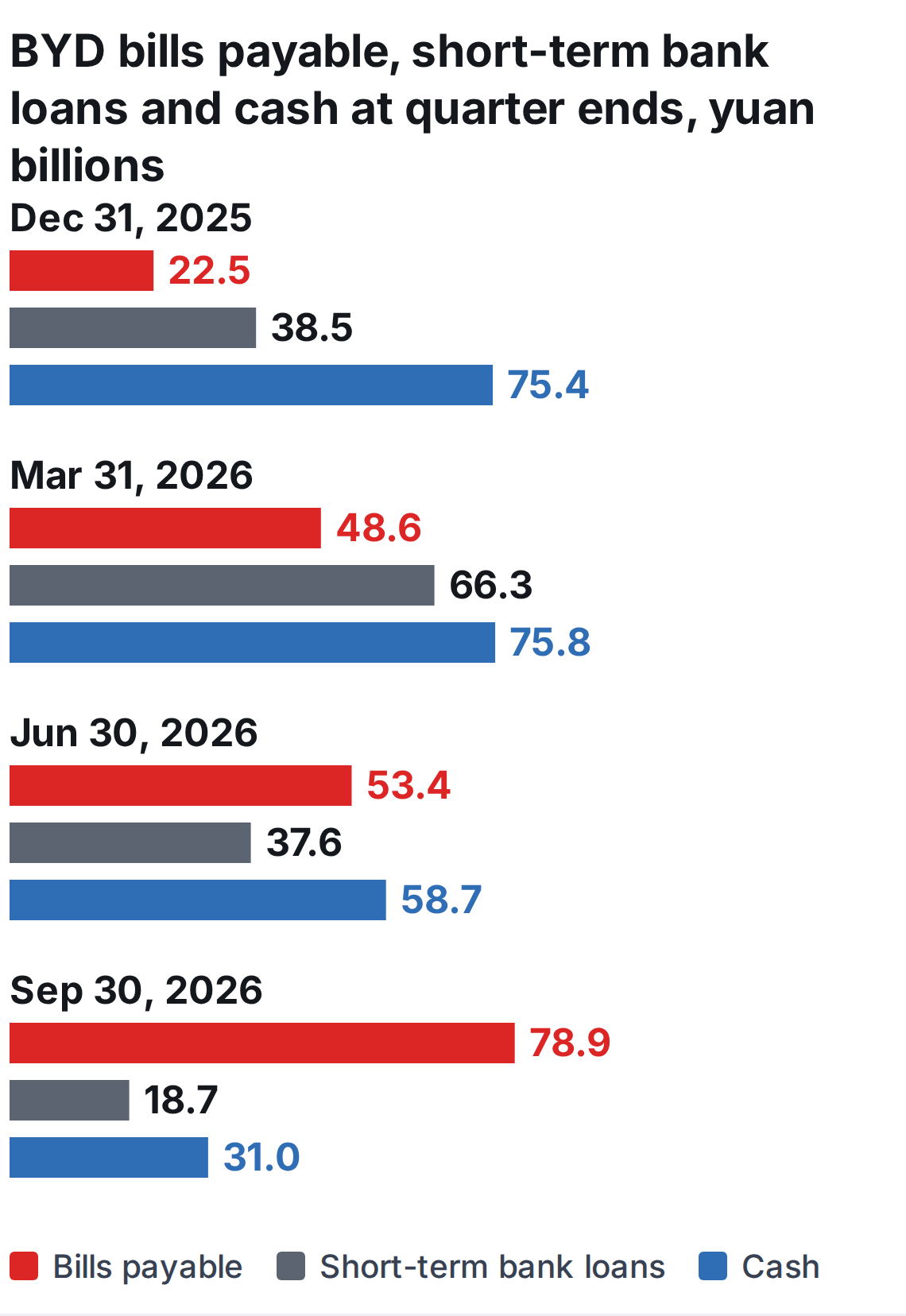
Cash fell from ¥75.4 billion ($11.2 billion) at the start of the year to ¥31.0 billion ($4.6 billion) at the end of September.
With securities held for trading, liquidity fell from ¥130.0 billion ($19.4 billion) to ¥71.7 billion ($10.7 billion), ¥57.0 billion ($8.5 billion) of it in the third quarter alone.
Loans, bonds and leases fell much less, from ¥119.1 billion ($17.8 billion) to ¥105.6 billion ($15.8 billion).
So BYD went from ¥10.8 billion ($1.6 billion) of net cash to ¥33.9 billion ($5.1 billion) of net debt in under nine months.
There is a curious round trip in BYD's bank debt, too:
Early in the year it borrowed: short-term bank loans rose from ¥38.5 billion ($5.7 billion) at the end of 2025 to ¥66.3 billion ($9.9 billion) at the end of March, which the first-quarter report put down to increased financing needs.
Then it paid them down fast: ¥37.6 billion ($5.6 billion) by the end of June and ¥18.7 billion ($2.8 billion) by the end of September.
Bills payable went the other way, from ¥22.5 billion ($3.4 billion) to ¥78.9 billion ($11.8 billion): supplier paper replaced bank credit.
Operating cash flow: ¥54.5 billion ($8.1 billion) in nine months, up 33%. But capital spending outran it, at ¥87.4 billion ($13.0 billion), and the operating figure is flattered by other people's money: supplier payables grew by ¥42.4 billion ($6.3 billion), customer prepayments by ¥41.5 billion ($6.2 billion).
So is BYD actually profitable? On paper, yes, even without subsidies: in 2025 pre-tax profit was ¥39.8 billion ($5.9 billion), of which ¥12.5 billion ($1.9 billion) were state grants; without them it would still be ¥27.3 billion ($4.1 billion), though thin, about 3 cents per dollar of revenue instead of 5.
In cash, not on its own: without the ¥83.9 billion ($12.5 billion) that suppliers and customers put in, nine-month operating cash flow would have been -¥29.4 billion (-$4.4 billion), even before ¥87.4 billion ($13.0 billion) of capital spending. So a sales slowdown, faster payment to suppliers or a cut in grants would hit its cash much faster than its profit.
The 2025 dividend was cut almost fourfold, to ¥3.3 billion ($0.5 billion) from ¥12.1 billion ($1.8 billion). Runway: under four months at the third-quarter deleveraging pace, about eight if BYD rolls its debt over.
Paying suppliers with paper
As of September 30, BYD's bills payable had reached ¥78.9 billion ($11.8 billion), 3.5 times the start of the year and 31% of what BYD owes suppliers, against 1% a year earlier.
By law a bill runs at most 180 days, so all of it is due by the end of March 2027 or sooner.
A supplier who needs cash early must discount the note: by 6% on some notes on Dilian, BYD's own platform, suppliers told Reuters in 2025.
Suppliers lend BYD working capital for free, and as trade payables it does not count as debt.
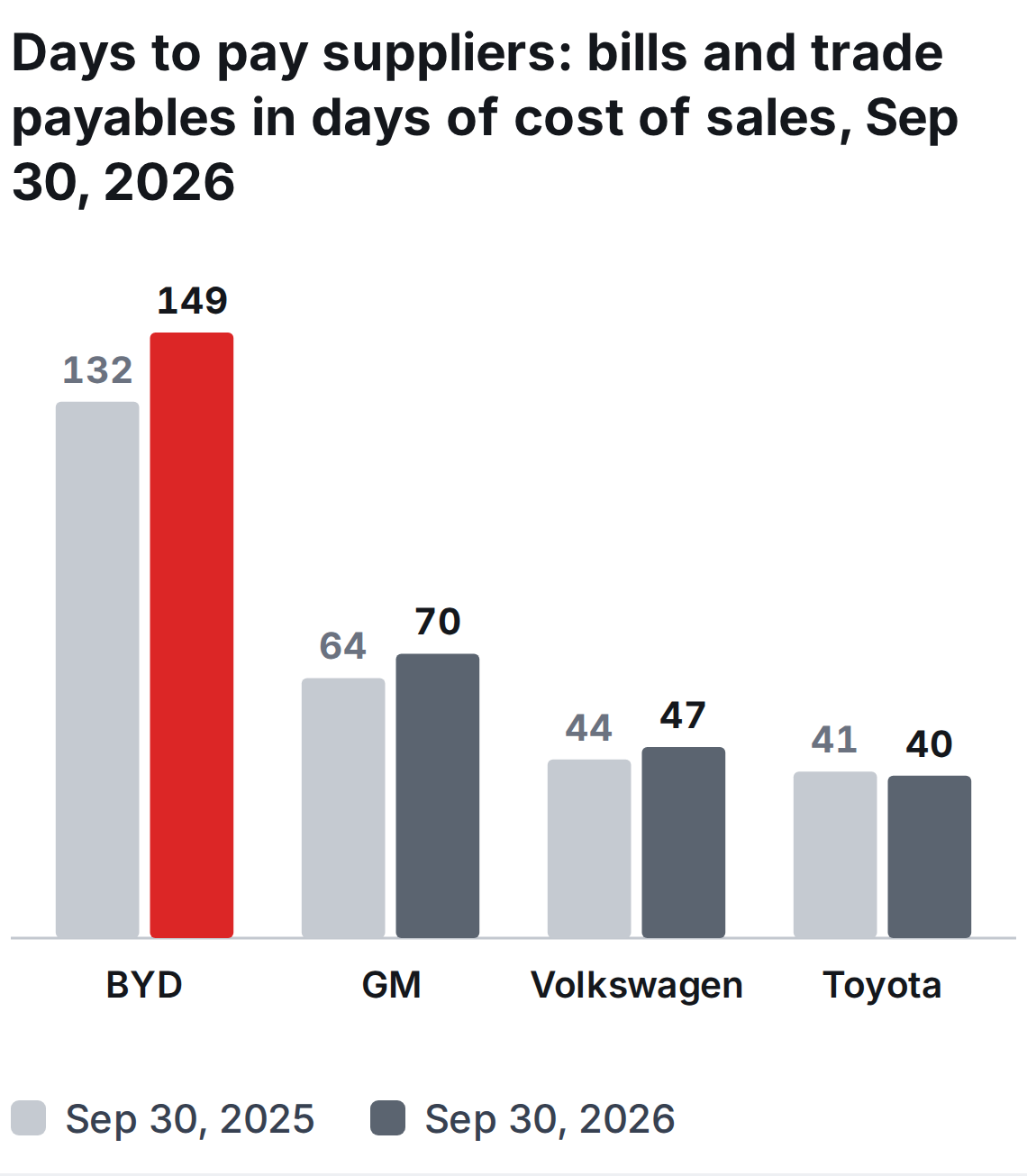
BYD's bills and trade payables equal 149 days of cost of sales, up from 132 a year earlier, against 40-70 days at GM, Volkswagen and Toyota. Next to the 180-day legal maximum for a bill, that leaves little room.
Regulators are pushing back. Since June 1, 2025 large companies may not force bills on small suppliers, and BYD promised to pay within 60 days; its bills only grew. In September 2026 the authorities again told buyers not to force commercial bills, guaranteed only by the buyer, on suppliers.
Conventional debt is moderate:
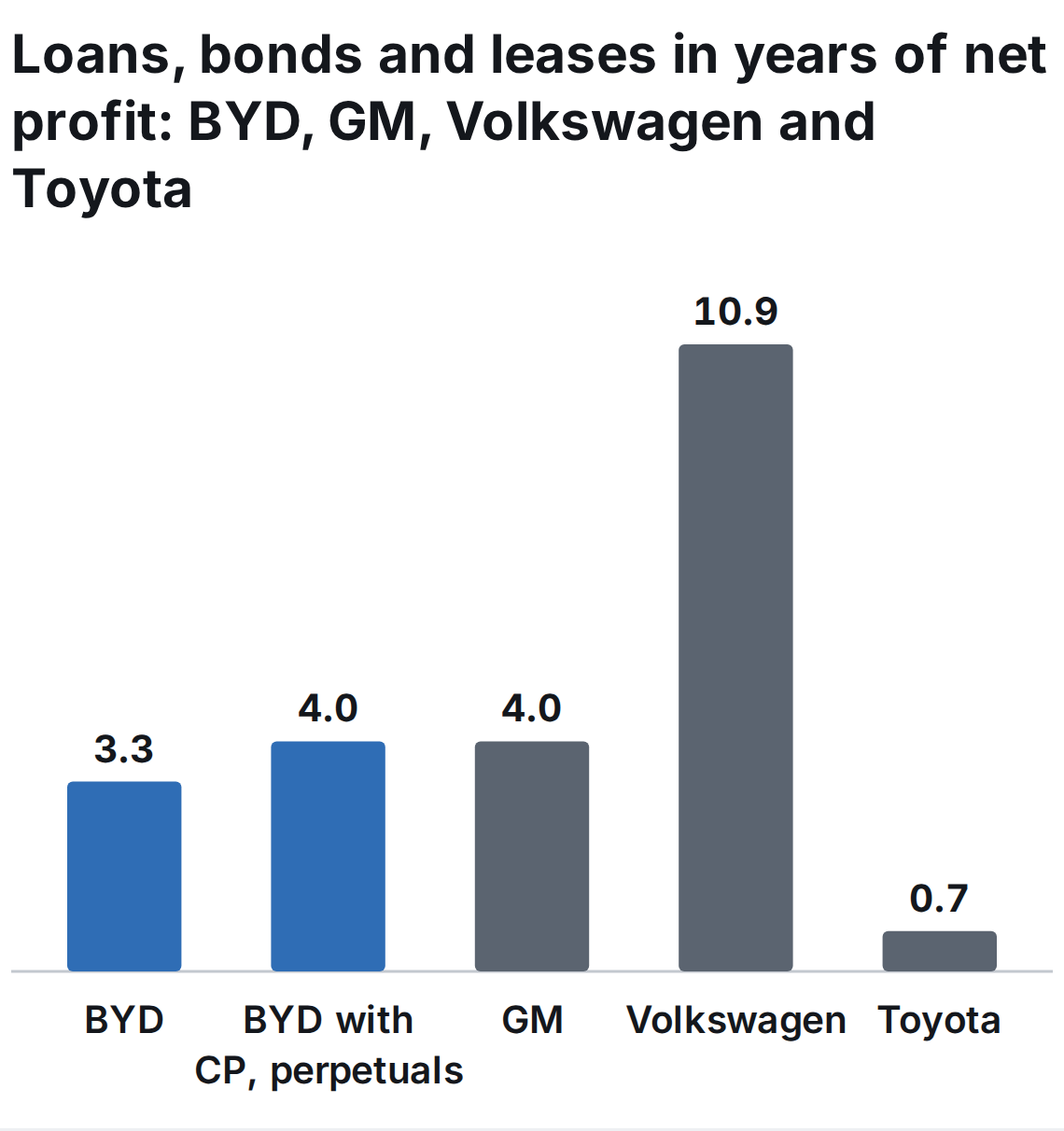
Loans, bonds and leases of ¥105.6 billion ($15.8 billion): 3.3 years of net profit, close to GM's 4.0.
With roughly ¥5 billion ($0.7 billion) of commercial paper and ¥17.1 billion ($2.6 billion) of perpetual bonds booked as equity: about ¥128 billion ($19.1 billion), 4.0 years, level with GM.
What changed is the mix: bank loans halved to ¥18.7 billion ($2.8 billion), bonds tripled to ¥15.0 billion ($2.2 billion), and supplier bills replaced bank credit.
Why? Partly a change of form. BYD used to pay many suppliers with Dilian, its own electronic IOUs, which sit in ordinary trade payables. In November 2025 Reuters reported that it was switching to bank and commercial bills, which sit in bills payable. So part of the jump is the same debt under a new name.
In the year to September 30, bills rose by ¥76.6 billion ($11.4 billion) while trade payables fell by ¥50.1 billion ($7.5 billion); everything BYD owes suppliers grew only 12%, to ¥251.6 billion ($37.5 billion).
But which paper? At the end of 2025, 46% of BYD's bills, ¥10.4 billion ($1.6 billion), were commercial acceptances guaranteed only by BYD itself, not by a bank.
In its June interim report BYD stopped giving that split, just as bills more than doubled to ¥53.4 billion ($8.0 billion). Over the same half-year its restricted cash, which includes the deposits banks usually take to back their bills, fell from ¥6.7 billion ($1.0 billion) to ¥2.9 billion ($0.4 billion).
Our reading, not a disclosed fact: most of the new paper is BYD's own, the kind the regulators told buyers in September not to force on suppliers. Bank-guaranteed bills would hardly have drawn their attention.
A sign of trouble? Most probably tactics: as the biggest carmaker in China, with thousands of suppliers, BYD can make them finance it at little cost to itself. Long terms are common there: in 2024 BYD took 127 days on average to pay suppliers and short-term creditors, against 108 for the Chinese car industry, by LSEG data cited by Reuters.
Questionable to Western eyes, but BYD's priority is clearly selling more cars at almost any cost, rather than making shareholders feel secure. The limit is the regulators' pushback above: the tactic works only while suppliers can be made to accept paper.
Cash, short-term loans, bills payable and total debt: BYD, GM, Volkswagen and Toyota, end of September 2026, US$ billions
US$ billions | BYD | GM* | VW* | Toyota* |
|---|---|---|---|---|
Cash | 4.6 | 18.8 | 30.7 | 63.0 |
Short-term loans | 3.3 | 0.5 | 22.7 | 6.2 |
Bills payable | 11.8 | none | none | n/a** |
Total debt | 15.8 | 15.8 | 82.5 | 17.8 |
Debt in years of net profit | 3.3 | 4.0 | 10.9 | 0.7 |
* Without captive finance arms; VW: automotive division; Toyota: March 31, 2026. Net profit: last four quarters, VW: 2025. BYD cash excludes ¥40.7 billion ($6.1 billion) of securities. ** Electronic notes, unreported. Sources: BYD, GM 10-Q, VW 9M report, Toyota 20-F.
Valuation: priced like Toyota per car, at twice its P/E
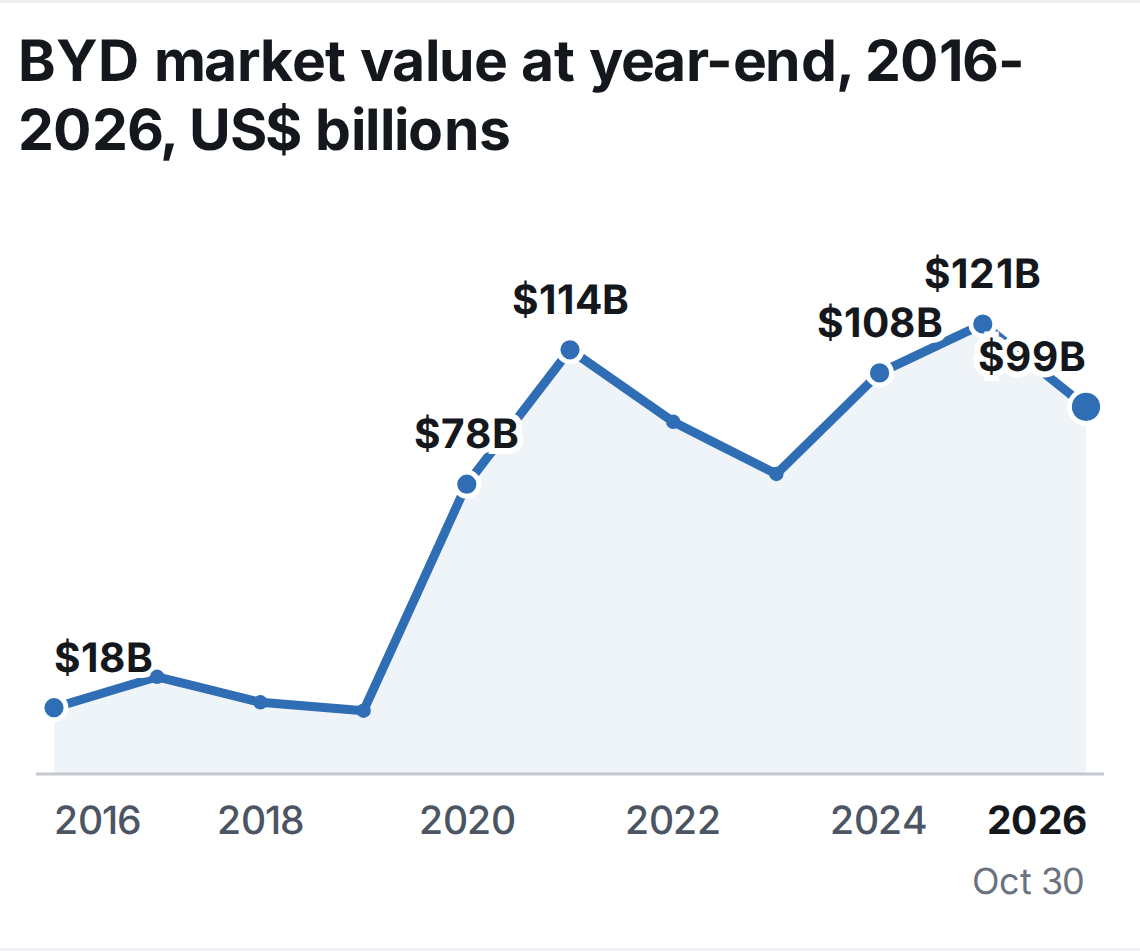
At HK$68.25 in Hong Kong and ¥81.65 ($12.27) in Shenzhen on October 30, BYD is worth about $99 billion. The shares are down 22% this year; the report moved them -0.6% in Hong Kong and -1.0% in Shenzhen, while Porsche rose over 10% in three days after its October 27 report despite falling sales, an example of what a profitable business and transparent investor relations can do even without sales growth.
By carmaker measures BYD is already expensive:
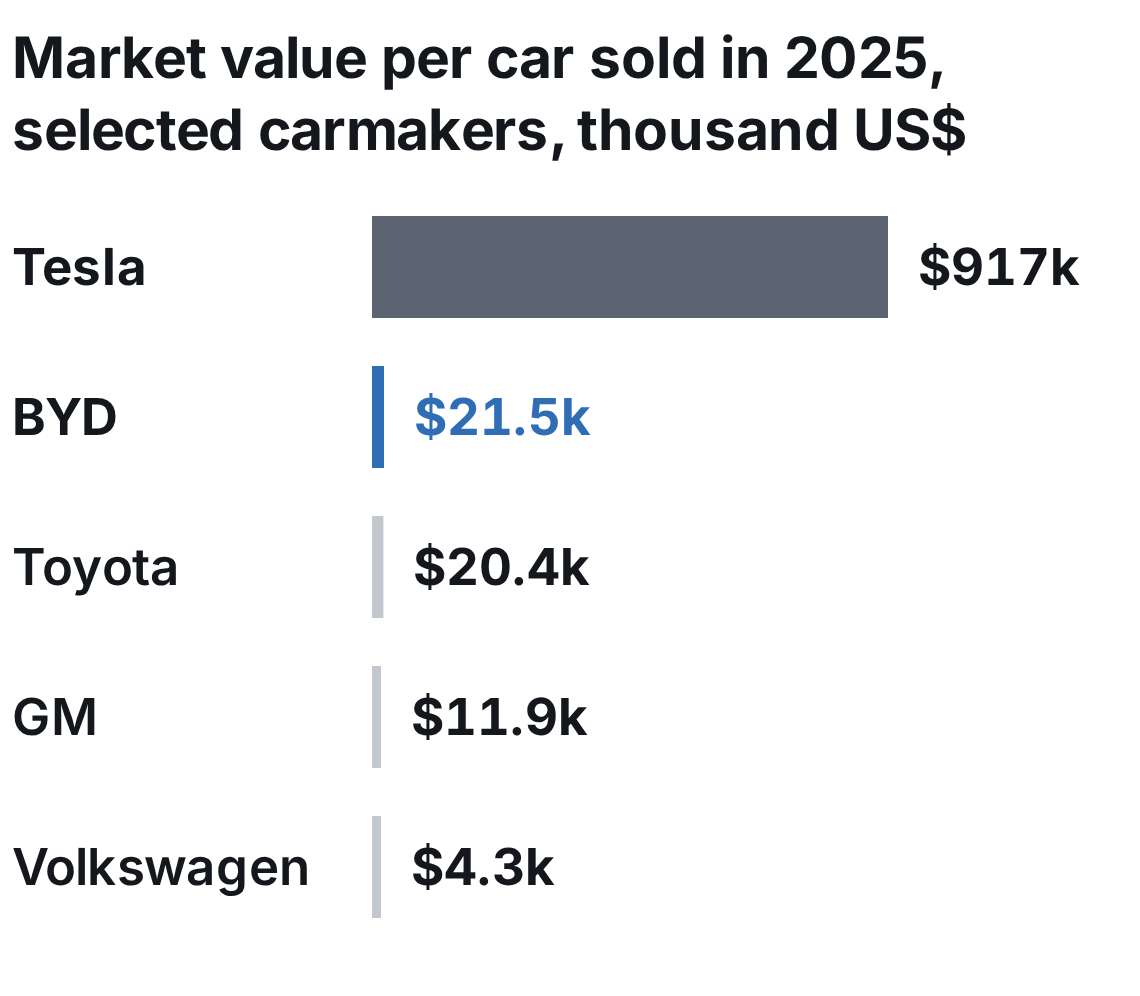
Per car sold in 2025 the market values it at $21,500, like Toyota ($20,400), nearly twice GM ($11,900) and five times Volkswagen ($4,300). But Toyota earned about twice as much per car ($2,160 against $1,070), so BYD's P/E of 20 is twice Toyota's. GM looks pricier only because its 2025 profit was less than half of 2024's.
By tech measures it is cheap: Tesla, valued on its bet on autonomy and robotaxis, is worth about 15 times BYD in total and 43 times per car sold in 2025. Tesla is Tesla, of course. What is significant is that BYD, with all its battery and electronics business and its rapid rise around the world, carries next to no premium over other carmakers.
The big idea. If BYD gets through the next year or two without a crisis, keeps its margins and climbs into the world's top five and then top three, it would combine what no carmaker has together: Toyota-like volume and Tesla-like control of the technology, with its own batteries, chips and driver assistance on every car.
Push harder into autonomy, and perhaps robots, on the same batteries and electronics, and BYD could end up ahead of Tesla and every other maker of cars, autonomous vehicles or robots on the combination of scale and sophistication. The market is not paying for that option today.
It depends on three things this article tracks: the cash squeeze ending without heavy dilution, access to Western markets, and proof of autonomy (a Level 3 permit or a robotaxi).
At the current pace, BYD would pass GM in 2028 and reach No. 3 by 2031
In 2025 BYD sold 4.60 million vehicles, sixth in the world, behind Toyota (11.32 million), Volkswagen (8.98 million), Hyundai and Kia (7.27 million together), GM (6.18 million) and Stellantis (5.48 million shipments).
Take the current pace: China flat at this year's 2.52 million, and overseas up 500,000 a year, about what the 2027 target of more than 2.5 million implies. If the other makers keep their 2024-2026 trajectories, BYD would pass GM in 2028 for fifth place and reach No. 3 by 2031, with about 6.9 million cars.
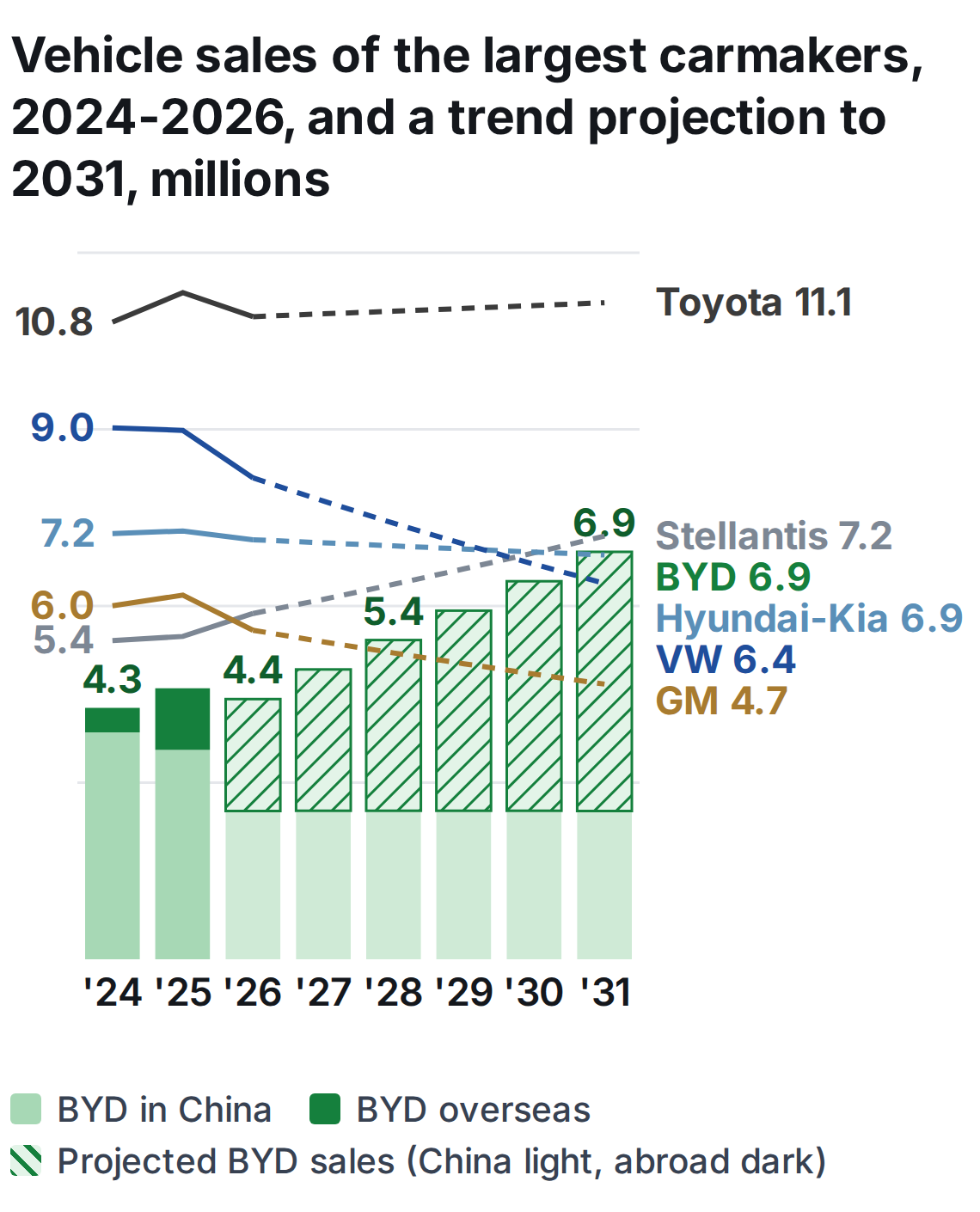
The arithmetic is the easy part. The question is whether BYD can get through a cash-strapped growth phase without diluting shareholders or needing a bailout. A Western company in its place would most likely find investors and banks ready to fund it; Chinese business seems to work by its own rules.
Worries and risks
In the filings:
Bills payable. ¥78.9 billion ($11.8 billion), more than cash and securities, all due by March 2027.
Why it matters: if suppliers or regulators demand cash, BYD needs tens of billions of yuan fast, as early this year, when short-term bank loans jumped by ¥27.8 billion ($4.1 billion) in one quarter.Low cash. ¥31.0 billion ($4.6 billion), down 59% this year; ¥71.7 billion ($10.7 billion) with securities.
Why it matters: under four months of runway at the third-quarter pace, eight if BYD rolls debt over. For comparison, Volkswagen's car business holds €33 billion ($38 billion) of net liquidity to carry it through its restructuring, about eight times BYD's cash.Bank loans: borrowed, then repaid. BYD raised its short-term bank loans from $5.7 billion at the end of 2025 to $9.9 billion in March, then cut them to $2.8 billion by September, while its cash fell too.
Why it matters: a question, not a claim. Either bank credit on good terms is scarce, or supplier paper is simply free; the filings do not say. The answer shows how BYD will fund its next plant.
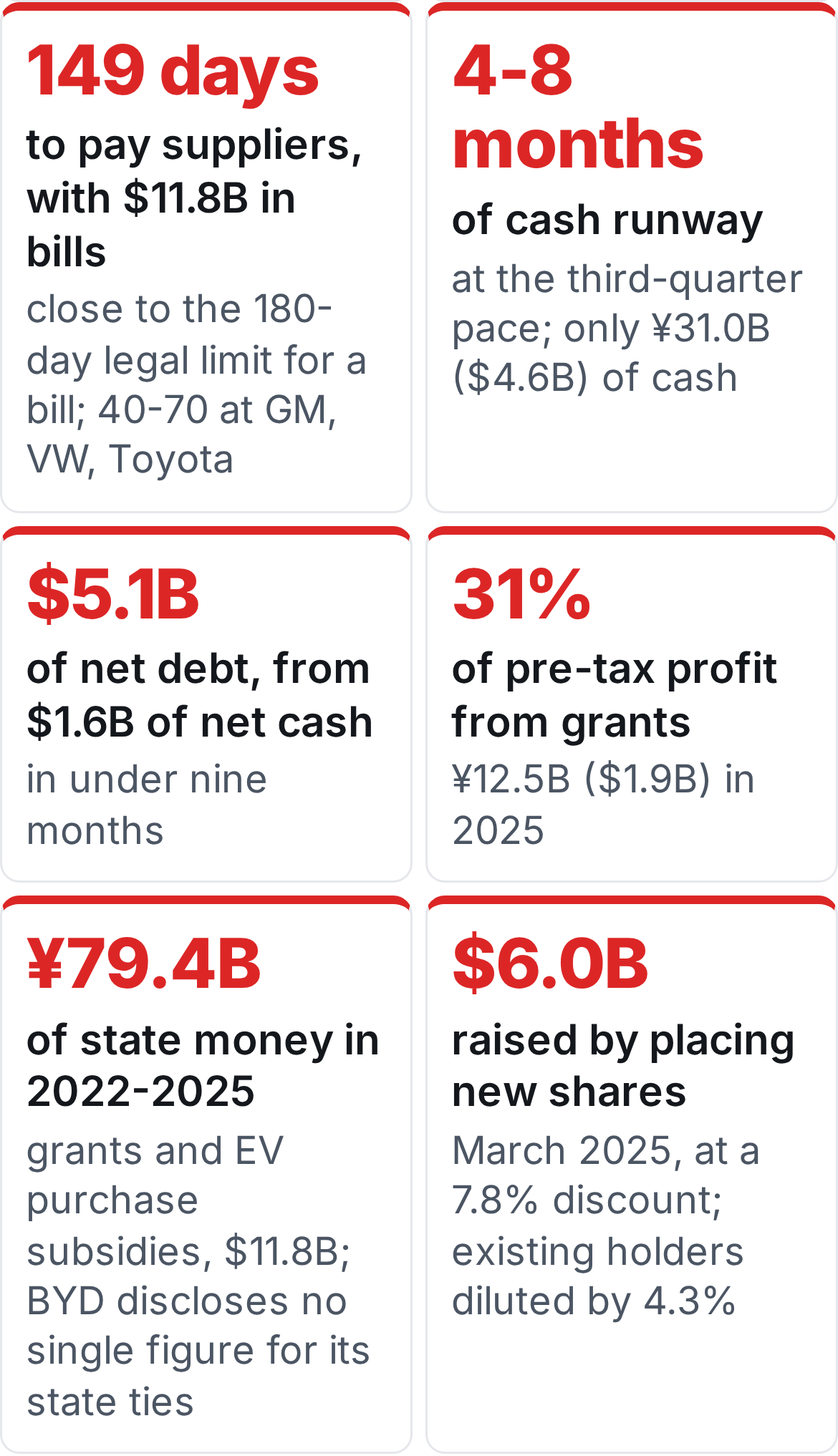
Subsidies. ¥12.5 billion ($1.9 billion) of grants in 2025, 31% of pre-tax profit, and more deferred.
Why it matters: conditions mostly undisclosed; deferred grants feed profit for years without new cash.Dependence on the state. Real, but BYD discloses no single figure for it.
Why it matters: BYD controls none of it; a policy change or a new duty hits profit before sales.
Beyond the filings:
China's car-market price war. Margins are thin anyway. A further drop in sales at home would hit something more important: BYD's working capital and its ability to pay suppliers with bills, forcing it to borrow in a hurry.
Regulation. Beijing has already moved against supplier bills: since June 1, 2025 large companies may not force them on small suppliers, and in September 2026 the authorities said it again. That hits BYD's main source of financing, its suppliers, directly. In September Beijing also told carmakers to stop price wars abroad and to price on cost and local demand.
Trade barriers. Probably the only real risk of a slowdown abroad: an EU duty on plug-in hybrids or, more critical, on parts for cars built in local plants. North America is already closed by two US laws, the 100% tariff and the ban on Chinese connected cars.
Politics. Trade wars rage, and the last five years, 2026 above all, show even war cannot be ruled out.
Dilution, a major risk. For a company earning ¥10 billion ($1.5 billion) a quarter the realistic downside is not default but a cheaper share placing, as in early 2025, when BYD raised ¥40.2 billion ($6.0 billion) by placing new shares at a 7.8% discount, diluting existing shareholders by 4.3%, with far more cash. Supplier bills, bank loans repaid below January's level, cash down 59%: the moves of a company that cannot refinance easily. At a stock price 22% lower, it would dilute more.
What to watch, and when to buy
BYD publishes no separate fourth-quarter report; its next full numbers are the 2026 annual report, due in late March 2027. But the signals come every month:
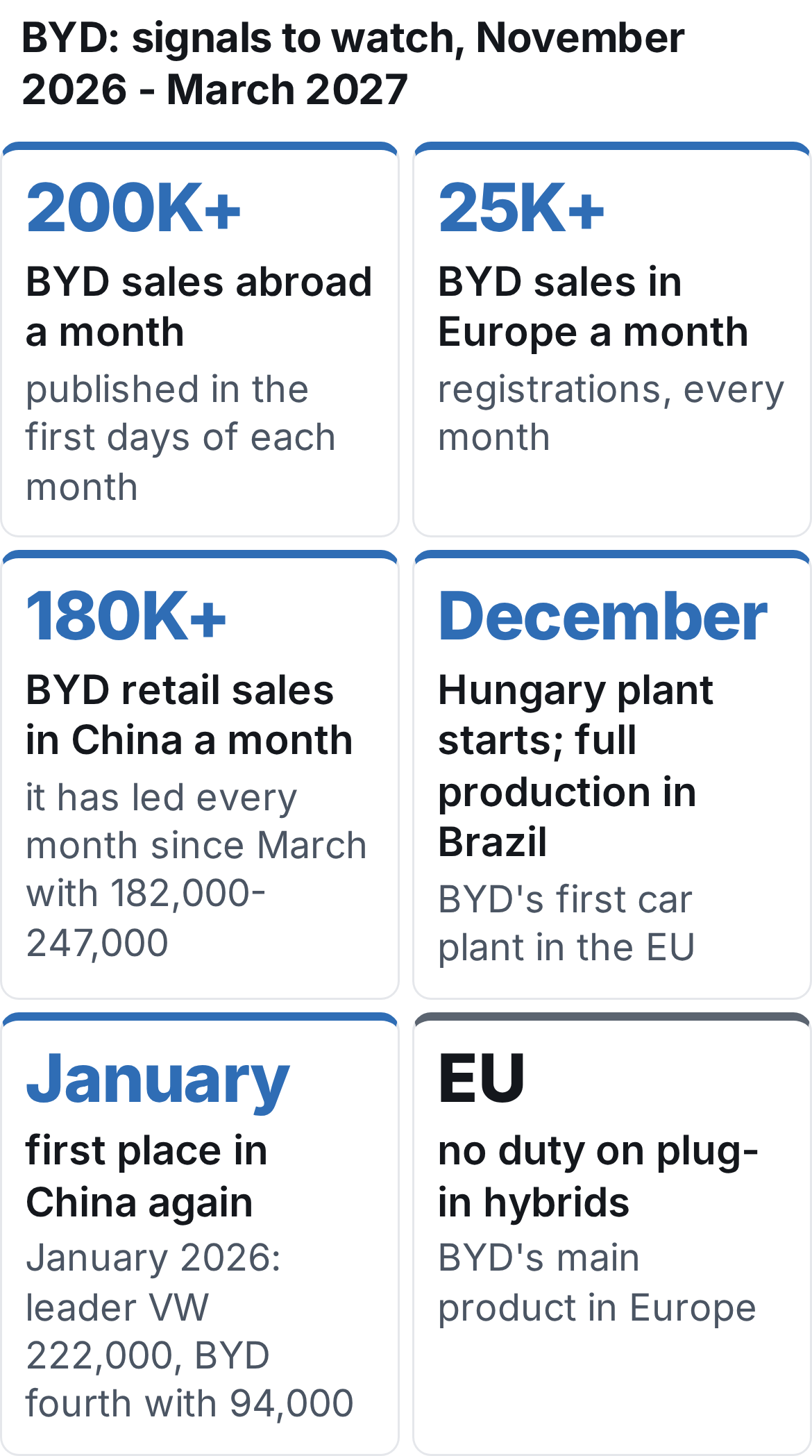
Every month. BYD sales abroad above 200,000 a month, published in the first days of each month; above 25,000 in Europe; about 180,000 or more in China at retail, enough to lead every month since March (182,000-247,000).
December. Series production starts in Hungary, BYD's first car plant in the EU, and full-cycle production in Brazil.
January. First place in China again, at whatever volume: in January 2026 the leader, Volkswagen, sold 222,000 cars and BYD, fourth, only 94,000, a collapse. Keeping first place would show BYD got through the start of the year at home smoothly this time.
The EU. No decision on duties for plug-in hybrids, BYD's main product in Europe.
If these hold, by mid-January the stock could be a good buy, before the market sees the full-year numbers.
Further good signs would be:
a Level 3 permit, a step toward truly autonomous cars and robotaxis;
a 2026 annual report in late March with cash at least where it was in September (though the best time to buy may come before it, in January);
the competition standing still: if Tesla keeps relying on outside suppliers for most of its batteries and other carmakers do not launch robotaxis, BYD has a good chance to get ahead.
This is a long-term bet: climbing into the world's top five would take BYD about two years, into the top three four to five, and the risks are more political than technical. But of all carmakers, BYD today seems to carry the most significant potential. Until the signals above confirm it, Hold.
Comments
Log in or sign up to join the conversation.