

Companies use investor or analyst day presentations as venues to show deep dive details on how their businesses operate and how the management team works to build share owner value. The detailed view of a business typically provided helps me evaluate the long-term dividend growth prospects of the company making the presentation. Recently, commercial property REIT Stag Industrial Inc. (NYSE:STAG) held their first ever Investor and Analyst Day presentation. I took the opportunity to hold a microscope up to this high-yield dividend payer and see what its all about.
The timing of the presentation could not be better. The STAG share price is down 24% since REITs as a group peaked in late January. The information from management highlighted the unique business model of STAG and reaffirms my recommendation that this REIT is a long-term hold for an attractive yield –currently 6.6%– and a growing dividend. Here are the highlights.
Looking for Inefficiencies
The core of STAG’s commercial property investment strategy is to find properties that are mispriced and will produce higher long-term cash flow yields. Founder and CEO Ben Butcher discussed the concept that traditional net lease financing with high-quality tenants, in major markets, with long-term leases is as close to a riskless transaction as you could find in commercial real estate. This type of property and lease deal is highly sought by commercial investors (REITs, pension funds, etc.) and the competition results in assets priced at low but safe yields. Butcher continued to state that if you remove just one of the factors that make a high quality commercial net lease so desirable by conservative investors, the investment return can increase dramatically. To quote: “In essence you would be overpaid for the risk you were taking.”
A business was developed to focus on single tenant industrial assets. This is a diverse market where return inefficiencies could and can be found.
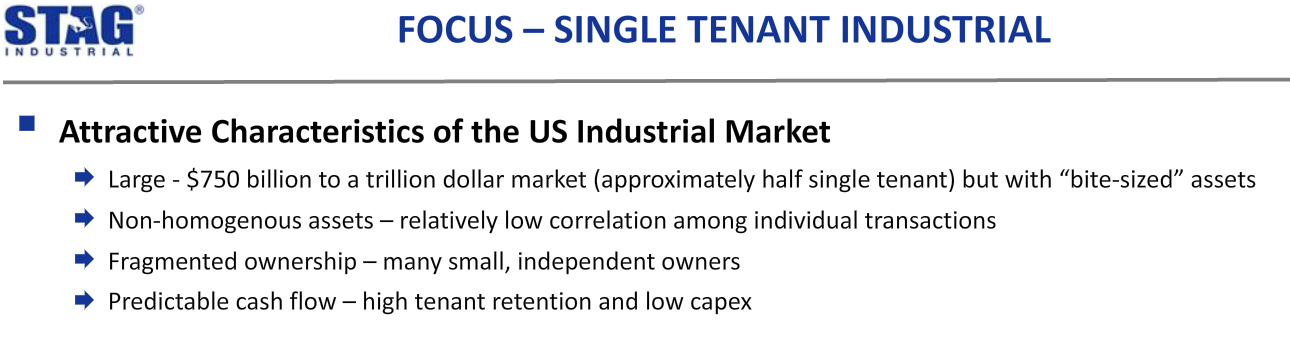
There is real risk in this market for an investor who owns one to a few properties. Yet there are ample opportunities to buy properties as small owners decide to sell for a variety of reasons. Large institutional investors avoid these properties because of the perceived risk and that the properties do not pass the rigid decision criteria used by this type of investor. To take advantage of these facts, Butcher and the STAG management team have developed their own proprietary risk assessment model that lets them evaluate every single industrial property that comes up for sale. The model takes the available, but imperfect, information about a property and develops a probabilistic assessment of the future cash flow that will be generated by the company.
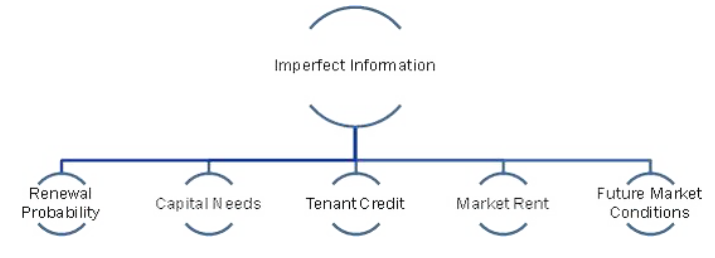
STAG’s acquisition team uses the model to evaluate thousands of properties to find those that will produce the best long-term cash flows. The property management team continues to use the model, feeding in data that will make future purchase decisions better. STAG views its risk assessment tool as its big differentiator in the commercial/industrial property REIT business.

Focus is on the process instead of the outcome. “We do not use the model to back into preconceived qualitative decisions to buy an asset, we use the model to decide the very assets that are worthy of pursuit.”
Strength in Numbers
Over a period of years, cash flow from a commercial property will not be linear. Leases end and must be renewed or a new tenant found. Properties need to be upgraded or repaired, requiring additional capital investments. STAG looks at a cash flow model that incorporates a 20-year period. The model uses statistical methods to develop a range of cash flow outcomes from a potential property acquisition. Outcomes are randomly simulated and probability weighted. The cash flow expectations of a single property look like this chart:
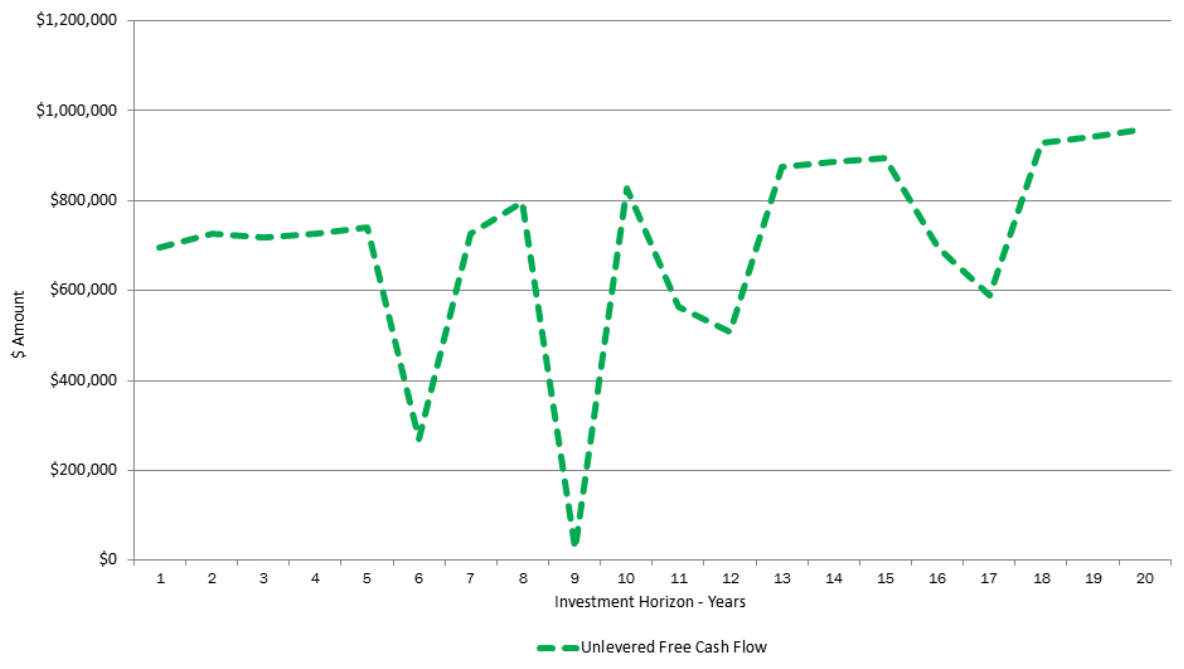
Management describes this projection as “Simple, volatile, and beautifully mispriced” prospective properties where above average cash flow expectations become the building blocks of STAG’s growth model. An attractive property shows an unlevered 10 and 20-year IRR of over 8%, which can be increased to 10% annual returns with leverage. STAG’s aggressive acquisition program levels out the cash flow swings and reduces the volatility. The 43 assets acquired in 2014 produce the cash flow shown by the blue dashed line.
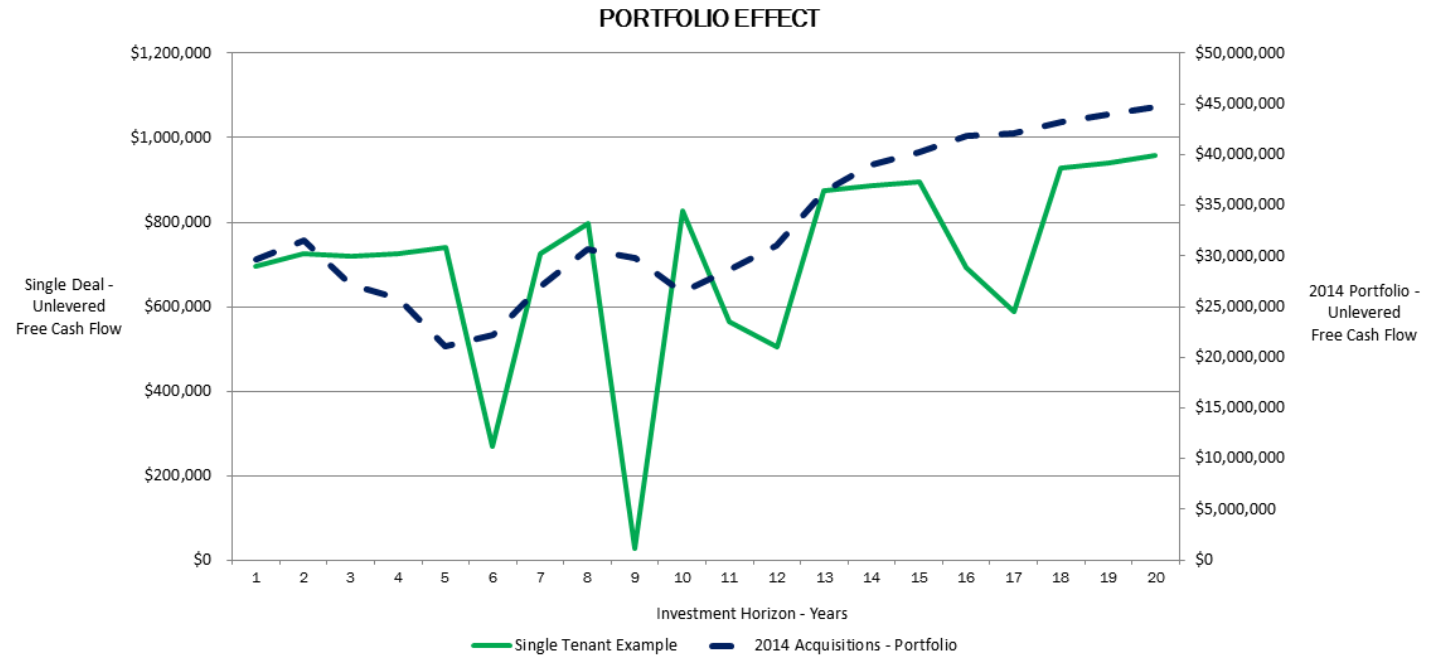
The model builds a property portfolio for the long term and after 10 years of acquisitions if the buying machine is turned off, free cash flow will continue to grow 4% compounded. Finally, STAG’s business model is tremendously accretive. Acquisitions are funded with 60% new equity (shares) issuance and 40% debt to produce a 10.5% return on equity. For each new share issued, an acquisition will produce $2.26 in funds from operations (FFO). This new acquisition cash flow rate is one-third higher than the $1.43 per share of FFO STAG reported in 2014. This system will produce growing cash flow per share, and a growing dividend, which is my primary goal when looking at dividend stocks.



Comments
Log in or sign up to join the conversation.