

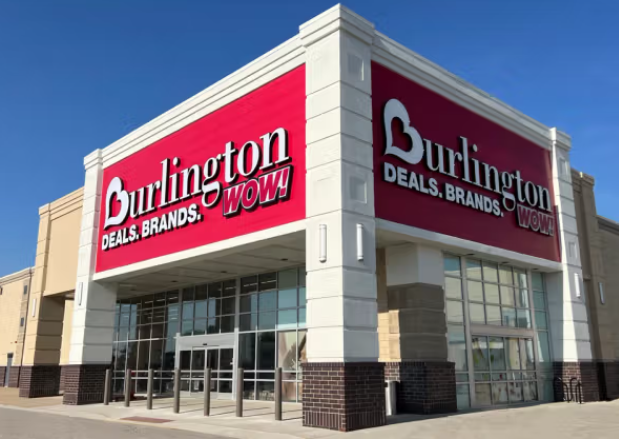
My thesis for Burlington (BURL) is that this store has a long-term plan that is making it much more efficient, so its earnings could continue to grow quickly. Right now, Burlington is benefiting from economic tailwinds because it’s a discount store and shoppers are trading down because of the poor economy. But Burlington was also becoming more profitable a few years ago when the economy was performing better as well.
Burlington highlighted its long-term track record in its Q1 2026 report. This discount store has now posted double-digit EPS growth for 14 quarters, or 3 and a half years in a row. And it posted 26% adjusted EPS growth in the first quarter and expects double-digit EPS growth for the full year of 2026 as well. It might look like Burlington is overvalued at first glance, especially if you’re using trailing metrics, but that’s because investors expect its strong EPS growth to continue. But Burlington’s first-quarter results may also have been an outlier to some extent.
Burlington’s First Quarter Was Unusually Strong
Burlington posted 6% comps in the first quarter, but the store’s performance was unusually strong because many low-income shoppers received larger tax refunds and spent the money on clothing. Burlington now expects 2% to 4% full-year same-store sales growth for 2026, and it also expects weaker second-quarter results.
But this store might also be providing conservative guidance. Last quarter, the store guided for flat EPS growth in Q1 2026, and then it posted 26% adjusted EPS growth. That’s a big difference. Burlington’s adjusted EPS for the quarter was $2.10, so it didn’t post huge percentage gains based on changes in a small number either. For example, if a store guided for $0.04 in EPS and reported $0.05, that’s also a 25% beat. So, Burlington’s long-term plan might be working better than management expected.
Burlington’s Long-Term Efficiency Plan
Burlington is making its stores more efficient. It moved some of its stores into smaller buildings and reduced the size of some of its existing stores as well. It’s also expanding aggressively with new, smaller-format stores. Basically, Burlington is reducing its rent expenses and its margins are expanding as a result. According to Yahoo Finance data, its gross margin rose from 40.6% in FY2022 to 43.9% in FY2025. Its operating margin rose from 4.4% to 7.3% over the same period.
So, even if Burlington doesn’t post strong comps in upcoming quarters, it could still generate double-digit EPS growth over the long term because its costs will be lower. Of course, by relocating some of its stores to strip malls that have higher traffic, it could continue to grow its revenue as well. Burlington’s smaller-format stores give the company more flexibility, so its relocated stores will probably be in better locations.
Peer Comparison for Burlington
It might be useful to compare Burlington’s efficiency to its peers’ efficiency. Burlington reported 33.9 million feet of selling square footage in its 2025 10-K. The company’s revenue was $11.567 billion, so its revenue per square foot was $341. In 2025, Ross (ROST) reported revenue of $22.751 billion and had 45.1 million square feet of selling space, so its revenue per square foot was $504. TJX (TJX) has multiple segments, so you have to add up data for each segment to get its total selling space. According to its 2025 10-K, its selling square footage was 60 million for Marmaxx, 20 million for HomeGoods, 12 million for TJX Canada, and 15 million for TJX International. That adds up to 109 million square feet. TJX also posted $60.372 billion in total revenue for 2025, so its revenue per square foot was $554.
Basically, Burlington still isn’t as efficient in terms of sales per square foot as its larger rivals, but it’s trying to close the gap. The bull case for Burlington is that its strong EPS growth will continue as it gradually improves its performance. But bears can also point out that it could be hard for Burlington to compete against other discount stores that are more efficient. Right now, all of the discount stores are in a good position because they’re capturing shoppers who are trading down from higher-priced department stores, so Burlington could still grow even if it’s less efficient than TJX or Ross.
My 2026 Projection for Burlington
Again, Burlington’s 2025 revenue was $11.567 billion. Burlington posted 14% revenue growth in the first quarter, but that strong result might be an outlier because of tax refunds. Burlington guided for 9% to 11% full-year revenue growth in 2026, and I think the midpoint of 10% revenue growth is realistic. Burlington is adding new stores, but its new stores are smaller as well, so I can’t just assume a constant uplift from new stores here.
Meanwhile, Burlington is still getting more efficient. Burlington also guided for its adjusted EBIT margin to rise by 10 to 30 basis points in 2026, but that might be a conservative estimate. Its EBIT was $887 million for FY2025, so its EBIT margin was 7.7%. In FY2024, it reported $744 million in EBIT with $10.635 billion in revenue, so its EBIT margin was 7.0%. So, its EBIT margin rose by 70 basis points in FY2025. And it sounds like Burlington is still building small stores and reducing the size of its existing stores, so its margins could continue to improve in FY2026.
So, I’d project that Burlington could report 10% full-year revenue growth in 2026, and its EBIT margin could also rise by 70 basis points again. That would result in a full-year EBIT margin of 8.4%. And Burlington would report $12.724 billion in revenue with an EBIT of $1.069 billion. Burlington expects its tax rate to be 25% in 2026, so its net income would be $802 million. It also guided for a diluted share count of 64 million in its Q1 2026 report, so its EPS for 2026 would be $12.63.
Analysts expect Burlington to report $11.78 in EPS for FY2026, according to Yahoo! Finance. So, with a share price of $321, Burlington is trading at a FY2026 P/E of 27. With EPS of $12.63 and a P/E of 27, my one-year price target would be $341. So, my price target is 6% higher than the current price. And Burlington has also beaten EPS estimates for the past 4 quarters, according to Yahoo! Finance. So, projecting that this store will beat bottom-line estimates in upcoming quarters as well doesn’t seem like a stretch to me.
Conclusion
Burlington has made significant improvements over the past few years and its EPS has consistently grown at double-digit rates. This is primarily because it’s using new, smaller-format stores to reduce its lease costs. While Burlington still isn’t operating as efficiently as its peers, based on sales per square foot data, this also means that it has more room to improve its performance as well. So, if Burlington can continue to improve its margins by reducing its rent costs, it might be slightly undervalued even though it’s an expensive stock right now.


Comments
Log in or sign up to join the conversation.