

Are they keratosis pilaris (KP)? Folliculitis? "Butt acne"? Ingrown hairs? Or simply irritated hair follicles from shaving, sweating, or friction?
The answer matters because these conditions can look similar but may respond to very different skincare approaches.
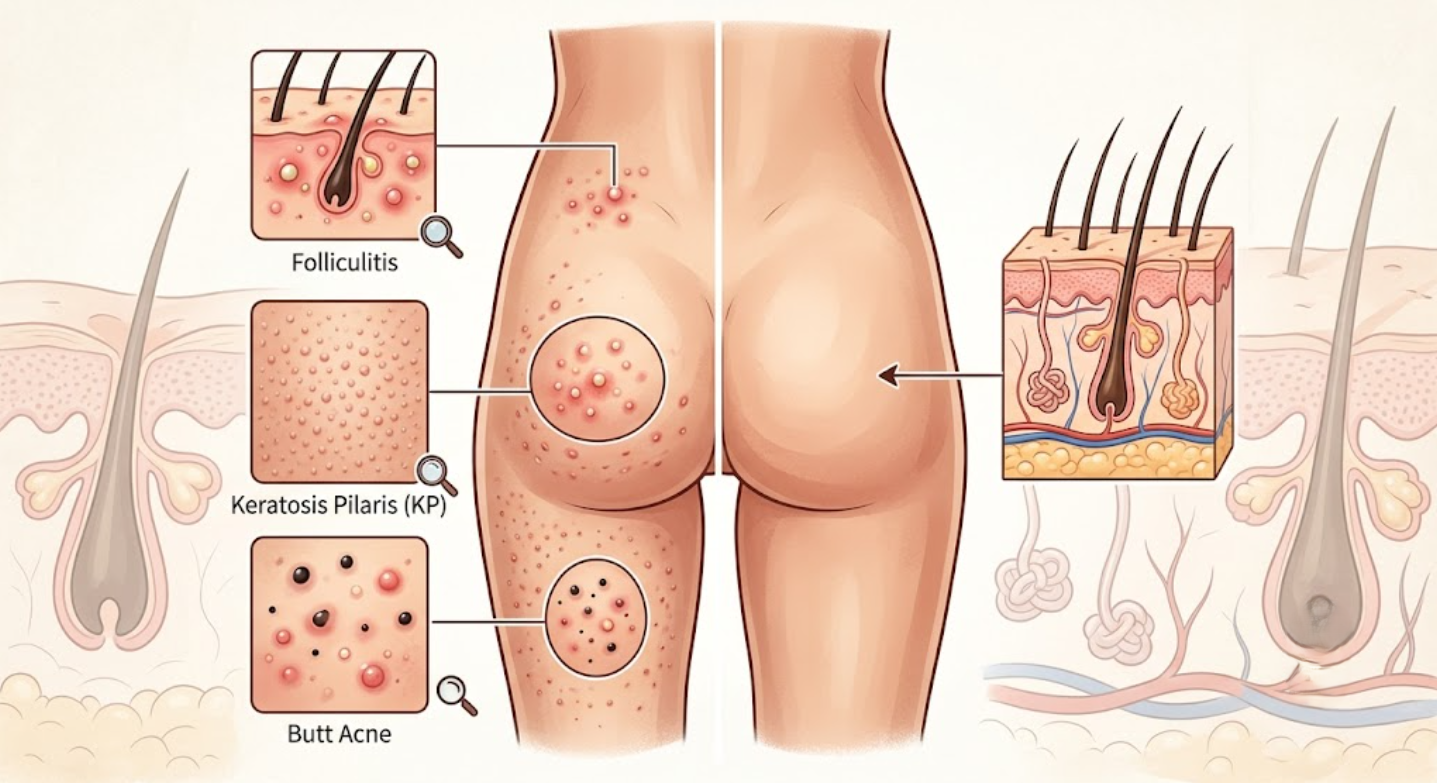
For example, keratosis pilaris typically produces small, rough, dry bumps around hair follicles and commonly affects the upper arms, thighs, and buttocks. Folliculitis, by comparison, involves irritated or infected hair follicles and can look more like a sudden acne breakout, sometimes with redness, itching, pain, or pus-filled bumps.
And what people call "Butt Acne" isn't always acne at all. Folliculitis and keratosis pilaris are actually common causes of acne-like bumps on the buttocks.
Understanding the differences can help you avoid using the wrong products—or making the bumps worse by over-scrubbing.
Quick Answer
Small, rough, uniform bumps on the thighs or buttocks are often consistent with keratosis pilaris, while red, inflamed, itchy, painful, or pus-filled bumps around individual hair follicles are more suggestive of folliculitis. True acne can also occur on the buttocks, but many cases called "butt acne" are actually folliculitis or KP.
If bumps are deep, painful, repeatedly drain, scar, or form tunnels beneath the skin, they should be evaluated by a dermatologist because conditions such as hidradenitis suppurativa can sometimes resemble acne or folliculitis.
Key Takeaways
Keratosis pilaris creates small, rough, follicular bumps and commonly affects the thighs and buttocks.
Folliculitis involves inflamed or infected hair follicles and may produce red, itchy, tender, or pus-filled bumps.
"Butt acne" isn't necessarily acne; folliculitis is a common cause of acne-like bumps on the buttocks.
Friction, tight clothing, shaving, waxing, and sweating can contribute to follicular irritation.
KP usually feels rough and dry rather than looking like conventional pimples.
Gentle exfoliation and moisturization can help manage KP.
Folliculitis may require a different approach depending on whether irritation, bacteria, fungi, or another trigger is involved.
Avoid picking, squeezing, or aggressively scrubbing bumps.
Persistent, painful, spreading, or recurring bumps deserve professional evaluation.
Why Do I Have Bumps on My Thighs and Buttocks?
The thighs and buttocks are particularly prone to bumps because they contain many hair follicles and are exposed to several potential triggers.
These include:
friction
sweating
tight clothing
prolonged sitting
shaving
waxing
exercise
clogged follicles
dry skin
keratin buildup
bacterial or fungal overgrowth
The location alone doesn't tell you what the condition is.
The appearance, texture, symptoms, and pattern provide much more useful clues.
Keratosis Pilaris: Small, Rough "Chicken Skin" Bumps
Keratosis pilaris, often called "chicken skin," occurs when dead skin cells and keratin build up around hair follicles.
It commonly appears as many small bumps that can feel:
rough
dry
grainy
sandpaper-like
The American Academy of Dermatology notes that KP commonly affects the upper arms, thighs, and buttocks.
What Does KP Look Like?
KP bumps can be:
skin-colored
white
pink
red
brownish
darker than the surrounding skin
The color can vary significantly depending on your natural skin tone.
The bumps are usually relatively small and uniform.
Rather than looking like individual pimples, they often create a generalized rough texture.
What Causes KP on the Thighs and Buttocks?
KP develops when keratin blocks hair follicles.
The exact reason some people develop these plugs more readily isn't completely understood, but genetics play an important role.
Dry skin can also make KP more noticeable.
This is why people may notice their KP becoming worse during:
cold weather
dry weather
periods of low humidity
frequent hot showers
What Does KP Feel Like?
One of the easiest ways to distinguish KP from acne is texture.
Run your hand across an area affected by KP and it may feel like:
Fine sandpaper or tiny grains.
The bumps aren't necessarily painful.
They may occasionally itch, but dryness and roughness are often more noticeable than pain.
Folliculitis: When Hair Follicles Become Inflamed
Folliculitis is different from KP.
It occurs when hair follicles become irritated or infected.
The American Academy of Dermatology describes folliculitis as an acne-like breakout that develops in hair follicles.
The bumps may appear:
red
swollen
itchy
tender
painful
pus-filled
They can occur almost anywhere hair grows, including the thighs and buttocks.
What Causes Folliculitis?
Folliculitis can have several causes.
Common triggers include:
Shaving
Shaving can damage or irritate follicles.
Waxing or Plucking
Hair removal can also create follicular irritation.
Tight Clothing
Repeated rubbing can damage follicles and increase irritation.
Sweat and Heat
Warm, damp environments can make follicular irritation more likely.
Bacteria
Bacteria such as Staphylococcus aureus can infect damaged follicles.
Fungi or Other Organisms
Some types of folliculitis have causes other than bacteria.
The appropriate treatment therefore depends on what's causing the folliculitis.
What Does Folliculitis Look Like?
Unlike KP, folliculitis often looks more inflammatory.
You may see:
clusters of red bumps
small pustules
a red ring around individual bumps
itchy spots
tender follicles
sudden breakouts
The bumps may resemble acne.
That's why folliculitis is frequently mistaken for "body acne" or "butt acne."
What Is Butt Acne?
"Butt acne" is a popular term—but it's not necessarily a medical diagnosis.
In fact, many bumps people call butt acne are actually folliculitis or keratosis pilaris.
True acne can occur on the buttocks, but it's important not to assume every pimple-like bump is acne.
The treatment can be completely different.
How Is Butt Acne Different From Folliculitis?
True acne involves clogged pores and inflammatory acne lesions.
Folliculitis centers around hair follicles.
They can look similar, particularly when there are many small red bumps.
That's why persistent or unusual breakouts are worth having evaluated rather than simply treating them with increasingly strong acne products.
KP vs. Folliculitis vs. Butt Acne
Here's a simple comparison:
Feature | Keratosis Pilaris | Folliculitis | Butt Acne |
Typical appearance | Tiny rough bumps | Red/inflamed bumps | Pimples, blackheads, whiteheads or deeper lesions |
Texture | Rough/sandpaper-like | Inflamed or tender | Acne-like |
Usually centered around follicles? | Yes | Yes | Often involves pores/hair follicles |
Pus common? | No | Can be | Can be |
Itching | Sometimes | Common in some cases | Less characteristic |
Pain | Usually minimal | Can be painful | Can be painful |
Common triggers | Keratin buildup, dry skin, genetics | Friction, shaving, infection | Acne-prone skin, hormones, occlusion |
Common locations | Thighs, buttocks, upper arms | Anywhere with hair | Can occur on buttocks |
This table is a guide, not a diagnosis.
Several conditions can overlap.
Why Thigh Bumps May Be KP
The thighs are one of the classic locations for keratosis pilaris.
If your bumps are:
small
widespread
relatively uniform
rough
dry
not particularly painful
KP may be more likely.
The American Academy of Dermatology specifically identifies the thighs and buttocks among common areas for KP.
Why Buttock Bumps May Be Folliculitis
The buttocks experience considerable:
friction
pressure
sweating
occlusion
contact with clothing
These factors can contribute to follicular irritation.
If you suddenly develop clusters of red or pus-filled bumps after:
working out
shaving
waxing
wearing tight clothing
spending time in a hot environment
folliculitis may be more likely than KP.
Can You Have KP and Folliculitis at the Same Time?
Yes.
This is an important point.
You might have chronic KP creating a rough baseline texture, while shaving, sweating, or friction triggers episodes of folliculitis.
For example:
KP → persistent rough bumps
plus
shaving/friction → inflamed follicles
The result can look much more severe than either condition alone.
Can Friction Cause Thigh and Buttock Bumps?
Yes.
Friction can irritate hair follicles and contribute to folliculitis.
Tight clothing and skin-to-skin rubbing can damage follicles, particularly when the skin is hot and damp.
This is why some people notice more bumps after:
long walks
running
cycling
gym workouts
hot weather
wearing tight leggings
Does Shaving Make These Bumps Worse?
It can.
Shaving can irritate hair follicles and contribute to folliculitis. The AAD lists shaving, plucking, waxing, rubbing, and tight clothing among factors that can damage follicles.
If your bumps repeatedly appear after hair removal, consider changing your technique.
Try:
using a clean, sharp razor
avoiding dry shaving
using shaving gel or cream
shaving gently
avoiding repeated passes over the same area
If shaving consistently causes follicular problems, discuss alternative hair-removal options with a dermatologist.
How to Treat Keratosis Pilaris on the Thighs and Buttocks
If your bumps are consistent with KP, treatment generally focuses on softening keratin buildup and keeping the skin moisturized.
The American Academy of Dermatology recommends gentle exfoliation followed by a keratolytic ingredient and moisturizer as part of at-home KP care.
Useful Ingredients Include:
lactic acid
glycolic acid
salicylic acid
urea
certain retinoids
You don't need to use all of them.
Choose a suitable product and introduce it gradually.
Moisturize Consistently
Moisturization is an important part of KP management.
Look for products containing ingredients such as:
urea
lactic acid
ceramides
glycerin
The AAD recommends applying moisturizer after bathing while the skin is still damp and continuing maintenance once the skin improves.
A strawberry skin lotion or KP-focused body lotion can be useful when roughness and follicular buildup are part of the problem.
Don't Scrub KP Aggressively
It can be tempting to attack rough bumps with:
body brushes
rough loofahs
abrasive scrubs
exfoliating gloves
But aggressive scrubbing can irritate KP-prone skin.
The AAD specifically recommends gentle exfoliation and warns that excessive scrubbing can irritate and worsen KP.
Think controlled exfoliation, not aggressive abrasion.
What About a Strawberry Skin Treatment?
If your thigh bumps also look like strawberry skin, the issue may involve visible follicles, keratin buildup, shaving irritation, or ingrown hairs.
A strawberry skin treatment routine may include:
gentle exfoliation
moisturization
improved shaving habits
avoiding excessive friction
consistent maintenance
Strawberry skin and KP can overlap, particularly when rough follicular texture is present.
Where Does a KP Skin Treatment Fit?
A targeted KP skin treatment is most appropriate when the main concern is:
persistent roughness
small uniform bumps
follicular keratin buildup
dry, sandpaper-like texture
Ingredients such as lactic acid, salicylic acid, glycolic acid, and urea are commonly used in KP care.
If your bumps are instead red, painful, pus-filled, or suddenly appearing, don't automatically assume KP.
A Multi-Active Approach for KP and Strawberry Skin
For people dealing with both keratosis pilaris and strawberry skin, a single basic moisturizer may not address everything.
A targeted routine can combine:
Gentle cleansing
Controlled exfoliation
Daily moisturization
Hair-removal care
Friction reduction
Consistent maintenance
TryStrawberry's Advanced Triple-Acid Complex is designed around exfoliation for rough, follicular skin and can fit into a routine targeting concerns such as KP and strawberry skin.
The goal is to improve the appearance of:
rough bumps
follicular buildup
uneven texture
strawberry skin
It should be used as a skincare product for these concerns—not as a treatment for bacterial or fungal folliculitis.
How to Prevent More Thigh and Buttock Bumps
Whether your bumps are caused by KP, folliculitis, or a combination, a few habits can help.
Change Out of Sweaty Clothes
Don't stay in damp workout clothes longer than necessary.
Choose Breathable Fabrics
Tight, non-breathable clothing can increase heat, moisture, and friction.
Avoid Picking
Squeezing or picking bumps can increase inflammation and pigmentation.
Shower After Exercise
This can help remove sweat and reduce prolonged exposure to heat and moisture.
Be Careful With Hair Removal
If shaving repeatedly triggers bumps, reconsider the technique or frequency.
Moisturize
Dry skin can make KP more noticeable, so consistent moisturization matters.
When Should You See a Dermatologist?
It's worth getting professional advice if:
bumps are painful
they contain significant pus
redness is spreading
bumps keep coming back
they leave significant scars
you develop deep nodules
the area repeatedly drains fluid
over-the-counter care isn't helping
Deep, painful, recurring nodules on the buttocks or inner thighs deserve particular attention. Hidradenitis suppurativa (HS) can cause painful nodules and abscesses in areas where skin touches skin, including the buttocks and upper thighs.
Similarly, folliculitis can sometimes require prescription treatment, especially when an infection is involved.
Frequently Asked Questions
Are bumps on my thighs more likely to be KP or folliculitis?
It depends on their appearance. Small, rough, uniform bumps are more characteristic of KP, while red, inflamed, itchy, tender, or pus-filled bumps are more suggestive of folliculitis.
Is butt acne actually acne?
Not always. Folliculitis and keratosis pilaris are common causes of bumps that people call "butt acne."
Can KP occur on the buttocks?
Yes. The buttocks are one of the common locations for keratosis pilaris, along with the upper arms and thighs.
Can folliculitis occur on the thighs?
Yes. Folliculitis can occur anywhere with hair follicles, including the thighs and buttocks.
Can shaving cause folliculitis?
Yes. Shaving, waxing, and plucking can damage hair follicles and contribute to folliculitis.
What's the best treatment for keratosis pilaris?
There isn't one universal treatment. Common approaches include moisturization and keratolytic ingredients such as lactic acid, glycolic acid, salicylic acid, and urea.
Can a strawberry skin treatment help KP?
Some treatments may overlap because both concerns can involve follicular buildup and rough texture. However, the appropriate routine depends on the actual cause of the bumps.
Should I exfoliate bumps on my buttocks?
If the bumps are consistent with KP, gentle exfoliation may help. If they're inflamed or infected folliculitis, aggressive exfoliation may irritate them further. When in doubt, get the condition identified first.
Why do I get bumps after working out?
Sweat, heat, tight clothing, and friction can irritate hair follicles and contribute to folliculitis. Changing out of sweaty clothing and showering after exercise can help reduce these triggers.
Can KP and folliculitis happen together?
Yes. Someone can have chronic KP and also experience episodes of folliculitis triggered by shaving, sweating, friction, or other factors.
Final Thoughts
Not every bump on your thighs or buttocks is acne.
If the skin feels rough and sandpaper-like, with many small, uniform bumps, keratosis pilaris may be the more likely explanation.
If you're seeing red, itchy, tender, or pus-filled bumps centered around hair follicles, folliculitis may be more likely.
And if you're calling the problem "butt acne," remember that the term can describe several different conditions—including folliculitis and KP.
The distinction matters because the treatment isn't the same.
For KP, consistent moisturization and gentle keratolytic exfoliation can help improve roughness and bumps. For folliculitis, identifying and removing the trigger is important, and some cases require medical treatment.
Most importantly, don't respond to every bump by scrubbing harder.
Identify the pattern, understand the likely cause, and choose a routine that matches the condition.
If bumps are painful, deep, recurrent, draining, or leaving scars, professional evaluation is the safest next step.
Comments
Log in or sign up to join the conversation.