

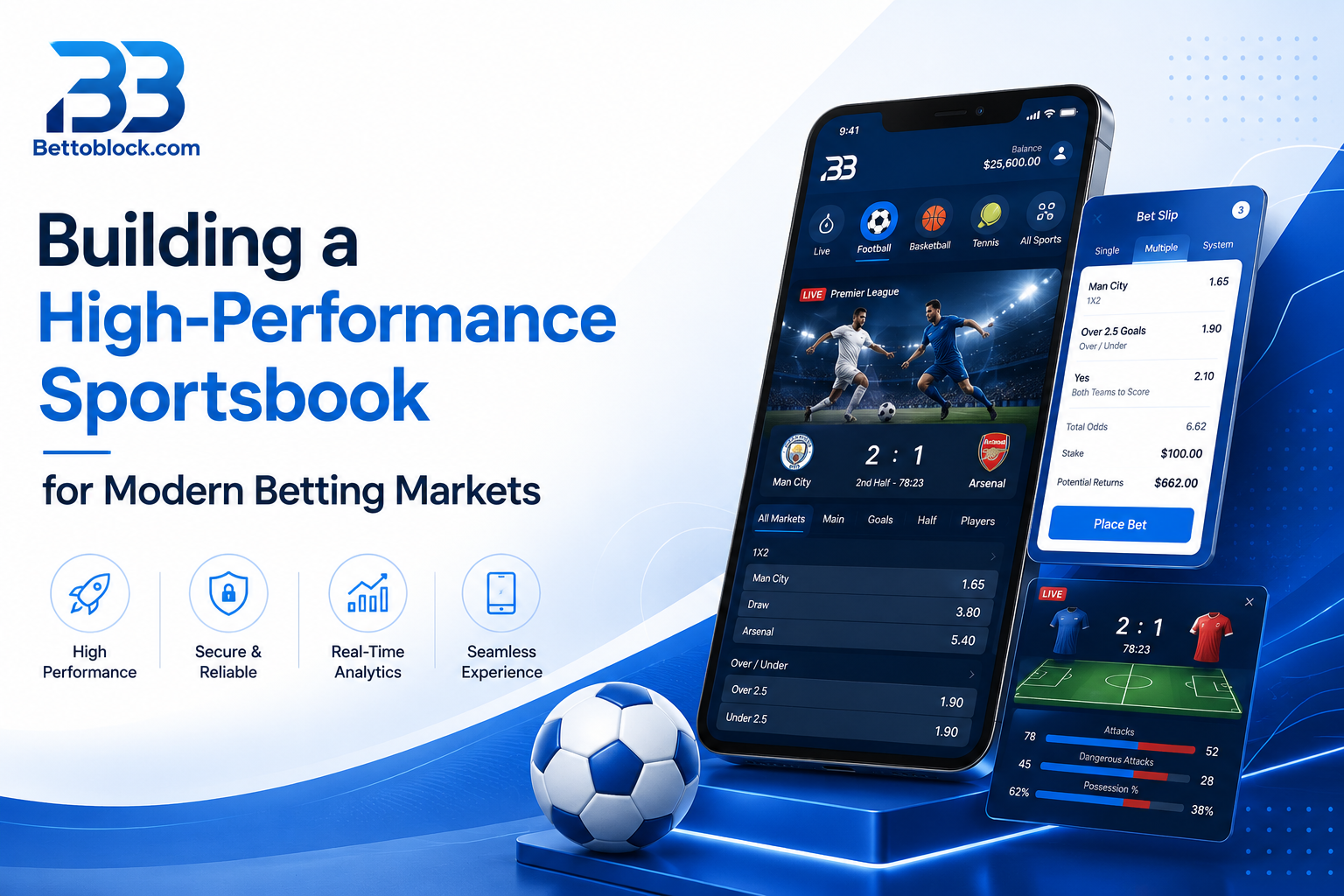
Launching a successful sportsbook requires more than adding betting markets to a website. Operators need a connected technology environment capable of processing live data, handling wagers, managing player accounts, supporting payments, monitoring risk, and delivering consistent experiences across devices.
We build sports betting platforms around these operational requirements. Our development approach connects player-facing features with the systems operators rely on behind the scenes. From real-time odds and live betting to reporting, wallet management, APIs, and administrative controls, every component is planned as part of a unified sportsbook ecosystem.
Building a Sportsbook Around Operator Requirements
Every betting business enters the market with different objectives. Some operators prioritize rapid deployment, while others require extensive customization and control over individual platform components.
Working with experienced White Label Sportsbook providers can give operators access to established betting infrastructure without requiring them to engineer every system independently. We approach these projects by first identifying target markets, expected traffic, sports coverage, payment requirements, languages, currencies, branding needs, and operational workflows.
This preparation helps determine which components should be configured and which require custom development. It also gives us a clearer technical foundation for integrating external services and preparing the platform for day-to-day sportsbook management.
Creating a Distinct Betting Experience
Using established technology does not mean every sportsbook needs to look or operate identically. Branding and user experience remain important parts of establishing a recognizable betting product.
A White Label Sportsbook can be customized around an operator's visual identity while retaining the underlying systems required for sportsbook operations. We can configure layouts, navigation, typography, promotional areas, event displays, bet slips, account interfaces, and other customer-facing elements.
Our focus is on making betting journeys straightforward. Players should be able to move between sports, leagues, competitions, events, and markets without navigating unnecessary steps.
Responsive development also ensures essential functionality remains accessible across desktop computers, tablets, and smartphones.
Bringing Core Sportsbook Functions Together
A modern sportsbook depends on numerous connected systems. Odds feeds need to communicate with event displays. Bet requests need to interact with account balances and risk rules. Results need to trigger settlements, while transactions and player activities need to remain visible to administrators.
Our white label sportsbook solution brings these essential functions into a coordinated technology environment.
Depending on project requirements, platforms can support pre-match markets, in-play wagering, bet slips, multiple bet types, cash-out functionality, player account management, promotions, multi-currency wallets, multilingual interfaces, reporting, and administrative controls.
Centralizing these functions helps operators manage their products without switching between unnecessarily fragmented systems.
Real-Time Odds and Live Betting Performance
Live betting places considerable demands on sportsbook technology because prices and market conditions can change rapidly during an event. Delays between a data feed and the player interface can create poor user experiences and operational challenges.
Current sportsbook offerings across the market prominently emphasize real-time feeds, live odds, automated market controls, settlement systems, and liability monitoring.
We design real-time functionality so updates can move efficiently between data services, backend systems, and player interfaces. Depending on the technical requirements, WebSocket-based communication can support rapid updates without forcing users to refresh their screens repeatedly.
Market suspension logic, bet validation, stake controls, and odds acceptance rules can also be incorporated to give operators greater control over live activity.
Choosing Technology That Supports Operations
Selecting the best Sports Betting Software Provider should involve more than comparing feature lists. Operators need to consider how effectively the underlying technology supports their actual business model.
Important factors include platform reliability, API capabilities, market coverage, risk controls, payment compatibility, administrative functionality, security, localization, and ongoing technical support.
We also consider how much control the operator needs. Some businesses want extensive customization, while others prioritize a more standardized configuration that reduces development requirements.
For operators assessing opportunities in regional markets, our Dubai sportsbook overview provides additional information about sportsbook technology considerations in the UAE.
Managing Risk and Liability
Risk management is a fundamental part of sportsbook operations. Operators need visibility into wagering activity and potential exposure while maintaining efficient bet acceptance processes.
As a Betting Software Provider, we can incorporate tools for monitoring stakes, liabilities, player activity, betting limits, and market exposure.
Administrative dashboards can present relevant information to trading and management teams without requiring them to manually assemble data from multiple sources. Automated rules can also support stake limits, unusual-activity alerts, market controls, and other operational requirements.
The objective is to give sportsbook teams useful information at the point where decisions need to be made while keeping manual controls available where appropriate.
Connecting Sportsbook Technology Through APIs
Sports betting platforms typically rely on several external systems. Sports data, odds feeds, payment services, verification tools, analytics platforms, messaging systems, and other technologies may all need to communicate with the sportsbook.
We use API-driven development to connect these services with core platform functionality. Integration architecture is planned around reliability, security, data consistency, and expected transaction volumes.
APIs can also make it easier to extend a platform as requirements change. New services can be introduced without unnecessarily rebuilding unrelated components of the sportsbook.
Where real-time information is required, we can combine APIs with appropriate streaming technologies to maintain efficient communication between systems.
Building Payment and Wallet Experiences
Deposits, withdrawals, wallet balances, and transaction records form an important part of the sportsbook user journey. Payment friction can affect how players interact with the platform, making integration quality essential.
We can connect appropriate payment gateways according to the operator's market and business requirements. Multi-currency support can also be incorporated for businesses operating across different regions.
Wallet architecture connects player balances with bet placement and settlement processes. When a wager is submitted, the system needs to validate the account, balance, market status, odds, limits, and other relevant conditions before confirming the transaction.
We structure these workflows to maintain clear records for both players and administrators.
Player Management and Back-Office Controls
Operators need more than a polished betting interface. They require back-office systems for managing accounts, payments, bonuses, betting activity, reports, content, and platform settings.
Our work as a Sports Betting Software Provider includes creating administrative environments that provide centralized access to essential operational functions.
Role-based permissions can determine which tools and information individual employees can access. This helps separate responsibilities between support, marketing, finance, trading, and management teams.
Player management systems can also support account status controls, verification workflows, transaction histories, communication, and promotional activity. Reporting functionality then gives teams a clearer view of how players interact with the sportsbook.
Supporting Player Engagement
Promotions can play an important role in sportsbook acquisition and retention strategies. Rather than treating promotions as isolated campaigns, we can integrate them directly into the platform's account and wallet environment.
Depending on the operating model, functionality can include free bets, promotional balances, odds boosts, loyalty mechanics, segmented campaigns, and other configurable incentives.
The administrative side is equally important. Operators need controls for eligibility, validity periods, wagering conditions, campaign monitoring, and promotional performance.
Current sportsbook platforms frequently combine player management, bonus engines, reporting, and marketing functionality within their broader operator stack.
Security and Responsible Platform Development
Sportsbooks process sensitive player and transaction information, so security must be considered throughout development rather than added after launch.
Our approach can include secure authentication, encrypted communication, controlled administrative permissions, API protection, activity logging, transaction monitoring, and infrastructure safeguards.
KYC and AML-related workflows can be integrated according to operator and jurisdictional requirements. Responsible gaming functionality can also be incorporated where required, including configurable account limits, exclusion mechanisms, and other player-protection controls.
Operators remain responsible for determining the licensing, regulatory, and legal requirements applicable to the jurisdictions where they intend to operate.
Mobile-First Sports Betting Experiences
A sportsbook interface needs to work efficiently on smaller screens where navigation space is limited. We therefore design mobile experiences around fast access to events, markets, bet slips, account balances, and important betting information.
Rather than simply shrinking a desktop interface, we consider how player behavior changes on smartphones. Navigation structures, button placement, market presentation, loading behavior, and bet-slip interactions are adapted accordingly.
Performance optimization also receives attention because betting users often interact with rapidly changing markets. Efficient frontend development and data handling help keep the interface responsive during active sporting events.
Custom Development and White Label Technology
There is no single development model suitable for every operator. White-label technology can reduce the amount of engineering required before launch, while custom sportsbook development offers greater control over product architecture and functionality.
We can also combine these approaches. Existing betting infrastructure can handle core functionality while custom interfaces, integrations, workflows, or administrative tools create differentiation where it matters most.
Before recommending an approach, we evaluate launch objectives, budget, technical requirements, intended markets, internal resources, desired ownership, and long-term product plans.
Building Sportsbooks for Long-Term Operations
A sportsbook launch is only the beginning of the product lifecycle. Data services change, payment integrations require maintenance, operating requirements evolve, and player expectations continue to influence product development.
We support sportsbooks through development, testing, deployment, integration management, performance monitoring, updates, and ongoing technical maintenance.
Our objective is to build betting technology that gives operators practical control over their product while providing players with fast and intuitive betting experiences. By connecting real-time data, risk tools, payments, player management, APIs, reporting, security, and responsive design, we create sportsbook platforms designed around the realities of modern betting operations.
Comments
Log in or sign up to join the conversation.