
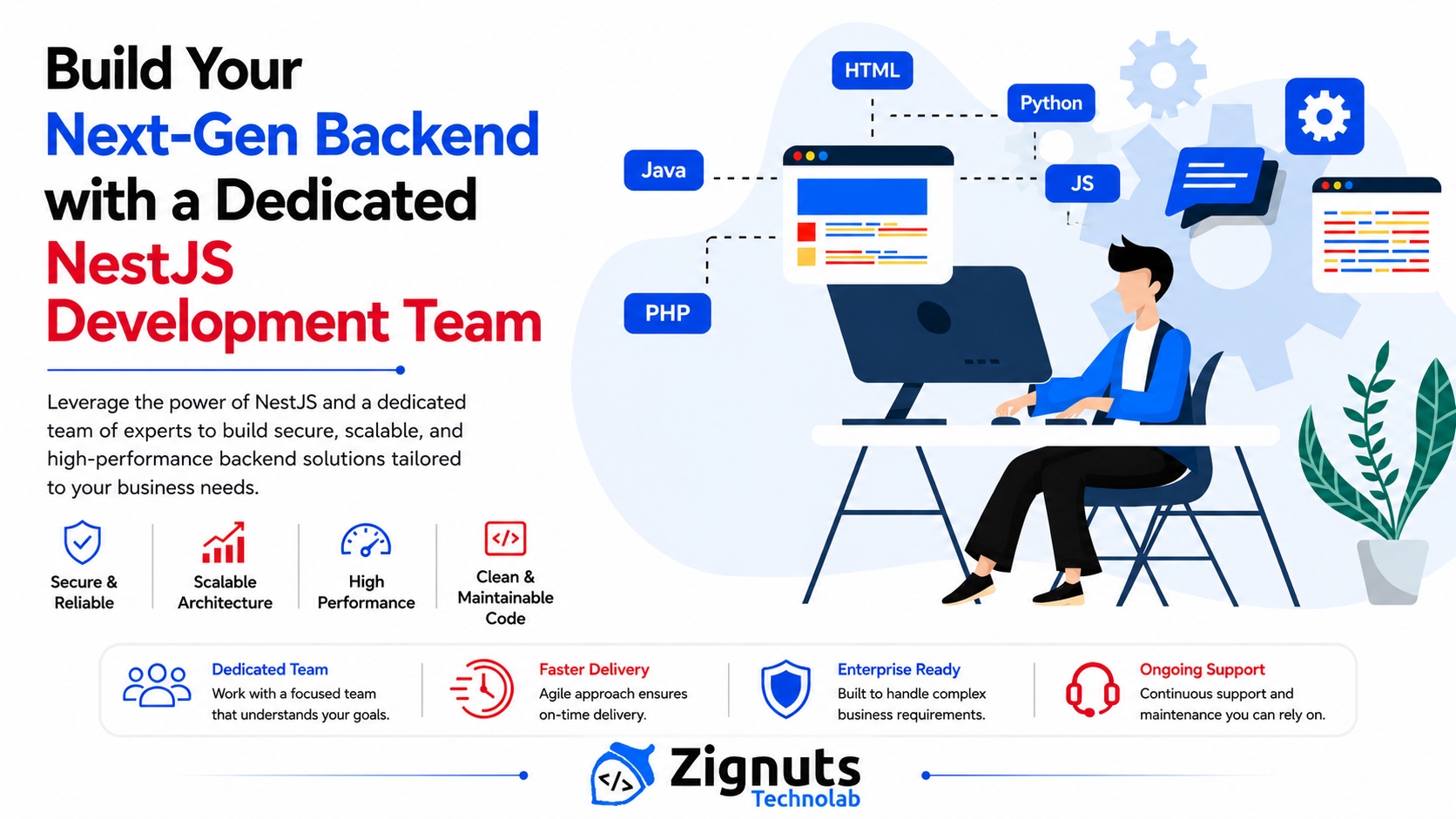
A backend can look perfectly capable when a product has a small user base, a limited feature set, and only a few integrations. The real test begins when the business starts growing. New customers arrive, product requirements multiply, APIs become interconnected, and developers need to make changes without disrupting existing workflows. At that point, adding more developers is not always enough. Businesses need the right engineering structure. This is why many companies choose to hire a NestJS development team, gaining the specialized backend expertise, continuity, and architectural ownership required to build and evolve modern applications.
For founders, C-Suite leaders, and technology decision-makers, the decision is bigger than choosing a development framework. It is about creating a backend capability that can support product growth without allowing technical debt, fragmented ownership, or slow development cycles to become strategic obstacles.
Why Businesses Need a Stronger Backend Strategy
Backend systems are responsible for much of what customers never see but constantly depend on.
Authentication, payments, business rules, databases, APIs, integrations, notifications, permissions, reporting, and data processing all depend on backend services.
When these systems are poorly organized, the consequences eventually reach the business.
A weak backend can lead to:
Slower feature delivery
More production defects
Difficult integrations
Higher maintenance effort
Unpredictable development timelines
Security concerns
Poor application performance
Difficulty onboarding developers
The challenge becomes more serious when the business is simultaneously trying to launch new features and maintain an existing product.
A dedicated team can provide continuity between these two priorities.
Why NestJS Is a Strong Foundation for Backend Development
NestJS is a Node.js framework built with TypeScript and designed around structured application development.
It provides architectural concepts such as modules, controllers, providers, dependency injection, guards, pipes, middleware, and interceptors.
For growing applications, these patterns can help developers establish clear boundaries between different areas of business logic.
That structure becomes especially useful when several engineers work on the same backend.
The value, however, does not come from the framework alone. A poorly designed application can still become difficult to maintain regardless of the framework used.
The development team's architecture decisions, coding practices, testing strategy, database design, security controls, and operational processes determine the actual quality of the final system.
What Is a Dedicated NestJS Development Team?
A dedicated development team is a group of professionals assigned to a specific product or business initiative for an extended period.
Depending on the project, the team may include:
NestJS developers
TypeScript developers
Backend architects
Database engineers
DevOps specialists
QA engineers
Project or product managers
This model differs from hiring individual developers for isolated tasks.
The team develops deeper knowledge of the product, business rules, technical architecture, and long-term roadmap.
That continuity can be valuable for businesses with evolving backend requirements.
The Business Advantage of Team Continuity
One of the hidden costs of software development is repeated knowledge transfer.
When different developers work on the same backend for short periods, each transition can require time to understand:
Existing architecture
Business rules
Database relationships
API contracts
Deployment processes
Security requirements
Technical decisions
A stable team reduces repeated context switching.
Developers can build institutional knowledge around the product and identify architectural problems earlier.
For executives, this can translate into more predictable development and better long-term ownership.
Building a Backend Around Business Domains
A next-generation backend should reflect the way the business actually operates.
For example, an e-commerce platform may have separate business domains for:
Customers
Products
Inventory
Orders
Payments
Shipping
Notifications
A dedicated NestJS team can organize these responsibilities into maintainable modules and services.
The objective is not to create as many components as possible. It is to establish logical boundaries that make the system easier to understand and change.
Where a Dedicated NestJS Team Can Create Value
SaaS Businesses
SaaS companies frequently evolve their products based on customer feedback.
They may introduce subscriptions, permissions, integrations, analytics, reporting, automation, and new workflows.
A dedicated team can continuously develop these capabilities while maintaining the existing platform.
E-Commerce
E-commerce businesses depend on reliable backend workflows for product catalogs, inventory, checkout, orders, payments, and customer accounts.
A dedicated team can focus on improving these workflows while preparing the backend for future requirements.
Financial Technology
Financial applications often require careful attention to transactions, permissions, authentication, auditability, and data integrity.
A dedicated team can maintain consistent engineering practices across these sensitive backend workflows.
Enterprise Software
Enterprise applications frequently need integration with existing systems and internal platforms.
A long-term development team can build knowledge of these dependencies and manage them as the business evolves.
A Dedicated Backend Development Workflow
Business Requirements → Architecture Planning → NestJS Development → API & Database Integration → Testing & Security → Deployment → Continuous Improvement
This model creates an ongoing development cycle rather than treating backend development as a one-time project.
Each stage should remain connected to business objectives.
Why Architecture Ownership Matters
A backend becomes difficult to manage when no one has clear responsibility for architectural decisions.
A dedicated team can establish ownership around:
Application structure
API standards
Database strategy
Security patterns
Testing practices
Deployment processes
Monitoring
Technical documentation
This does not mean executives should surrender technology ownership.
Leadership should still define business priorities, budgets, risk tolerance, and expected outcomes.
The development team should translate those priorities into sustainable engineering decisions.
The Financial Perspective
A dedicated development team is an investment, so the business case should be measurable.
Potential benefits include:
Faster feature development
Reduced developer turnover impact
Lower repeated onboarding effort
More predictable delivery
Better code maintainability
Faster issue resolution
Consistent technical knowledge
Greater flexibility to scale development capacity
The actual return depends on project complexity and team quality.
Businesses should therefore establish metrics before the engagement begins.
Useful indicators may include feature delivery time, defect rates, production incidents, development throughput, infrastructure costs, and maintenance effort.
Dedicated Team vs Short-Term Development
Short-term development can be effective for clearly defined projects with limited future changes.
A dedicated team becomes more attractive when the product requires continuous development.
Consider a company that expects to add new integrations every quarter. A rotating team may repeatedly spend time understanding the existing backend before implementing each requirement.
A dedicated team already familiar with the architecture can potentially begin from a stronger position.
The choice should depend on the product roadmap rather than simply the preferred hiring model.
How to Select the Right NestJS Team
Evaluate Architecture Experience
Ask how the team approaches modular architecture, service boundaries, databases, integrations, and scalability.
Examine Production Experience
A developer who has only built prototypes may not be prepared for production concerns.
Look for experience with monitoring, logging, deployment, security, performance, and incident resolution.
Assess Communication
A dedicated team must communicate clearly with product owners and business stakeholders.
Technical knowledge without effective communication can create project friction.
Review Testing Practices
Ask how the team handles unit testing, integration testing, end-to-end testing, regression prevention, and automated quality checks.
Understand Documentation
The team should document architecture, APIs, deployment procedures, and important technical decisions.
Security Should Be Built Into the Development Process
Backend security should not be added after the application is complete.
The development team should consider:
Authentication
Authorization
Input validation
API protection
Secrets management
Dependency security
Encryption
Logging
Access control
Secure deployment
Businesses handling sensitive information should also identify applicable privacy and compliance obligations early.
Avoiding the Microservices Trap
A dedicated NestJS team may have experience with microservices, but that does not mean every product needs them.
For some businesses, a well-structured modular monolith is more practical.
Microservices can introduce:
More infrastructure
More deployment complexity
Distributed communication
Additional monitoring requirements
Data consistency challenges
The architecture should be based on actual business requirements.
A good development team should be willing to recommend simplicity when simplicity is appropriate.
A Practical Implementation Plan
Step 1: Define the Business Roadmap
Identify upcoming features, integrations, customer requirements, and growth expectations.
Step 2: Assess the Current Backend
Document technical debt, architecture problems, performance issues, security risks, and integration dependencies.
Step 3: Build the Right Team
Select developers and specialists according to the actual project requirements.
Step 4: Establish Architecture Standards
Define coding standards, API conventions, testing requirements, security practices, and deployment workflows.
Step 5: Prioritize High-Impact Improvements
Start with backend areas that create measurable business or operational value.
Step 6: Establish Continuous Monitoring
Track application performance, errors, infrastructure behavior, and customer-impacting issues.
Step 7: Review Progress Regularly
Evaluate both technical and business metrics to determine whether the team is delivering the expected value.
Common Mistakes Businesses Should Avoid
Hiring Only for Framework Knowledge
Knowing NestJS is useful, but backend architecture requires broader engineering expertise.
Ignoring Business Context
Developers need to understand why a feature matters, not only how to implement it.
Measuring Only Lines of Code
More code does not mean more business value.
Skipping Documentation
A dedicated team should make the organization less dependent on individual developers, not more dependent.
Building Too Much Too Early
Future requirements should influence architecture, but they should not justify unnecessary complexity.
Treating Security as a Final Phase
Security needs to be incorporated throughout development.
What Executives Should Ask Before Hiring
Before approving a dedicated NestJS development team, leadership should ask:
What backend problems are affecting the business today?
What outcomes should the team deliver?
Which systems need integration?
What technical debt needs immediate attention?
How will security be managed?
What development capacity is required?
How will the team's performance be measured?
Who owns architectural decisions?
How will knowledge be documented?
How will the solution evolve as the business grows?
These questions create a clearer connection between technology investment and business objectives.
Measuring Long-Term Success
A dedicated team should be evaluated through outcomes rather than activity.
Useful metrics can include:
Time required to deliver new features
Production defect frequency
API performance
Deployment reliability
Technical debt reduction
Developer onboarding time
Integration delivery time
Customer-impacting incidents
Infrastructure efficiency
The appropriate metrics will vary by business model.
The important point is to establish measurable expectations before development begins.
Conclusion
A next-generation backend is not created by technology alone. It requires architectural discipline, experienced developers, clear ownership, strong security practices, reliable testing, and a development process connected to business objectives.
NestJS provides a structured foundation for modern Node.js and TypeScript backend development, while a dedicated development team can provide the continuity needed to evolve that foundation over time.
For businesses with an active product roadmap, complex integrations, or growing backend requirements, a dedicated NestJS development team can be more than an outsourced coding resource. It can become an extension of the organization's product and engineering capability.
The smartest approach is to start with the business problem, define measurable outcomes, select the right expertise, and build the backend incrementally around real requirements.
FAQs
1. What is a dedicated NestJS development team?
A dedicated NestJS development team is a group of developers and related specialists assigned to continuously work on a company's backend or product. The team typically develops deeper knowledge of the architecture and business requirements over time.
2. Why choose a dedicated team instead of individual developers?
A dedicated team can provide broader expertise, continuity, shared product knowledge, and more consistent development practices. It can be particularly useful for products requiring ongoing backend development.
3. Is NestJS suitable for large backend applications?
NestJS can be used for large applications when supported by appropriate architecture, infrastructure, database design, security, testing, and monitoring.
4. What skills should a dedicated NestJS team have?
A strong team should have expertise in NestJS, TypeScript, API development, databases, security, testing, cloud infrastructure, DevOps, monitoring, and system architecture.
5. How much control does a business retain with a dedicated development team?
The business can retain control over product priorities, roadmap decisions, security expectations, budgets, and business requirements. The development team handles technical implementation and provides engineering recommendations.
6. Can a dedicated NestJS team modernize an existing backend?
Yes. A team can assess an existing backend, identify technical debt, improve selected components, strengthen testing and security, and gradually modernize the architecture.
7. How should businesses measure a dedicated team's success?
Businesses can measure feature delivery speed, reliability, defect rates, performance, maintenance effort, integration delivery, technical debt, and other metrics connected to their strategic objectives.
Comments
Log in or sign up to join the conversation.