

Here's a doozy. Nicolai Tangen, who is the head of Norway's sovereign wealth fund, is very concerned about the economic fallout from the war in Iran. He's modeling a 49% decline for the fund's equity sleeve and a 37% decline for the fund overall. That doesn't appear to be a prediction; it appears to be one possible outcome out of many from an analysis they ran.
Here's an even bigger doozy from Ted Seides, who says the S&P 500 is broken as a benchmark due to concentration issues primarily, but that the concentration causes other problems that skew passive versus active investing. Something is just off because of how badly passive is beating active; it doesn't make sense in terms of magnitude or persistence, he said.
He notes single stock volatility is pretty much at an all-time high, which helps the largest tech companies dominate the index. He also said there is more chop at the sector level, too. The 44% in tech plus communications should cause us to "rethink what that means for portfolio construction and performance measurement."
We've talked before about the tech sector tending to outperform the broader index in both directions most of the time. If the S&P 500 is broken because too much is in tech and communications and too much is in just ten companies, then that causes all sorts of problems with portfolio performance measures for larger pools of capital like mutual funds and hedge funds. At some weighting to tech stocks, you've got these types of vehicles benchmarking to the tech sector, not a diversified index. Ted's context included the extent to which the industry is entrenched, deriving alpha versus the S&P 500, the index is used for beta, and although not part of the formulas for Sharpe Ratio and Standard Deviation, the index is the comparison.
"Equity market exposure should provide broad-based, diversified, liquid exposure to economic growth. Today’s S&P 500 ignores most sectors in the economy, while favoring sectors that have been winning and are highly exposed to the future of AI."
"In today’s equity markets, diversification no longer resides in the cap-weighted S&P 500."
This is less of an issue for advisors. If a portfolio is doing what the client needs in terms of risk/volatility tolerances, kicking off a sustainable income if needed, and capturing growth, then that is what matters. So from that perspective, benchmarking an advisory client to the S&P 500 is fine. My clients have nowhere near 44% in tech and communications; that is a lot of potential risk that is easily avoided. There's no way to know if there will ever be a consequence for that risk, but the risk is there all the same.
If something terrible happens to the broad index, it seems pretty logical to think it will be tech plus communications that will take the worst of it because that is often how it goes, but a little more bottom up, there are plenty of signs of current excess with those two sectors.
You've probably heard of the Invesco S&P 500 Equal Weight ETF (RSP), which, as the name implies, gives equal weights to all 500 constituents of the index, so Nvidia (NVDA) has the same weight as Organon (OGN). Less talked about, though, is the ALPS Equal Sector Weight ETF (EQL). I wrote about this fund when it first came out in 2009 for TheStreet.com.
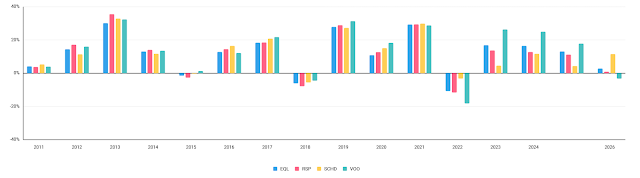
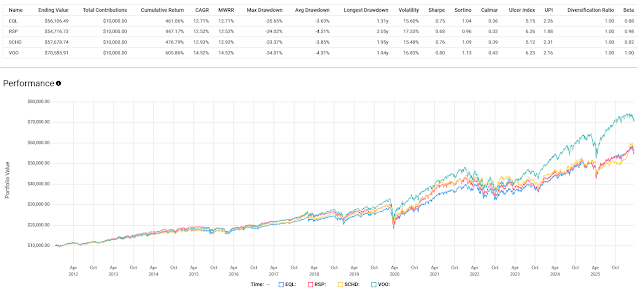
According to my article in 2009, tech's weighting (which included communications back then) in the S&P 500 was 18% versus 44% for those two now. RSP now has a combined 17.1% in those sectors. After rebalancing, EQL's weight to the two is 18.18%. The chart shows differentiation between RSP and EQL versus the S&P 500, and I threw in SCHD, which only has 13.5% in tech plus communications. You can see they started out similar, but then VOO pulled away as tech started to outperform at an accelerating rate. If tech continues to rip, then yeah, RSP, EQL and SCHD will fall further behind, but if the idea is not wanting to be front and center to a tech implosion while still using broad-based index funds, these should be looked at.
Strategically, I think this is where capital efficiency in terms of leveraging down could come into play. This space is evolving. Quite a few providers offer funds that leverage up like the ReturnStacked Funds which tend to be 100/100, WisdomTree (WT) has several that are 90/60 along with a couple of others that are 90/90, Simplify has a couple, Unlimited has a couple that target twice the volatility, and there are some one offs out there where I bet the providers will increase their offerings.
The latest one that came out this week is the WisdomTree Efficient US Plus International Equity Fund (NTSD), which is 90% domestic and 60% foreign. For an equity allocation, a 67% allocation to NTSD with 33% in cash could equal 100% of an unleveraged equity allocation with no cash leftover. There might be a slight performance dispersion one way or another, but whatever happened to equities, 33% would be sitting there in cash. If the 60 domestic /40 foreign equity sleeve fell 30%, then you'd expect NTSD to fall 45%. With 33% in cash, the dollar consequence would be the same, but the cash would just be sitting there.
That strategy wouldn't address the index concentration issue, but for a $100,000 equity allocation, there'd only be $67,000 exposed to risk assets.
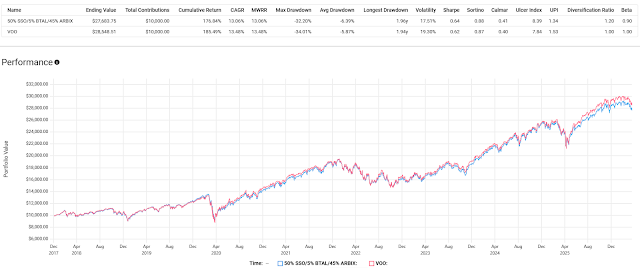
We've looked at examples like this before. With just about every 2X fund, the dispersion between the index and twice the index in a fund is very wide but SSO has been pretty true to capturing twice the S&P 500. As the capital-efficient space evolves, this concept might actually make sense to do.

Comments
Log in or sign up to join the conversation.