


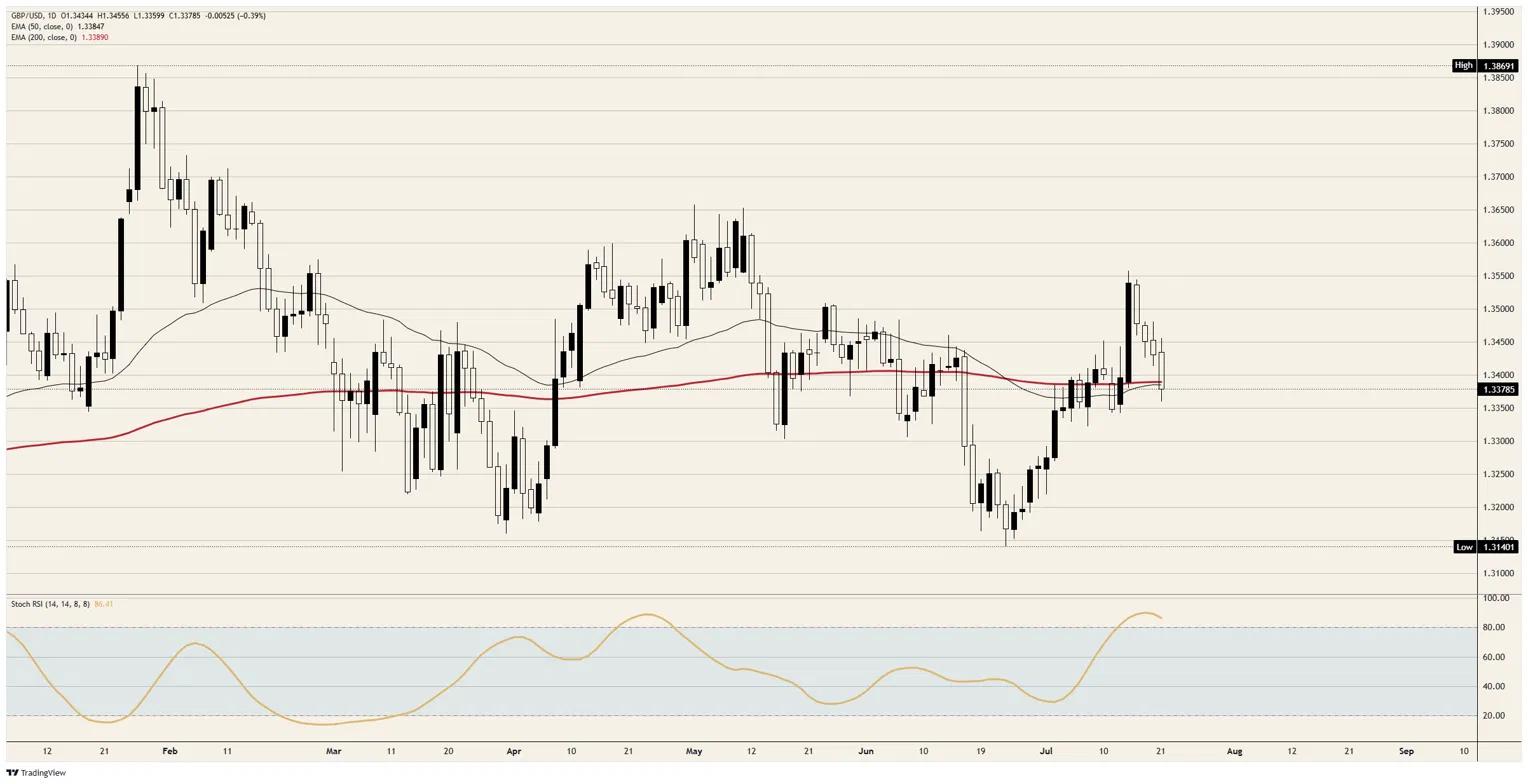
The British Pound received a labour market report on Tuesday that beat consensus on nearly every line, and sold off anyway. Sterling slid from a London morning high just above 1.3450 to a New York low just above 1.3350, knifing through the 50-day and 200-day Exponential Moving Averages that sit converged just below 1.3400. GBP/USD trades near 1.3380 late in the session, the weakest of the majors on the day, on track for a fourth consecutive daily decline, and holding its first session beneath both long-term averages since the mid-July rebound began. More than a third of that rebound off the summer base near the 1.3150 area is already gone.
The one number that mattered went the wrong way
On the surface, Tuesday's labour market data argued for a Pound bid rather than a fourth day of selling. Employment rose 147K in the three months to May against 100K prior, the claimant count climbed just 6.7K in June against a 28.3K consensus, and the unemployment rate slipped to 4.9% when the market expected 5%. The blemish sat in the pay figures, where average earnings including bonuses slowed to 4.3% against a 4.5% consensus, extending the cooling trend the Bank of England has spent months waiting for.
Pay is the line the Monetary Policy Committee actually trades on, and the market treated the rest of the report as noise accordingly. The Bank held at 3.75% in June with two dissenters voting for 4.00%, and rate pricing that carried nearly three hikes at the peak of the war panic has deflated to roughly one move to 4.00% over the coming months. Every wage print that cools chips away at what remains of that premium, and the premium is most of what has been holding Sterling up through a war-bid Dollar.
A new Prime Minister and the same old Dollar
The political layer is not helping matters, because Andy Burnham is newly installed in Downing Street and markets are still waiting for the cabinet list and fiscal arithmetic that will define his government. That information vacuum keeps the credibility discount on UK assets alive, the third layer of the term premium, debt structure, and political credibility framework this publication has been running since June. A currency already renegotiating its rate premium has little patience left over for an open-ended budget question, least of all one priced in a gilt market that carries the highest long-end yields in the Group of Seven on the bloc's second-lowest gross debt load.
Across the Atlantic, the Dollar keeps collecting a war premium the Pound cannot match. The strike campaign against Iran runs into a tenth consecutive night while a 10-day ceasefire proposal circulates alongside open talk of widening the war, a standoff that keeps Treasury yields and safe-haven demand pointed the same direction. With a Federal Reserve hike fully priced by December and the July meeting only a week away, the Dollar side of this pair holds every card the UK side keeps folding.
An inflation print with the premium on the line
Wednesday's Consumer Price Index at 06:00 GMT is now the whole ballgame for the week. Consensus expects headline inflation to cool to 2.7% YoY in June from 2.8%, with core easing to 2.5% and the monthly rate slowing to 0.1%. A soft print lands directly on the wound the wage data opened, dragging the last priced hike further down the curve, while an upside surprise would hand the hawkish dissenters fresh ammunition and give the Pound its first genuine reason to bounce in a week.
Friday stacks the rest of the risk in one session. June retail sales carry a -0.2% MoM consensus after May's 1.2% jump, and the preliminary July Purchasing Managers Indexes arrive with services already printing 48.8 and the composite at 49.3, both below the boom-bust line. Thursday's consumer confidence reading, seen improving marginally to -21, is the lone sentiment check in between. A currency trading beneath its long-term averages into that kind of docket needs the data to argue on its behalf, and this week's consensus sheet mostly argues the other way.
Technical levels to watch
Resistance: The converged 50-day and 200-day EMAs just below 1.3400 now cap the tape, with Tuesday's rejection high just above 1.3450 behind them and the mid-July peak near 1.3550 the far marker.
Support: The session floor just above 1.3350 is first support, followed by 1.3300, with the summer's line in the sand at the 1.3150 area beneath that.
Bias: Bearish. Four consecutive daily declines through both long-term averages, with a cooling inflation print expected within hours, point toward 1.3300 next, and only a daily close back above 1.3400 puts the recovery case back on the table.
GBP/USD daily chart



Comments
Log in or sign up to join the conversation.