


Ten years ago, the world watched the United Kingdom vote to walk away from the European Union.
While the political class was clutching its pearls and every talking head on television was promising Armageddon by Christmas, I told you something different. I told you that when the establishment panics, the serious investor reaches for gold.
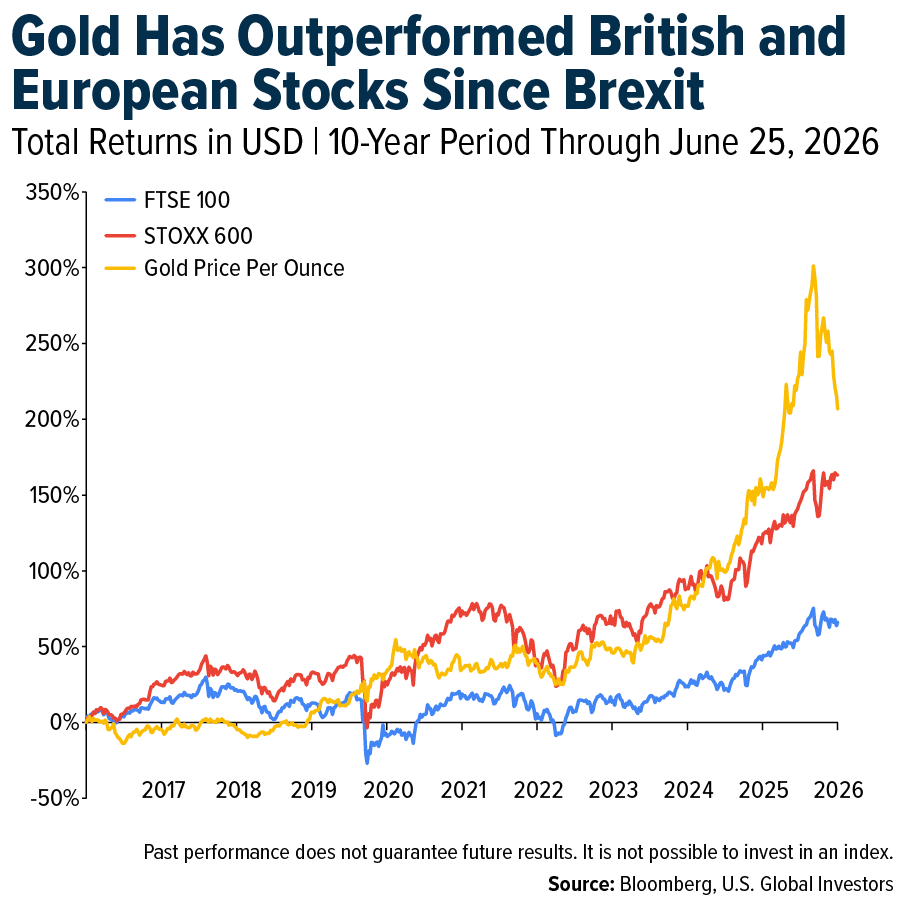
Since the 2016 referendum, the yellow metal has tripled in price. It broke through $5,000 an ounce earlier this year before catching a breather near $4,000.
Over the same stretch, we’ve lived through a once-in-a-lifetime pandemic, two energy crises, a land war in Europe and a trade war. Through all of it, gold has kept its head while governments lost theirs.
To observe Brexit’s 10th anniversary, I’m sharing four lessons, which have almost nothing to do with the UK and everything to do with how you protect your wealth.
#1 – Uncertainty is the Fear Trade’s best friend.
Ten years ago, I couldn’t have told you that a virus would shut down the planet, that Russia would torch Europe’s energy market, or that the UK would cycle through prime ministers like paper towels. Nobody could.
But I didn’t need to. All I needed to know was that we’d entered an age of constant uncertainty, and that gold helped investors manage it.
This is what I’ve long called the Fear Trade. It’s why central banks continue to stock up on bullion. And it’s why I still recommend a 10% weighting in gold, with 5% in physical gold, 5% in gold miners. Boring? Maybe. But the boring trade tripled, outperforming British and European stocks.
#2 – Sometimes sovereignty comes with a cost.
Some critics like to point out that Brexit failed to usher in booming growth, as many people in the Leave camp argued would happen. In fact, a Stanford economist estimated that the British economy is likely 8% smaller today than it otherwise would have been.
That said, I don’t believe Brexit was purely an economic policy. It was a constitutional decision, a vote to reclaim British government and culture from a committee of unelected bureaucrats. As I wrote 10 years ago, “British citizens and businesses have grown fed up with an avalanche of failed socialist rules and regulations from Brussels, responsible for bringing growth and innovation to a grinding halt.”
I appreciate how Michael Caine put it. The legendary British film actor, 93, said in a 2017 interview that he voted for Brexit because he’d “rather be a poor master than a rich servant.”
Ten years ago, Britain elected to be masters instead of servants. Whether you think that was wise or foolish, it’s the one thing that an economist’s spreadsheet can’t measure.
#3 – Don’t forget to collect your dividends.
To reiterate, a post-Brexit, Thatcher-style boom never arrived. But it’s important to understand why it never arrived.
The inconvenient truth is that, after voting to leave the bloc, Britain has barely used the freedoms it fought for. According to the Cato Institute, the UK government still has close to 7,000 European laws on the books. The bonfire of red tape never got lit.
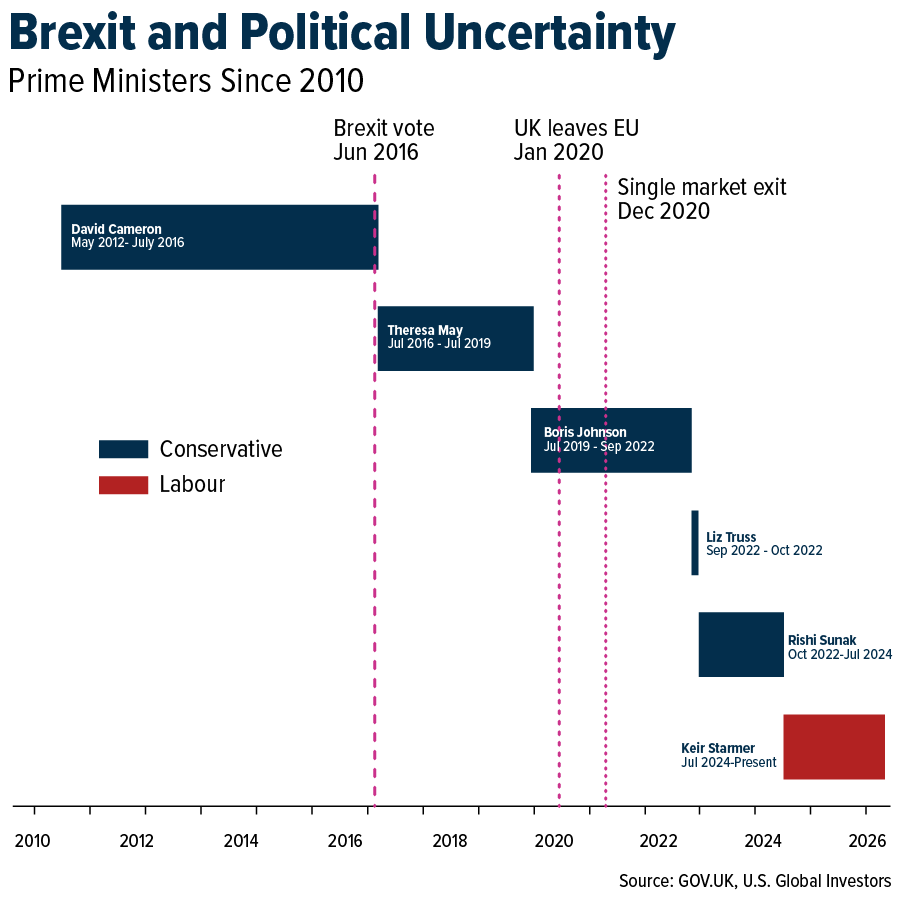
And the political class? It burned through five prime ministers in 10 years, one of whom lasted all of 49 days.
That’s not to say Westminster has been completely idle. They reformed the EU’s strict Solvency II insurance rules, and since the referendum, London’s insurance market has doubled to $187 billion, the largest in the world. The City, London’s financial district—which doomsayers swore would dry up—is instead near record employment, posting record bank profits and ranks as the number two destination for global capital anywhere on the planet, hosting some $16 trillion of it.
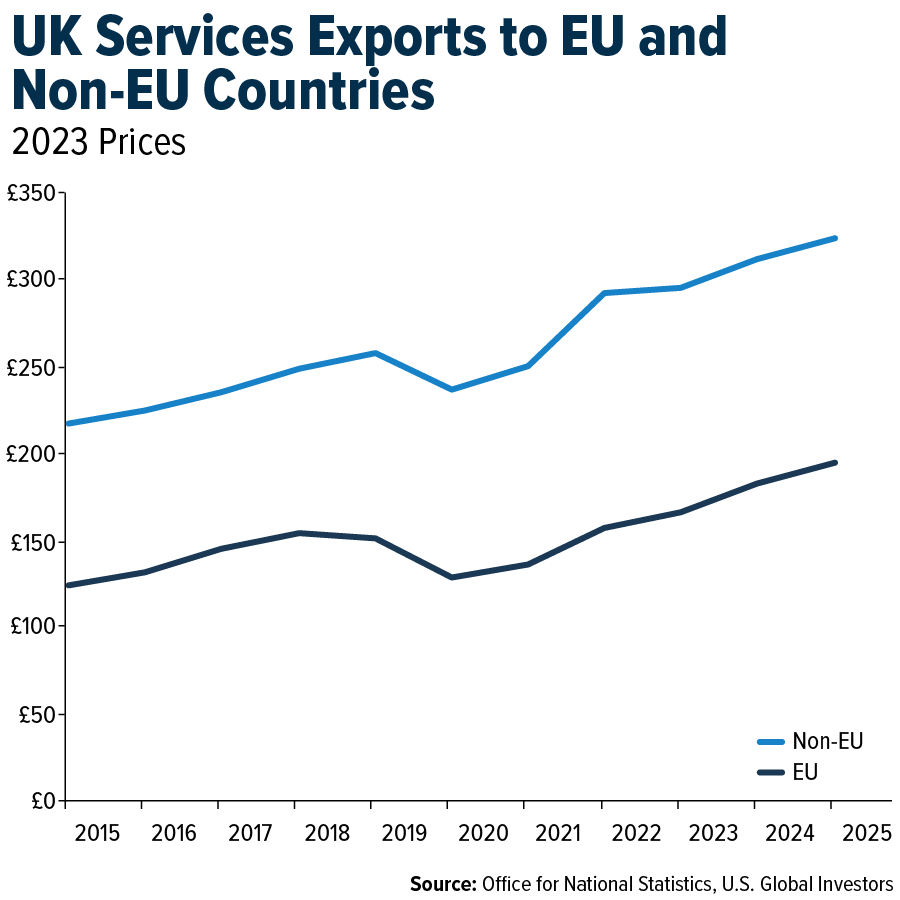
The country’s services sector—financial, business, travel and tourism—has also held up nicely, with exports to EU countries growing approximately 60% from 2015 to 2025.
#4 – The crowd is often loudest right when it’s the most wrong.
Public sentiment can be a fickle thing. According to a recent Ipsos poll, close to 60% of Britons said they would vote to rejoin the EU today. About half say they support a new referendum after the next General Election, which will be held no later than August 2029.
But ask those same people if they’d be fine with the euro, open borders and Brussels’ socialist rules, and the number drops.
Ten years ago, the crowd was screaming that the UK had just committed economic suicide, that a recession was right around the corner. They were wrong then. Today, some in the crowd are now screaming because they have buyer’s remorse, or “Bregret.” Are they wrong now?
I won’t presume to know how people feel. What I do know is that public sentiment is often loudest right at the turns, when it’s about to be proven wrong.
That’s why I think it’s always a good idea to think twice before trading on the noise. The serious investor learns to do the opposite of the mob—to feel a little nervous when the crowd is irrationally exuberant (RIP Alan Greenspan), and vice versa.
Ten years ago, they were screaming about Britain, and today they’re screaming about something else. Gold doesn’t care, and neither should you.

Comments
Log in or sign up to join the conversation.