

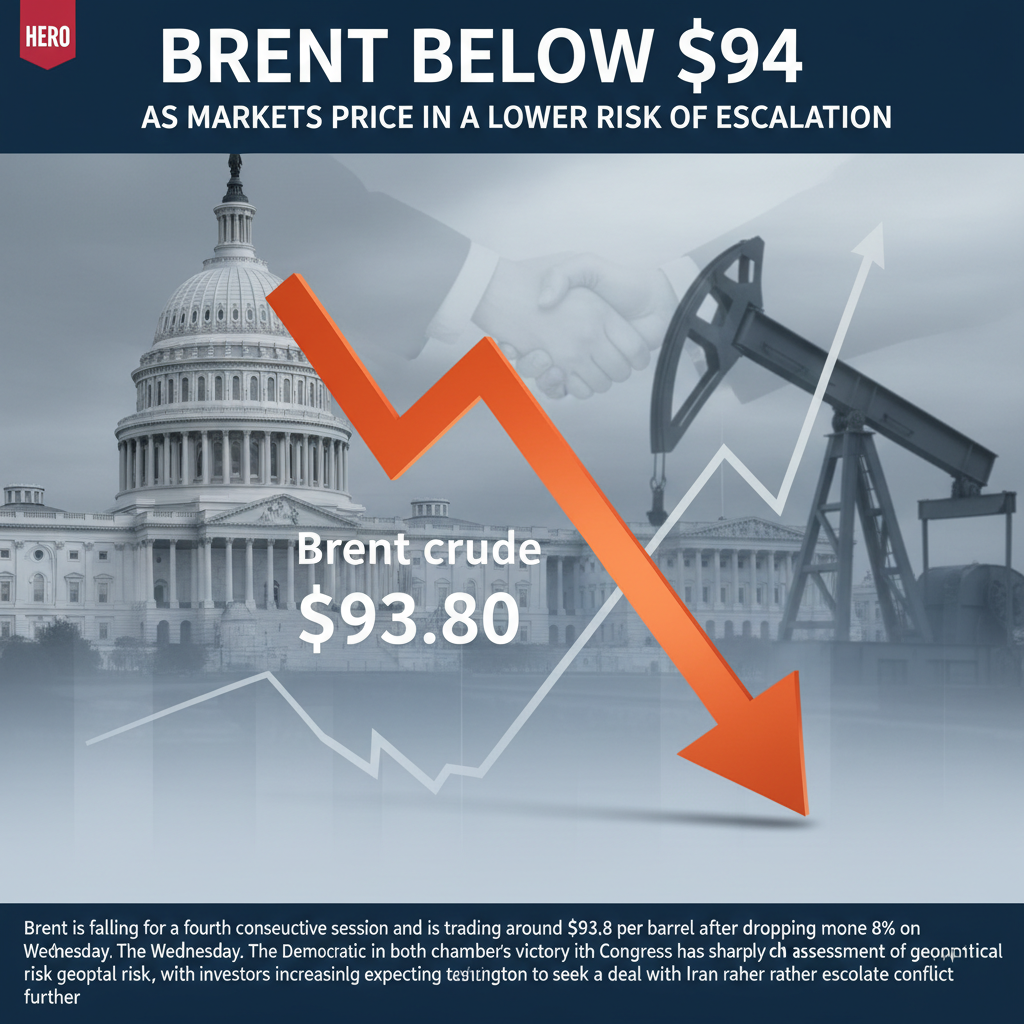
Brent is falling for a fourth consecutive session and is trading around $93.8 per barrel after dropping more than 8% on Wednesday. The Democratic victory in both chambers of Congress has sharply changed the market’s assessment of geopolitical risk, with investors increasingly expecting Washington to seek a deal with Iran rather than escalate the conflict further.
3 Takeaways
Brent has fallen to around $93.8, its lowest level since late August.
Oil is already down roughly 20% this week.
JPMorgan estimates the global oil market was oversupplied by around 1.4 million barrels per day in October.
The oil market is going through one of its sharpest repricings of geopolitical risk in months.
Following the Democratic sweep of both chambers of Congress, investors see a lower probability of further US military escalation against Iran. Donald Trump acknowledged that the war played a role in the Republican defeat, while Vice President JD Vance also pointed to the conflict as one of the reasons behind the party’s poor result.
After dropping more than 8% on Wednesday, Brent continued lower on Thursday and traded near $93.82.
The benchmark has now lost around one-fifth of its value this week. If the decline holds through Friday, it would mark oil’s largest weekly fall since April 2020.
Supply and demand
The physical supply picture has also become significantly less tight.
Crude flows through the Strait of Hormuz have almost recovered to pre-war levels, although logistics and insurance costs remain elevated.
JPMorgan estimates that the global oil market returned to a surplus of around 1.1 million barrels per day in September and 1.4 million in October. That is already close to last year’s average surplus.
US demand data remain relatively resilient. Crude, gasoline and distillate inventories all fell last week, while implied demand reached its highest level in around a year.
This suggests that the current sell-off is being driven mainly by the collapse in geopolitical risk premium rather than by a sudden deterioration in end-user demand.
Geopolitics
Military risk has not disappeared completely.
The new Congress will not take office until January, while the president still retains significant authority over foreign policy.
Eurasia Group estimates the probability of renewed US strikes on Iran at around 60%, while the chance of a comprehensive agreement is seen at only 10%.
A fresh escalation could therefore quickly send Brent back toward the $110–125 area.
Technical outlook
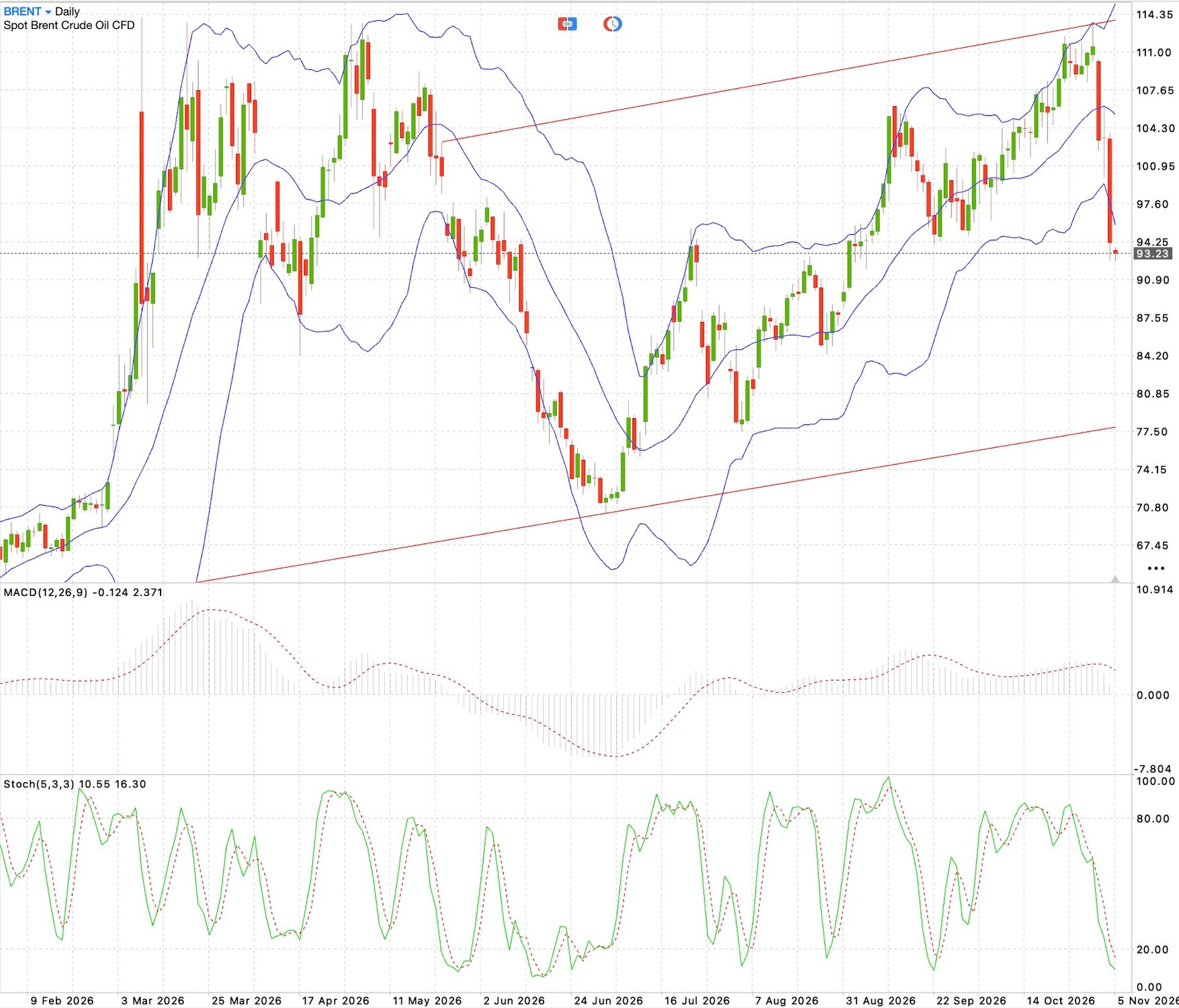
The technical picture has weakened sharply after the break below $100.
Initial support is located around $92–93. Below that, the next key psychological level is $90.
First resistance is now seen around $96–97, followed by the more important $100 area.
For Brent to stabilise, it would need to recover at least the $96–97 zone.
FAQ
Why has Brent fallen so sharply?
The market has sharply reduced the probability of further escalation with Iran after the Democratic midterm victory, while Middle Eastern supply has continued to recover.
Is the oil market now oversupplied?
According to JPMorgan, the global market moved into a surplus of around 1.4 million barrels per day in October.
Can Brent quickly return above $100?
Yes, if diplomacy breaks down and the US or Iran returns to large-scale military escalation.


Comments
Log in or sign up to join the conversation.