

Controlling vehicle entry is becoming increasingly important for commercial buildings, industrial facilities, residential communities, parking areas, and secured properties. Organizations need a reliable way to manage incoming and outgoing vehicles without creating unnecessary congestion.
A modern boom barrier provides a simple but effective solution. Instead of relying on manual gates or security staff to control every vehicle, an automated barrier can help regulate traffic while supporting the overall access-control strategy of a facility.
For sites that require faster and more organized vehicle management, an automatic boom barrier can be an efficient addition to the entrance and exit system.
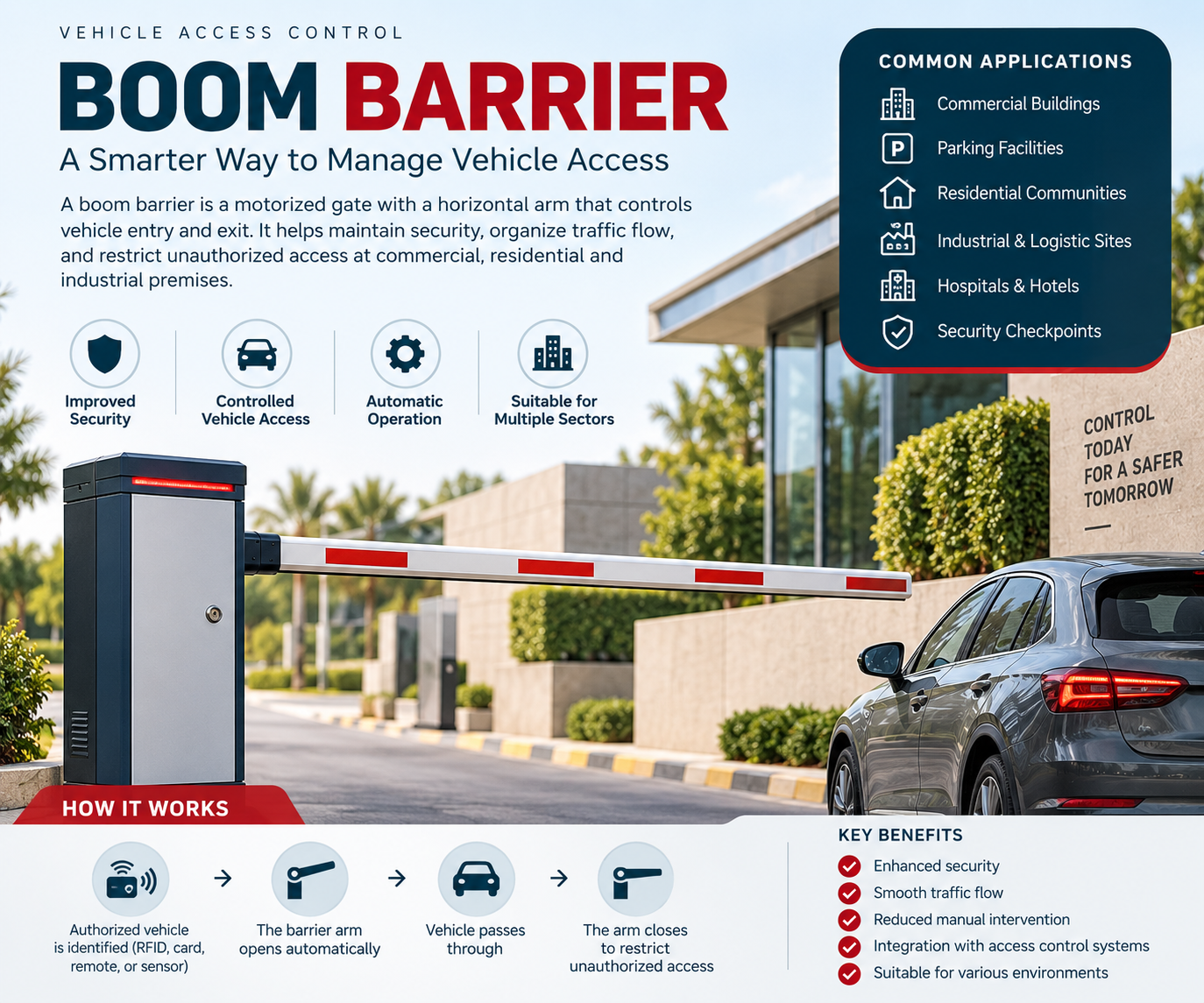
The Role of Boom Barriers in Vehicle Security
A security boom barrier acts as a controlled physical checkpoint between unrestricted and restricted areas. The barrier arm remains lowered until permission is granted for a vehicle to pass.
This simple method allows facilities to manage vehicle movement while maintaining a clear and visible security boundary.
Unlike a traditional gate, an automatic boom gate is designed specifically for frequent vehicle movement. It can open and close quickly, making it suitable for entrances where operational efficiency is important.
Supporting Better Traffic Flow
Busy entrances can quickly become congested if access control is slow or poorly organized.
A properly selected traffic barrier gate can help maintain smoother vehicle movement by creating a dedicated entry and exit process. Vehicles can be stopped, verified, and permitted to continue through the controlled lane.
This makes boom barriers particularly useful in:
Office building entrances
Commercial parking areas
Residential communities
Warehouses
Factories
Logistics centers
Hospitals
Hotels
Educational facilities
Industrial compounds
In these applications, the barrier becomes an important part of traffic organization as well as security.
Automatic Operation Reduces Manual Control
One of the main advantages of an electric boom barrier is automated operation.
Instead of requiring a security guard to physically open a gate, the barrier can receive a signal from an approved control device. This may include a remote controller, access-control panel, vehicle detector, RFID reader, or another compatible system.
A remote control boom barrier can be especially useful at locations where security staff need to manage entry from a control room or guardhouse.
This approach can improve convenience while maintaining control over who enters the property.
Boom Barriers and Parking Management
A parking boom barrier is widely used at commercial and private parking facilities.
Parking areas often require a controlled entrance to separate authorized users from unauthorized vehicles. The barrier can support this process by opening only after a valid access signal is received.
Depending on the project, the system may be integrated with:
RFID access
Vehicle detection
Ticketing systems
Parking management systems
Card readers
Security control panels
Safety sensors
This turns a basic boom barrier gate into a more intelligent access-management solution.
Integration With Vehicle Access Technology
A modern boom barrier system can operate as part of a wider access-control network.
For example, RFID technology can identify approved vehicles automatically. A loop detector can sense when a vehicle is approaching or passing the barrier. Safety sensors can help detect objects in the barrier area.
The combination of physical access control and electronic identification can create a more organized entrance-management process.
For projects requiring this type of integration, the HB145 boom barrier system can be considered for controlled vehicle access applications.
Key Factors Before Selecting a Boom Barrier
Selecting the right boom barrier requires more than simply choosing a boom arm and motor. The system should match the physical layout of the entrance, expected traffic conditions, access-control method, operating frequency, and environmental requirements of the site.
Lane Width
The width of the vehicle lane is one of the first factors to consider. The boom arm should be long enough to cover the required entrance while still operating safely and efficiently.
A narrow parking entrance may only require a short boom arm, while wider industrial or commercial access points may require a longer arm. Accurate site measurements are therefore important before selecting the barrier model.
Vehicle Volume
The expected number of vehicles using the entrance should also be evaluated.
A residential building with limited daily traffic will have different operational requirements from a shopping center, factory, logistics facility, or commercial parking area where vehicles may enter and exit continuously.
For high-traffic sites, the selected boom barrier should be suitable for frequent operation and capable of supporting the required traffic flow without creating unnecessary delays.
Opening and Closing Frequency
The number of times the barrier is expected to operate each day is another important consideration.
Some installations may only require occasional opening and closing, while others may involve repeated operation throughout working hours.
The motor, mechanical components, and control system should therefore be selected according to the expected duty cycle. Choosing a barrier that matches the operating frequency can help improve reliability and long-term performance.
Access Method
The project team should clearly define how vehicles will be authorized before selecting the barrier system.
Depending on the application, access may be controlled through:
RFID readers
Remote controls
Access cards
Push-button controls
Security personnel
Vehicle detection systems
Parking management systems
Integrated access-control software
Safety Devices
Safety is an essential part of boom barrier operation.
Vehicle detection sensors, photocells, loop detectors, and other safety devices can help identify vehicles or objects within the barrier operating zone. These devices can reduce the risk of the boom arm closing while a vehicle is still passing through.
For busy entrances, proper safety integration is especially important to support smooth and controlled operation.
Installation Environment
The installation environment should also be reviewed carefully before selecting a boom barrier.
Important considerations include:
Outdoor temperature and weather conditions
Exposure to dust or moisture
Foundation and mounting requirements
Availability of electrical power
Drainage conditions
Entrance layout
Space around the barrier cabinet
Position of control devices and sensors
Why Boom Barrier Installation Matters
Correct boom barrier installation plays an important role in system performance.
The barrier cabinet should be securely mounted, the boom arm should move freely, and electrical and control components must be connected correctly.
Sensors and vehicle detectors should also be positioned carefully so they can perform their intended function.
Professional installation should normally include:
Site inspection
Entrance measurement
Foundation preparation
Barrier positioning
Electrical connection
Control-system integration
Sensor installation
Operational testing
Choosing a Boom Barrier Supplier
A suitable boom barrier supplier should be able to provide more than just the physical equipment.
Project requirements may also involve:
Technical product selection
Boom arm configuration
Access-control compatibility
Sensor selection
Installation support
System testing
Maintenance guidance
Understanding these requirements early can help reduce installation issues and improve overall system performance.
Automatic Boom Barriers for Commercial and Industrial Projects
The demand for organized vehicle access is growing across commercial and industrial developments.
A vehicle access barrier provides a practical way to separate public areas from restricted vehicle zones while maintaining efficient traffic movement.
Industrial facilities may use barriers at security checkpoints, while commercial buildings may use them at parking entrances. Residential developments may install them at community access points.
The same basic barrier technology can therefore support many different operational environments.
Improving Security Without Creating Traffic Delays
One of the major challenges in access control is balancing security with convenience.
If an entrance is too slow, vehicle queues may develop. If access is too easy, security can be compromised.
A correctly configured automatic boom gate helps address both requirements. Authorized vehicles can move through the entrance efficiently while unauthorized vehicles remain restricted.
When combined with detection systems, RFID, and access-control equipment, the barrier can provide a more controlled and structured entrance process.
Conclusion
A boom barrier is more than a simple gate. It is an important component of modern vehicle access management.
From commercial parking areas to industrial security checkpoints, boom barriers can support controlled entry, organized traffic movement, and improved site management.
By selecting the appropriate barrier type, control method, safety equipment, and installation approach, businesses can create a reliable vehicle access solution suited to their operational requirements.
Whether the application requires a parking barrier, security checkpoint, industrial entrance, or remote-operated access point, a properly planned boom barrier system can provide an effective balance between security and traffic efficiency.
#BoomBarrier #AutomaticBoomBarrier #BoomBarrierGate #AutomaticBoomGate #ParkingBoomBarrier #BoomBarrierSystem #SecurityBoomBarrier #VehicleAccessBarrier #TrafficBarrierGate #ElectricBoomBarrier #AccessControl #VehicleAccessControl #ParkingAccessControl #SecuritySystems #RFIDAccess
Comments
Log in or sign up to join the conversation.