

It’s August – officially the dog days of summer - a time when traders struggle to find good trades…
But, one area that’s ripe with opportunity is bonds.
Problem is, most trade Bonds wrong and there’s a good chance you are in that group too.
Let me start with an analogy.
After months of searching, you find the perfect home. The house is offered for $300k.
What information would you need to value this house? A few local ‘comps’ to see what other houses have sold for? If the same house sold for $400k yesterday, 300k seems like a sweet deal. On the other hand, if that same house sold for 200k last week, 300k seems high.
We need to value this property relative to others in the neighborhood; right?
Now, back to bonds…
Just like we can’t put a bid on our house without ‘comps’, we can’t trade bonds in isolation either. Bonds need to be valued relative to other bonds.
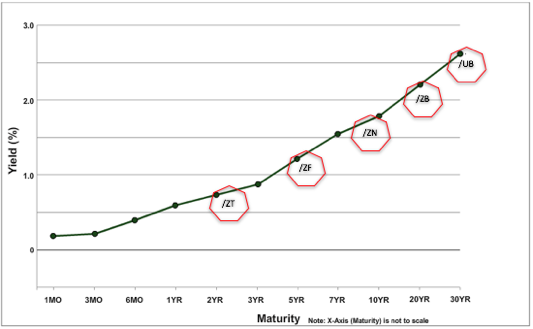
Above is an image of the yield curve – and using futures (or ETF’s) we can trade each point of the yield curve. Here’s where most go wrong trading bonds: traders find a comfort zone, maybe they trade /ZB because it’s what they always traded, it’s what they know.
But, what if China buys an enormous amount of /ZN contracts (10yr)? The /ZN will trade higher, right? But what about /ZB? What about /ZF?
Using this example, here’s a tip: If you’re trading /ZB, and you want to sell (short) /ZB -- you should consider selling /ZN instead. We know China is buying /ZN - that will push /ZN higher and make it trade expensive relative to it’s neighbors (/ZF and /ZB).
In this example, seasoned bond traders would sell /ZN (rather than /ZB).
Professional traders would sell the NOB, the spread between 10yr future contracts and 30yr future contracts.


Comments
Log in or sign up to join the conversation.