

“I see a red door and want to paint it black” – Rolling Stones
In many ways, today is the key for understanding how the 2018 year will end. Not just because of retail spending in the US, but also because of the binary nature of the present market set up. Things are either black or red and there is no middle ground. The ability for investors to believe in the growth story overnight took a hit with European flash PMI reports, but facts about 4Q growth in Europe remaining soggy don’t matter. Nor does the meat of details about why German 3Q GDP was so weak. Economic facts matter far less than political reality today. The choices in Italy and UK over the path forward for a larger European Union are at risk – its black or red. Similarly, the US/China talks on trade will be set at the G20 next week as Xi and Trump meet, even as the US ratchets up a campaign against China’s Huawei Technologies. Either we see more tariffs and an extended trade war or we won’t. For the bulls, there are multiple keys - the goal for 2019 is that it will be less scary than 2018 with the policy divergence of the US and the rest of the world contained by a newfound dovish FOMC, that global growth rebounds and that EM capital flows return. For the bears, the US trade and Fed risks are joined by the UK and Italy threats to the EU – making the growth hiccup a stomach flu for the next year as 2019 transitions to a 2020 recession. Here are the key political stories driving this black Friday.
- UK Brexit deal hopes now being pushed to business leaders for support as Eurosceptic MPs remain unconvinced. The timeline for deal moves to Sunday with EU leaders with focus on UK/Spain issue of Gibraltar.
- US asks allies to drop China Huawei - According to the WSJ, American officials have briefed their government counterparts and telecom executives in friendly countries where Huawei equipment is already in wide use, including Germany, Italy, and Japan, about what they see as cyber security risks, these people said.
- Italy appears set to wait for EU May elections before moving on budget battle. Lots of press on the Italian/EU budget battle with very little news as the present government seems entrenched in supporting its plan and hoping for a different EU reaction in the Spring.
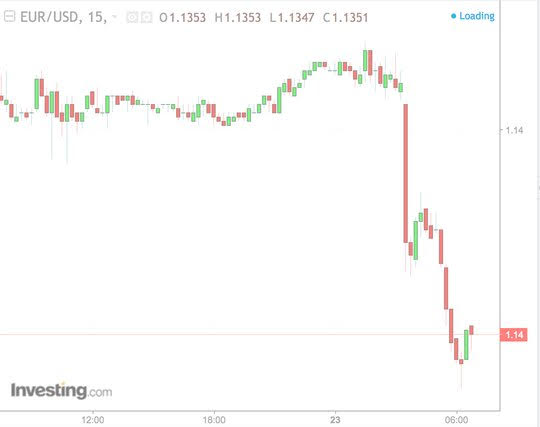
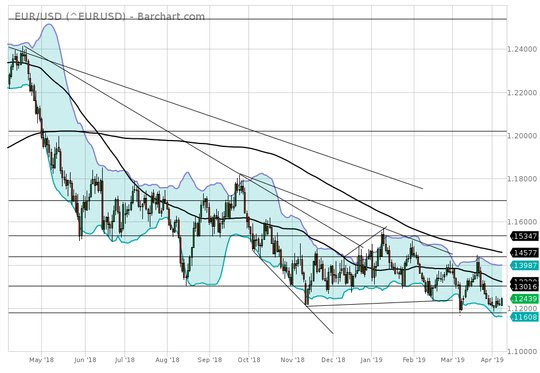
For the risk-on mood that started in Europe, you merely need to track the EUR. The weaker growth spurs hope that you have a less aggressive ECB. Markets are back to banking on central bank stabilizers for financial conditions. The US FOMC hopes are similarly turning, making the EUR/USD relationship central to understanding other markets.
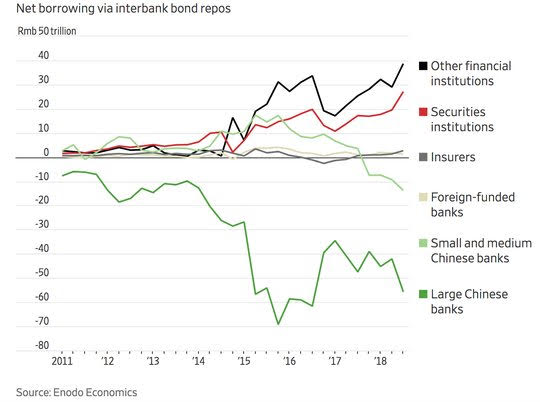
Question for the Day: Are emerging markets looking for a new leader? Short answer – yes – with neither the US or China in the running – its about Europe or a commonwealth collection to offset the present gloom. The great recession brought forth China as the kingpin for emerging market recoveries. The 2015 RMB issues and the deleveraging push from Beijing leave the world searching for a different savior. The present issue for China is about the widening split between the private sector debt and the SOE / big banks where market forces seem to have no role.
The US, also, remains far down the list as Trump trade and foreign policy clashes with the FOMC for making emerging market economies nervous. The OECD head economist has a solution more global coordination elevating the role of the G20 meeting next week as more than just about US/China trade talks. As OECD Boone notes “in the event of a downturn, governments should leverage low-interest rates to coordinate a fiscal stimulus . . . a coordinated fiscal stimulus at the global level would be an effective means of quickly responding to a sharper-than-expected global slowdown.”
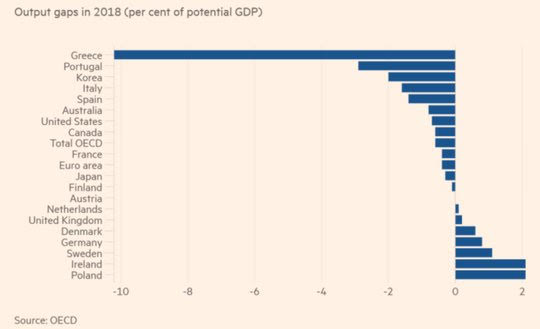
The solution for global growth offsets to the gloom risks of debt and trade wars comes from the business cycle and government stimulus where it makes the most sense – Europe, Korea, Canada and Australia stand out. Markets will be watching for inflation, growth and policy shifts in these countries to matter to how emerging markets may play forward into 2019.
What Happened?
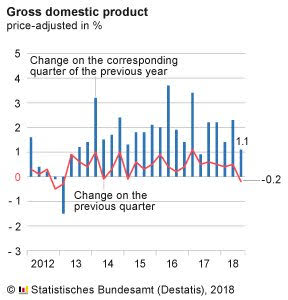
- German 3Q unrevised GDP at -0.2% q/q, 1.1% y/y after +0.5% q/q, 2.3% y/y – as expected. Growth was supported by gross fixed capital formation with machinery and equipment up 0.8% q/q and in construction by 0.9% q/q, however, household consumption fell 0.3% - with auto purchases slower – while government purchases were up 0.2% q/q.
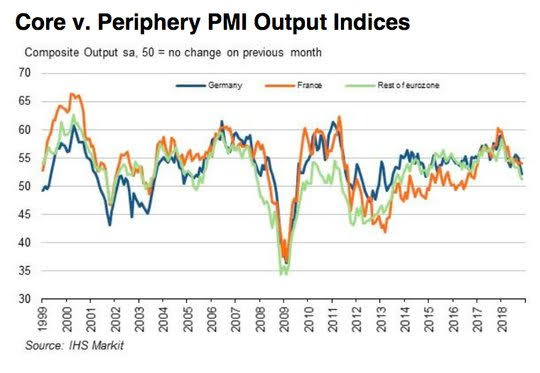
- Eurozone November Composite PMI fell to 52.4 from 53.1 – weaker than the 53 expected - 47-month lows. Eurozone November flash manufacturing PMI falls to 51.5 from 52.0 – weaker than the 51.7 expected – 30-month lows. Services PMI fell to 53.1 from 53.7 – also weaker than the 53.5 expected – 25-month lows. The Manufacturing Output index slips to 50.4 from 51.3 – 65-month lows. The growth drop came from slower order book growth and falling exports. Manufacturing led weakness with output weakest since July 2013. Also, notable output price inflation was unchanged and elevated. As Markit notes, “the weakness in 3Q growth was not a blip,” with readings for 4Q suggesting 0.3% q/q GDP.
- German flash composite fell to 52.2 from 53.4 – weaker than 53.1 expected – 47-month lows. Manufacturing PMI slips to 51.6 from 52.2 – less than the 52.1 expected – 32-month lows. The Services PMI slows to 53.3 from 54.7 – also weaker than the 54.4 expected – 6-month lows. Confidence in business 12M ahead fell to near 4-year lows.
- French flash composite slips to 54.0 from 54.1 – more than the 53.8 expected – but 2-month lows. Manufacturing PMI fell to 50.7 from 51.2 – weaker than the 51 expected – 26-month lows. The services PMI fell to 55.0 from 55.3 – as expected – and 2-month lows. Manufacturing output index improves to 49.6 from 48.9 – 2-month highs. Nevertheless, 12M forward business confidence slips to 2-year lows.
Market Recap:
Equities: The US S&P500 futures are off 0.3% after a 0.3% gain Wednesday. The Stoxx Europe 600 is up 0.2% with tech focus. The MSCI Asia Pacific was 0.7% lower in thin volume with India and Japan closed, focus was on China tech issues.
- Japan Nikkei closed for holiday
- Korea Kospi off 0.60% to 2,057.48
- Hong Kong Hang Seng off 0.35% to 25,927.68
- China Shanghai Composite off 2.49% to 2,579.48
- Australia ASX up 0.40% to 5,793.40
- India NSE50 closed for holiday
- UK FTSE so far flat at 6,960
- German DAX so far up 0.2% to 11,159
- French CAC40 so far up 0.1% to 4,944
- Italian FTSE so far up 0.5% to 18,698
Fixed Income: Focus is on weaker data driving ECB to do less and with UK hopes lower but Italy impasse worries kicked down the road. US bonds waiting for weekend in short session – German 10-year Bund yields are off 1.7bps to 0.35%, French OATs off 2.2bps to 0.725% while UK Gilts are off 4bps to 1.38%. Periphery is bid with Italy off 8bps to 3.365%, Spain off 1bps to 1.625%, Portugal off 2bps to 1.925% and Greece off 2.5bps to 4.49%.
- US Bonds return bid with curve flattening – tracking equities – 2Y up 0.2bps to 2.816%, 5Y off 1bps to 2.88%, 10Y off 1.3bps to 3.05% and 30Y off 1.6bps to 3.30%.
- Japan JGBs closed for holiday.
- Australian bonds rally tracking China equities, ignoring flash PMI – 3Y off 1pbs to 2.053%, 10Y off 1.5bps to 2.647%.
- China PBOC skips open market operations for 21st day, keeps liquidity neutral. 1-year paper yield slides 3bps to 2.50% while 10Y rose 1bps to 3.40%.
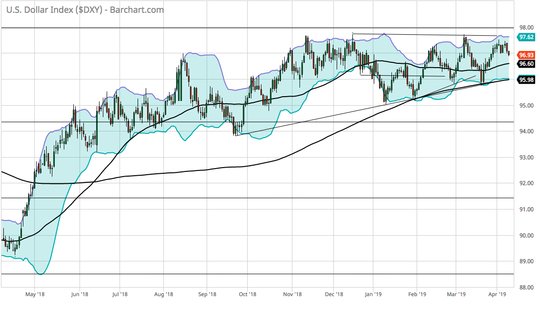
Foreign Exchange: The US dollar index up 0.15% to 96.86 with 96.40-96.87 range – focus back to 97 and 97.20 for more momentum upside. USD is bid in EM – EMEA: ZAR off 0.8% to 13.865, TRY up 0.2% to 5.29, RUB off 0.25% to 65.80; ASIA: TWD flat at 30.904, KRW off 0.1% to 1130.50 and INR holiday stuck at 70.70.
- EUR: 1.1350 off 0.45%. Range 1.1338-1.1421 with 1.13 and 1.12 back in play after weaker data – focus is on US rates and next week risks.
- JPY: 112.80 off 0.1%. Range 112.78-113.01 with EUR/JPY off 0.6% to 128.05 – equities lower, EUR moving with 112-114 key – Japan holiday leaves this an order book exercise.
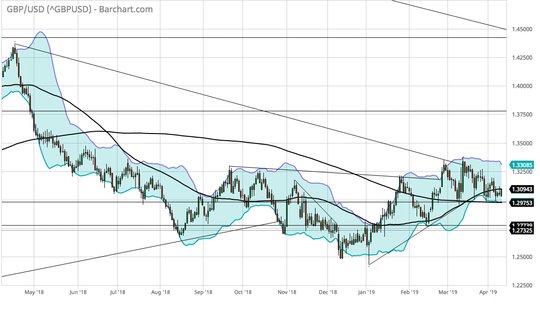
- GBP: 1.2825 off 0.4%. Range 1.2804-1.2883 with EUR/GBP .8850 off 0.1% - all about Brexit and Sunday next. 1.27-1.29 keys.
- AUD: .7225 off 0.4%. Range .7220-.7258 with commodities lower, China doubts higher - .7150-.7300 consolidation. NZD off 0.5% to .6780 with .6880 top holding expect 0.6640 retest.
- CAD: 1.3225 up 0.3%. Range 1.3185-1.3241 with today’s data key – 1.3150-1.3300 boundaries – oil hit an issue to watch.
- CHF: .9970 up 0.2%. Range .9935-.9980 with EUR/CHF 1.1315 off 0.25% - all about UK first – Italy second with EUR weakness about growth – 1.00 pivotal $ resistance again.
- CNY: 6.9306 fixed 0.12% stronger, but now off 0.25% to 6.9470 with 6.9304-6.9510 range.
Commodities: Oil lower, gold lower, Copper off 0.9% to $2.8120. China iron ore fell 2.4%.
- Oil: $52.25 off 4.3%. Range $51.73-$54.82 – dead cat bounce reopens $50 barrier risk with focus on weaker global demand despite US surprise inventory drawdown. Brent off 2.5% to $61.00 with focus similarly at $60.
- Gold: $1221.85 off 0.55%. Range $1220.50-$1229. Market watching USD again with $1215-$1235 key. Silver off 1.6% to $14.27 with $14.12-$14.35 focus. Platinum off 0.75% to $841.25 and Palladium off 0.85% to $1145.50.
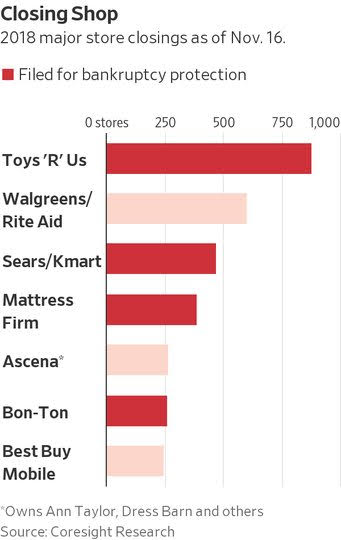
Conclusions: Winner take all? Sometimes being 4th is the best result. The focus on retail shopping today and this weekend won’t go away. There is a winner take all feel to investing in the space but after the reversal of FAANG, many are interested in the brick-and-mortar survivors. The WSJ highlights this point today. US retailers have announced the closure of 5,468 stores this year through Nov. 16, according to Coresight Research. That compares with 6,765 closures during the same period in 2017, when familiar names like RadioShack and The Limited shut.
Economic Calendar:
- 0830 am Canada Sep retail sales -0.1%p 0.3%e/ ex-autos -0.4%p 0.2%e
- 0830 am Canada Oct CPI (m/m) -0.4%p +0.2%e(y/y) 2.2%p 2.2%e/ core 1.5%p 1.5%e
- 0945 am US Nov flash manufacturing PMI 55.7p 55.7e / services 54.8p 54.9e / composite 54.9p 56e
Comments
Log in or sign up to join the conversation.