


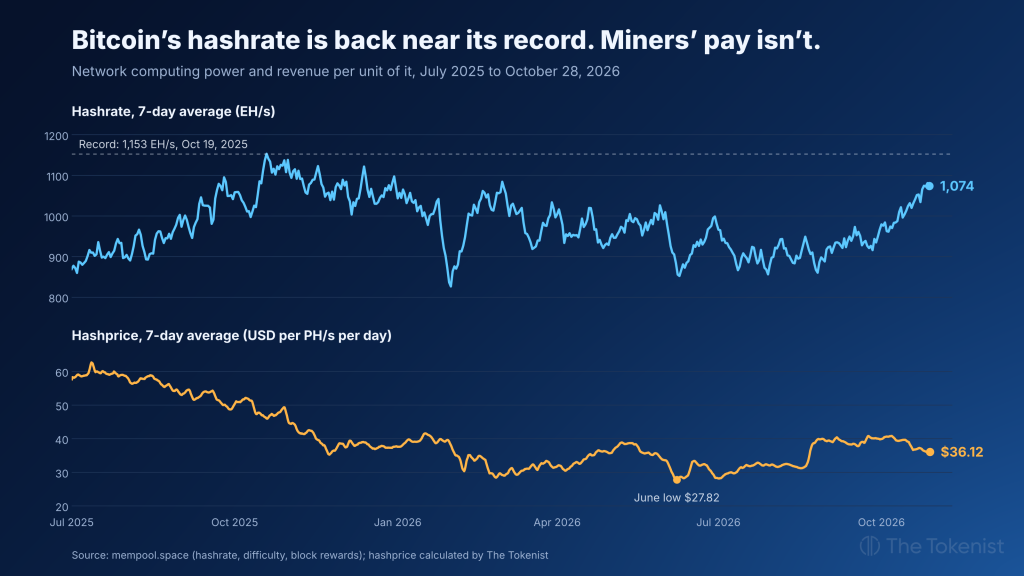
Bitcoin’s hashrate, the computing power that secures the network, averaged 1,074 exahashes per second (EH/s) in the seven days to Wednesday, October 28, 6.8% below its October 2025 record. At the same time, miners are bringing back machines they switched off when revenue hit record lows over the summer. Bitcoin is trading at $81,471, up 2.2% in the last 24 hours.
The recovery has been gradual. Miners’ pay hasn’t kept up. Revenue per unit of computing power is still about 23% lower than a year ago, and the network’s next difficulty adjustment, due on Thursday, is set to reduce it again.
How Close Is Bitcoin’s Hashrate to Its Record?
Closer than at any point this year. On mempool.space’s estimates, the seven-day average peaked at 1,153 EH/s on October 19, 2025. It fell to 826 EH/s on January 31 and averaged about 900 EH/s in July, before rising above 1,000 EH/s again on October 11 for the first time since June 1.
October’s average so far, 1,025 EH/s, is the highest monthly figure since December 2025. Hashrate can’t be measured directly. Data providers estimate it from how quickly blocks arrive, so daily readings are noisy and differ between sources. Luxor’s Hashrate Index, for example, put the network at 1,080 EH/s on October 25. The trend is the same across sources.
Difficulty, the protocol’s own measure of how hard blocks are to find, reflects the same climb. It rose 5.92% to 140.58 trillion on October 16, and mempool.space estimates a further 6.3% rise when the next adjustment arrives at block 973,728, around 17:00 UTC on Thursday. That would take difficulty to about 149.4 trillion, its highest since November 2025 and roughly 4% below the 155.97 trillion record set on October 29, 2025.
Why Are Miners Switching Machines Back On?
Because the summer rally lifted revenue off the floor. Hashprice, the dollar revenue earned per petahash per second (PH/s) of computing power in a day, set a record low monthly average of $30.37 in June, Luxor’s Hashrate Lookback for July shows. At that level, Luxor estimated, any machine using more than about 27 joules per terahash lost money on power costs, and roughly 227 EH/s of installed capacity sat idle.
Bitcoin rose from $57,800 on July 1 to $87,396 on September 21. By The Tokenist’s calculation from block rewards and difficulty, hashprice averaged $39.33 in September, about 30% above June. That was enough to make older machines profitable again, and the network has since added about 170 EH/s from July’s average, most of the capacity Luxor counted as idle.
What Does the Hashrate Rebound Mean for Bitcoin Miners?
Tighter margins. Each new machine that switches on takes a share of a fixed reward. Hashprice averaged $36.12 over the past seven days, against about $47 a year ago, and Thursday’s adjustment would cut it to roughly $34 if the price stays the same.
Transaction fees provide little cushion. Over the last 144 blocks, miners collected 452.1 BTC, of which only 2.10 BTC, or 0.46%, came from fees. The rest was the fixed 3.125 BTC subsidy that every block pays.
At least one of the largest listed miners isn’t driving the rebound. CleanSpark’s September update shows its average operating hashrate fell to 36.0 EH/s in September from 38.3 EH/s in August, and that it mined 529 BTC, down from 593. The company also said it will stop publishing monthly production figures and report quarterly, like its peers in the energy and data center sectors, as it builds out its Sandersville data center site. Pool data doesn’t show who is adding capacity, but it does show how concentrated block production is: Foundry USA, AntPool and F2Pool mined 64% of last week’s blocks.
Bitcoin Price Analysis: Can BTC Hold Above Its 50-Day EMA?
So far, yes, though not by much. BTC trades at $81,500 on Binance, 0.8% above its 50-day exponential moving average (EMA) at $80,832 and well above the 200-day EMA at $76,443. It has rebounded 2.9% from last Saturday’s low.
Resistance: $84,898, the October 21 high, where last week’s drop began.
Support: $79,221, the October 24 low, which held through three tests this week.
Some analysts watch the hash ribbon, which compares the 30-day and 60-day hashrate averages. The 30-day average crossed above the 60-day on August 27, the signal usually taken to mean miner selling has run its course, and it has stayed above since, at 1,028 EH/s against 983 EH/s. BTC closed at $80,250 that day, so it has gained 1.6% since.
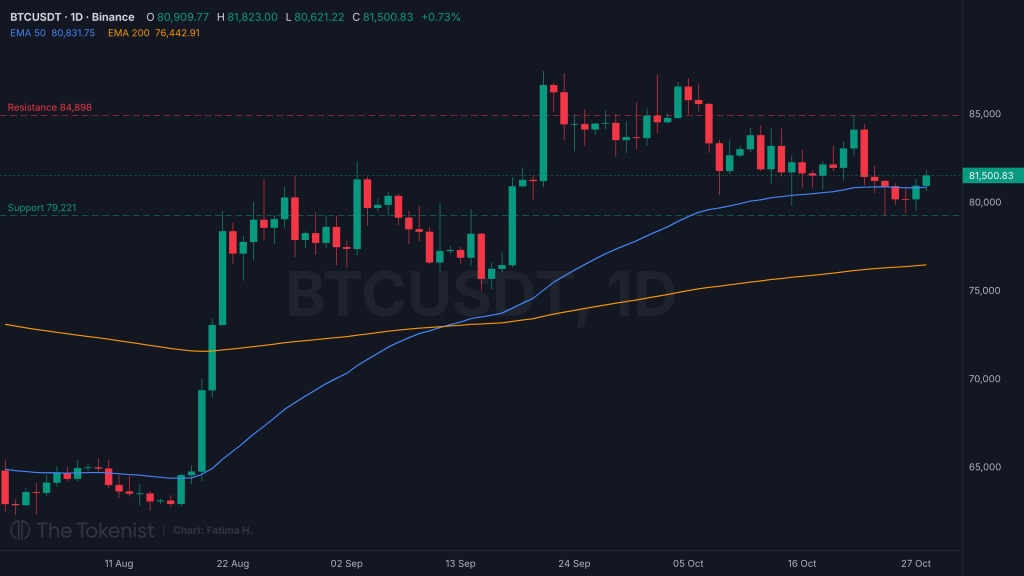
BTCUSDT 1D chart. Source: TradingView
Scenario | Condition | Where it could lead |
|---|---|---|
Advance | A daily close above $84,898 | $87,396, the September 21 high |
Pause | Holding between $79,221 and $84,898 | Sideways trade above the 50-day EMA at $80,832 |
Retreat | A daily close below $79,221 | $76,443, the 200-day EMA |
The hashrate shows that miners are willing to invest in the network again. Whether they can afford it depends on Bitcoin’s price. Thursday’s difficulty adjustment will give them less revenue per machine, and only a higher price would offset that.



Comments
Log in or sign up to join the conversation.