


Photo by Shutter Speed on Unsplash
Back on March 16, we outlined a critical scenario for Bitcoin, highlighting the potential for a corrective recovery into the $74K–$80K resistance zone. At the time, the expectation was that any rally into this region could face strong selling pressure, as it represented a key technical barrier within a broader corrective structure. CHECK IT HERE
Fast forward to now, and Bitcoin has delivered exactly that type of move. Price staged a recovery that can be interpreted as an ABC corrective pattern, pushing into the projected resistance zone before encountering a sharp rejection. This reaction from resistance adds weight to the idea that the recovery phase may already be complete.
From an Elliott Wave perspective, the recent structure fits well as a completed ABC correction. If this interpretation is correct, then the market has likely resumed its broader corrective or bearish phase, opening the door for further downside in the near term.
However, there is an alternative scenario worth considering. The recovery could still be developing into a leading diagonal, forming wave A of a larger, higher-degree ABC corrective recovery. While this would imply that the bigger picture may still allow for another push higher later on, the short-term outlook remains the same—additional downside is likely before any meaningful continuation to the upside.
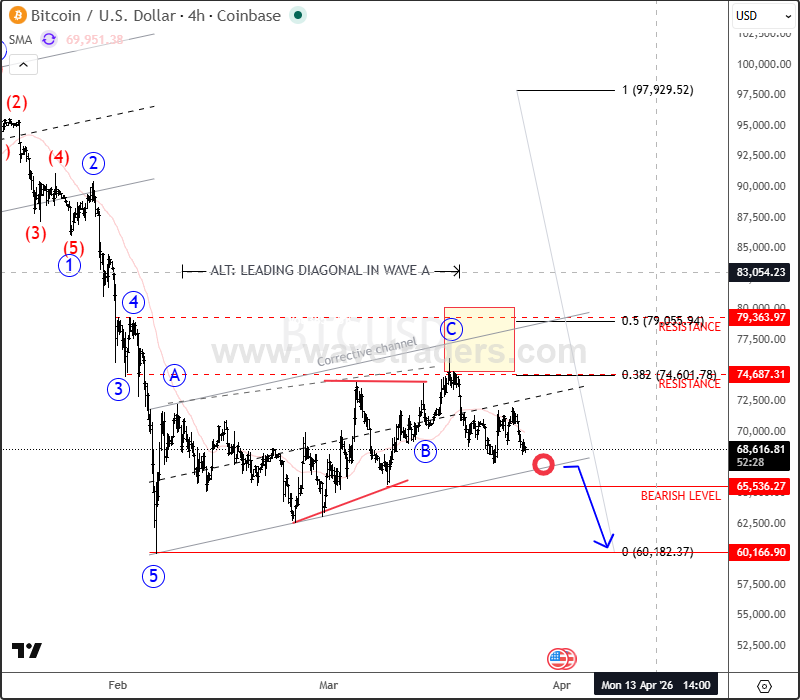
In both scenarios, the key takeaway is unchanged: the market should now produce at least a three-wave decline. Current projections suggest that this move could target the $65K–$60K region, which aligns with previous support zones and typical retracement levels following a completed correction.
As always, price action around these levels will be critical. Whether Bitcoin confirms a deeper correction or builds a base for a more complex recovery will depend on how the market behaves once it approaches the lower support zone.
For now, the rejection at $74K–$80K stands as a technically significant signal—one that shifts the focus from recovery to caution in the short term.



Comments
Log in or sign up to join the conversation.