

For much of 2015, I was criticized for being too bearish. The U.S economy was expected to finally grow at 3.0% (or better) and interest rates (particularly long-term rates) were expected to soar. I had a very contrary view, particularly versus views being espoused in the wealth management industry. There were few signs of inflation, necessary for rising long-term rates and anti-growth headwinds were blowing harder from overseas. The retail side of the business swallowed the stronger corporate balance sheet story hook, line and sinker in spite of balance sheet evidence to the contrary. The first rumblings of equity market trouble materialized last summer. Most pundits blame China for the equity market rout, but the corporate credit markets had been signaling trouble for about a year.
Credit spreads of B-rated U.S. corp. bonds vs. UST benchmarks since 6/14 (Source: Bloomberg):
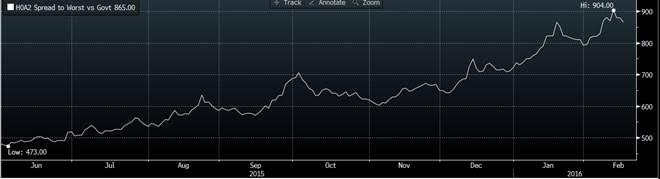
The bond market has been signaling trouble among corporate credits, particularly among junk-rated corporate credits. However, trouble in emerging markets and consistently falling long-dated UST yields indicated that growth would probably not be strong enough to overcome structural deflationary forces around the world.
UST 10-year Note Yield since Jan. 2014 (Source: Bloomberg):
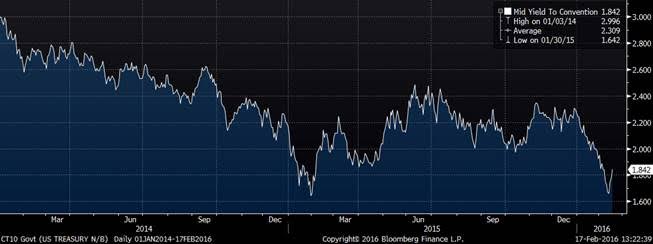
Bond market conditions and economic data were clearly indicating that the pace of growth slowing and inflation pressures were lessening. My outlook and strategy simply reflected what the data were stating. Bond market behavior during this time lent credence to my outlook.
By late December, following a failed attempt by risk asset markets to fully recover from the summer rout (which I pointed out was faltering in October of last year), my-less-than-bullish base case scenario was playing out.
As the calendar rolled around to January, market and economic conditions deteriorated. The cry from pundits, market participants and even some Bond Squad readers was: Recession is near!
Once again, I Iooked at the data and overall bond market conditions, and saw little in the way of recession. Yes, credit spreads widened among U.S. corporate bonds, but this could be mainly attributed to retail investors reallocating out of fear. Long-term UST yields plunged, but this appeared the result of declining inflation expectations and plunging foreign sovereign debt yields. Outside of a sharp slowdown in manufacturing (due in part to the strong dollar which was related to the fact that UST yields were higher than their developed sovereign debt counterparts), there seemed to be little “recession” in the data.
In a matter of weeks, I found myself on the other side of the sentiment spectrum. I had gone from not seeing an obvious pending economic boom to missing the signs of an impending recession. Please bear in mind that my sentiment and outlook was basically unchanged. It was the sentiment of those around me which had changed. What caused the wild swings in sentiment? It appears to be the nearly total reliance on reading market and asset value conditions without considering the context. This can be summed up in the following story.
A jetliner was flying through a mountainous area on autopilot using what is believed to be reliable GPS software. As the jetliner approaches a mountain peak, the co-pilot notices that a communications tower, which was not included in the software, has been erected. The co-pilot warns the pilot of this unanticipated obstacle. The pilot turns to the co-pilot and tells him to ignore the tower, which can be seen clearly through the windshield. Astonished, the co-pilot asks: “Why?”
The pilot explains to the co-pilot that the jetliner is equipped with the most modern avionics suite and has been updated with the most recent navigation software. Thus, the communications tower the co-pilot saw through the windshield was anecdotal evidence and anecdotal evidence was unreliable. However, the tower was really there and, as a result, the plane smashed into the tower.
This is precisely what is happening in the financial industry today. Strategists and analysts look rely on data-driven correlation models, often without looking through their windshield to see what might have changed.
When I look around the world, I see scant evidence of inflation. As long as global inflation and long-term sovereign debt yields remain low, long-term UST yields should remain low. A yield of 2.00% on the 10-year UST note could represent a significant barrier, off of which long rates could rebound lower. For now, a range of 1.50% to 2.00% appears likely. At the same time however, the U.S. economy could (should) continue to expand, albeit at a moderate pace. With risk assets rebounding this past week, I guess I will once again be viewed as too bearish. However, I can only go by what economic data and global economic conditions are telling me.
At present, the view outside the windshield tells me that Europe and Japan should experience another year of sub-par growth and low, even declining, inflation. NIRP could become a long-lasting policy and more QE (particularly by the ECB) could be on the horizon. Low inflation, NIRP and QE asset purchases all augur for low long-term UST interest rates. Unless of course NIRP and QE are successful in boosting growth and inflation, but that is doubtful. At the time of this writing, German bund yields are negative through eight years and JGB yields are negative through nine years.
JGB and DBR yield curves (Source: Bloomberg):
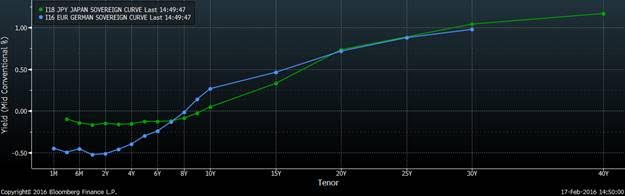
What is disturbing to me is how flat the JGB yield curve has become. As it would be difficult (but not impossible) for the very long end of the curve to “go negative,” a flat or inverted curve out to 10-years might be as “recessionary” as the yield curve can get in Japan. It suffices to say that I am not a believer that central banks can fix any economy. Fiscal reforms must change to reflect structural and demographic realities for an economy for run most efficiently.
In spite of low (and falling) global interest rates, the wealth management industry continues to focus on rising rates. The industry continues to make the mistake that Fed tightening automatically equates to higher rates all along the UST yield curve. I have spoken with other fixed income professionals and they have expressed similar frustrations. Some have even experienced the ire of wealth management professionals when they have expressed low rates for longer sentiments during advisor meetings and conference calls.
Although I can empathize with advisors (who have had the rising rate trade rammed down their throats for several years), fixed income professionals from around the industry have been very consistent with their views that interest rates should remain low and should peak at lower rates than they have in past cycles. The low rate thesis has been, in my opinion, articulated very well. However, the low-rate thesis is not a good story. As they say: Never let the facts get in the way of a good story.

Comments
Log in or sign up to join the conversation.