
Groundwater plays a crucial role in supporting industries, infrastructure projects, commercial establishments, and institutions across India. As the demand for groundwater continues to increase, regulatory compliance has become essential for ensuring responsible and sustainable water use.
Organizations planning to extract groundwater are often required to obtain a CGWA NOC before commencing operations. The online platform cgwa-bhuneer.mowr.gov.in has made the application process more organized by enabling applicants to register, submit documents, monitor application progress, and receive official updates electronically.
A professional hydrogeological survey is equally important because it provides scientific information about groundwater availability and supports sustainable extraction planning.
Understanding the Bhuneer Portal
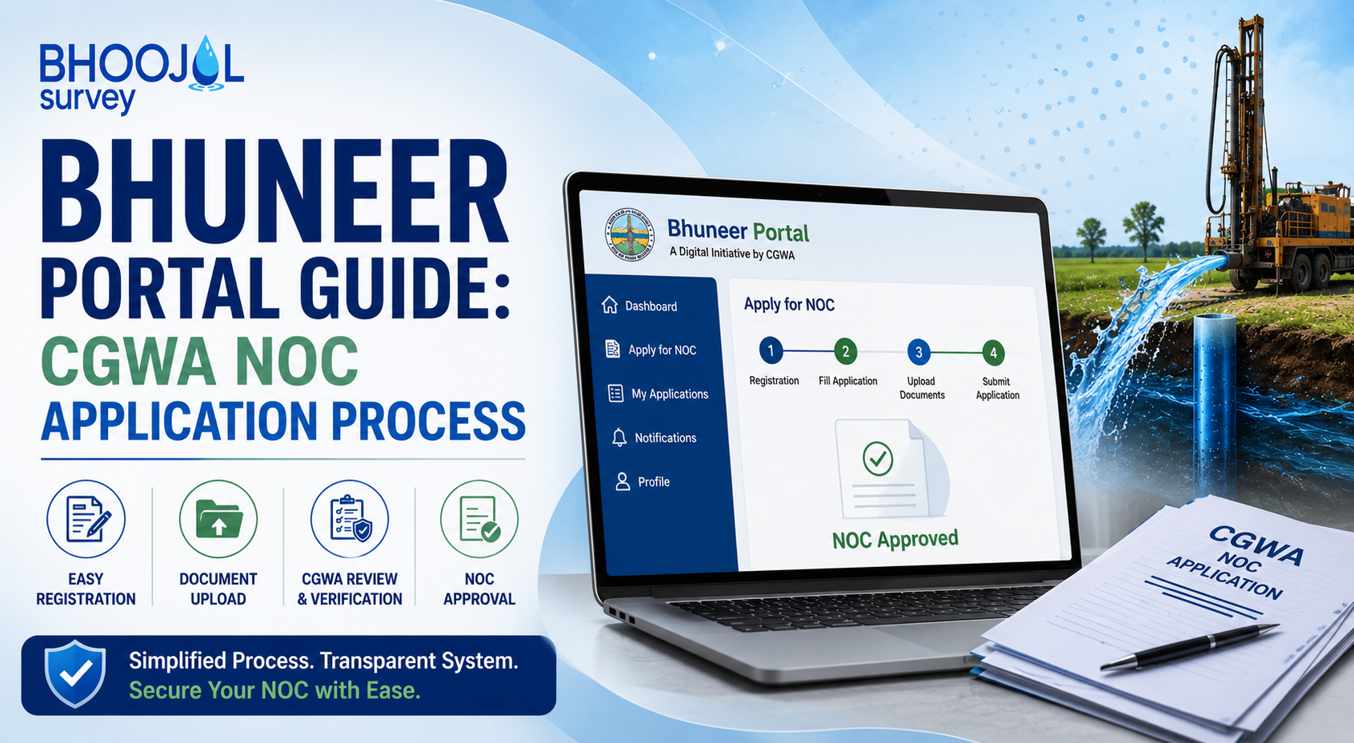
The Bhuneer Portal is a centralized online system designed to simplify groundwater-related application procedures. Instead of relying on lengthy manual submissions, applicants can complete the majority of the approval process through a secure digital platform.
The portal enables users to create accounts, submit application forms, upload supporting documents, respond to official observations, and monitor the progress of their applications from a single dashboard.
The digital system has significantly improved transparency by allowing applicants to track every stage of the approval process. Electronic communication also reduces paperwork and minimizes the time required for document submission and verification.
What Is a CGWA NOC?
A CGWA NOC is an official authorization that permits groundwater abstraction under applicable regulations. Depending on the nature of the project, groundwater requirement, and location, organizations may need this approval before extracting groundwater.
The objective of the approval process is to regulate groundwater usage, prevent excessive extraction, protect aquifers, and promote sustainable water resource management.
Compliance with groundwater regulations not only fulfills legal obligations but also demonstrates an organization's commitment to environmental responsibility and sustainable development.
Who Should Apply?
Various sectors may require groundwater extraction approval before beginning operations. Manufacturing units, commercial buildings, educational institutions, healthcare facilities, residential townships, construction projects, infrastructure developments, mining operations, and industrial establishments often fall within the scope of groundwater regulations.
Applicants should carefully evaluate their groundwater requirements and verify applicable regulatory conditions before initiating the application process.
Preparing the Required Documentation
Accurate documentation is one of the most important aspects of obtaining regulatory approval. Before beginning the online application, organizations should gather all necessary records and verify that every document contains accurate and updated information.
Project details, site information, groundwater requirements, ownership records, authorization documents, borewell specifications, technical reports, and environmental compliance documents should remain consistent throughout the application. Incomplete or incorrect documentation frequently results in additional scrutiny and unnecessary processing delays.
Careful document preparation also improves communication with reviewing authorities and minimizes requests for clarification during technical evaluation.
Importance of a Hydrogeological Survey
A detailed hydrogeological survey forms an essential part of many groundwater approval applications. The survey evaluates geological formations, groundwater availability, aquifer characteristics, recharge potential, water table conditions, and sustainable groundwater extraction capacity.
Scientific assessment provides valuable technical information that supports responsible groundwater management and helps authorities determine whether proposed extraction levels are environmentally sustainable. Reliable survey findings strengthen the technical foundation of the application and improve overall documentation quality.
Beginning the Application Process
The application process starts with user registration on cgwa-bhuneer.mowr.gov.in. Applicants create an account by providing organizational details and valid contact information. After successful registration, they gain access to the online dashboard where all application-related activities can be managed.
Once logged into the portal, applicants begin entering project-specific information. Every section of the application should be completed carefully because inconsistencies between submitted information and supporting documents may delay the verification process. Project location, groundwater requirements, proposed extraction details, and organizational information should be reviewed thoroughly before moving to the next stage.
Uploading supporting documents is the next important step. Each file should be clear, complete, and submitted in the required format. Properly organized documentation enables reviewing authorities to examine the application more efficiently. Before final submission, applicants should verify that every uploaded document matches the information entered in the application form.
Technical documentation is another critical component of the application. Reports related to groundwater assessment, extraction requirements, recharge measures, and findings from a hydrogeological survey help establish the scientific basis of the proposal.
Accurate technical information allows authorities to evaluate groundwater sustainability while ensuring responsible utilization of available resources.
Application Review and Verification
After completing all sections of the application, applicants should carefully review every detail before final submission. Even minor errors in project information, groundwater requirements, or uploaded documents can lead to delays during verification.
A thorough review helps ensure that all information is accurate, complete, and consistent throughout the application. Once the application is submitted, the concerned authority begins the evaluation process based on the documents and technical information provided.
During verification, officials examine the submitted records to ensure that the proposed groundwater extraction complies with applicable regulations. If additional clarification or revised documents are required, notifications are sent through cgwa-bhuneer.mowr.gov.in.
Applicants should regularly monitor their accounts and respond promptly to any observations to avoid unnecessary delays in processing.
Proper documentation remains one of the most important factors in obtaining a CGWA NOC successfully. Every report should accurately represent the project site and groundwater requirements. Inconsistent records, incorrect calculations, poor-quality scanned documents, or missing information often result in requests for corrections, increasing the overall processing time.
A detailed hydrogeological survey significantly strengthens the application by providing scientific evidence regarding groundwater conditions. The survey evaluates geological formations, groundwater recharge potential, aquifer characteristics, water table conditions, and sustainable extraction capacity.
These findings enable regulatory authorities to determine whether groundwater abstraction can be permitted without adversely affecting surrounding water resources. Well-prepared technical reports also demonstrate that the applicant has adopted a responsible approach toward groundwater management.
One of the major advantages of cgwa-bhuneer.mowr.gov.in is the transparency it offers throughout the application lifecycle. Instead of relying on manual communication, applicants can track the current status of their application, receive notifications regarding deficiencies, upload revised documents when necessary, and download official communications from a single digital platform. This streamlined process saves valuable time while improving overall administrative efficiency.
Sustainable groundwater utilization not only protects natural resources but also contributes to long-term operational stability.Preparing a successful application requires careful planning, accurate documentation, scientific assessment, and timely communication with the reviewing authority.
Organizations that complete every stage methodically generally experience fewer delays and a smoother approval process. Conducting a professional hydrogeological survey, verifying technical reports, and submitting complete documentation through cgwa-bhuneer.mowr.gov.in significantly improves the quality of the application.
Frequently Asked Questions
1. What is the purpose of the Bhuneer Portal?
The Bhuneer Portal is an online platform that enables applicants to submit groundwater-related applications, upload documents, track application status, and receive official updates electronically.
2. Who needs a CGWA NOC?
Industries, commercial establishments, infrastructure projects, institutions, and other eligible organizations planning groundwater extraction may require a CGWA NOC, depending on applicable regulations and groundwater usage.
3. Why is a hydrogeological survey important?
A hydrogeological survey provides scientific information about groundwater availability, aquifer conditions, recharge potential, and sustainable extraction limits, making it an important part of many groundwater approval applications.
4. How can applicants track their application status?
Applicants can log in to cgwa-bhuneer.mowr.gov.in to monitor application progress, receive notifications, upload revised documents if required, and download official communications.
5. How can organizations improve their chances of obtaining a CGWA NOC?
Organizations should prepare complete documentation, conduct a detailed hydrogeological survey, submit accurate technical information, respond promptly to observations, and follow all applicable groundwater management guidelines to improve the likelihood of timely approval.
Comments
Log in or sign up to join the conversation.