
The digital classroom has fundamentally democratized education. Anyone with an internet connection and a smartphone or laptop can access lectures from top-tier universities, watch expert tutorials, and enroll in specialized courses on demand. Yet, as the e-learning landscape continues to expand, a critical shift is taking place in how students, educators, and employers view success.
The old metric of success—accumulating certificates, completing modules, and memorizing textbook theories—is rapidly losing ground to a more demanding standard: actual skill acquisition.
In modern digital education, practical capability isn't just an optional bonus; it is the core currency of achievement. Here is why skill-centric e-learning outperforms traditional passive learning every single time.
1. The Death of Theoretical Memorization in a Fast-Moving Economy
For decades, traditional education focused heavily on rote memorization. Students retained facts long enough to pass an exam, only to forget them shortly after. In a modern economy driven by rapid technological advancements, software updates, and shifting industry demands, memorized facts have an extremely short shelf life.
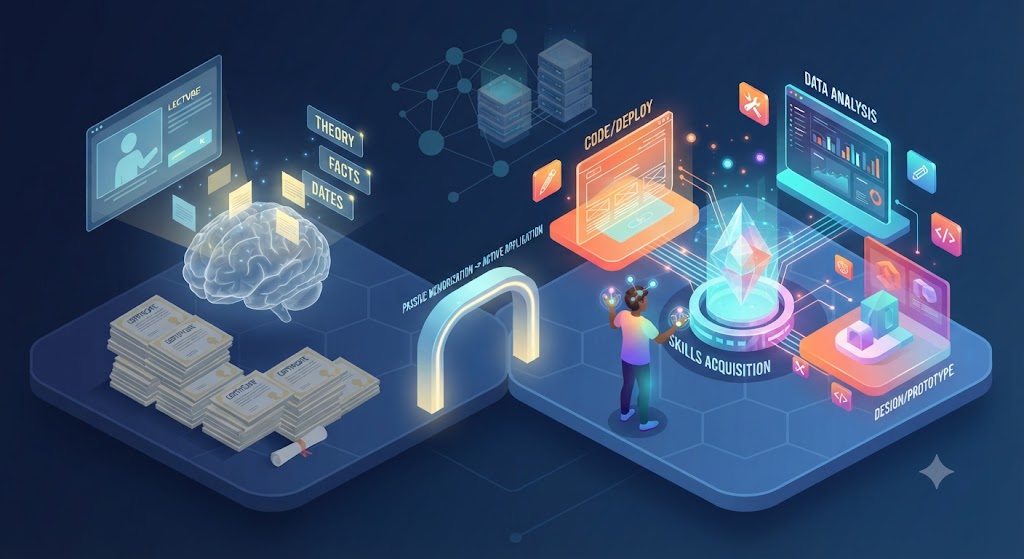
Skills, however, are adaptable.
Problem-Solving Frameworks: When an e-learning course focuses on teaching how to think through a problem rather than just telling you the answer, you can apply that logic to entirely new tools and scenarios.
Transferable Competencies: Technical proficiency in data analysis, coding logic, or digital communication remains valuable long after specific software interfaces change.
2. Employers Hire What You Can Do, Not What You Watched
When a hiring manager reviews a resume, a digital badge or a completion certificate indicates that a candidate sat through a course. It says nothing about whether they can execute tasks under pressure, debug broken code, or manage a live project.
Portfolio Over Paper: Skill-based e-learning prioritizes capstone projects, real-world simulations, and practical portfolios.
Demonstrable Value: An e-learning graduate who can showcase a functional application, a detailed financial model, or a live marketing campaign instantly stands out from someone who only has a list of completed modules.
Modern platforms are responding by shifting toward project-based assessments, interactive coding environments, and peer-reviewed assignments that prove real competence.
3. Engagement and Motivation Through Active Application
Passive video watching is one of the biggest pitfalls of digital education. It is easy to zone out during a two-hour lecture, leading to high drop-out rates across massive open online courses (MOOCs).
When e-learning is built around skill acquisition, the dynamic changes from passive consumption to active participation:
Immediate Feedback Loops: Interactive platforms give learners instant feedback on quizzes, code execution, or design exercises, turning learning into an engaging, game-like process.
Intrinsic Motivation: Learners stay motivated when they can immediately see the practical utility of what they are building or solving, drastically increasing completion rates and long-term retention.
Transforming the Future of Digital Classrooms
The true promise of e-learning was never about replacing physical classrooms with digital video players; it was about making high-quality education dynamic, modular, and deeply practical.
By prioritizing hands-on skills over passive completion certificates, we bridge the gap between education and employment. Whether you are upskilling for a career change or exploring a new discipline, remember that the goal of digital education isn't just to finish a course—it is to change what you are capable of doing when you close the tab.
Comments
Log in or sign up to join the conversation.