

If you run a plant that relies heavily on high-temperature processing—whether you operate a fleet of continuous curing tunnels or a massive industrial oven—you’ve almost certainly had a vendor pitch you on Waste Heat Recovery Systems (WHRS).
The pitch is always the same: “Install this heat exchanger, slash your natural gas bill by 15% to 30%, and watch the system pay for itself in two years.”
It’s a compelling pitch, sure. Lowering utility expenses directly improves operating margins. But focusing exclusively on energy savings misses a much bigger, more strategic story. Lower utility bills are really just the tip of the iceberg.
When you capture ambient thermal energy that would otherwise vent into the sky and cycle it back into your operations, you unlock ripple effects across your entire facility. From extending the lifespan of critical machinery to winning high-stakes enterprise contracts, here are the unexpected business benefits of waste heat recovery systems that rarely make it into the initial sales deck.
1. Protecting Assets: Equipment Longevity and Reduced Thermal Shock
Industrial equipment dies a slow death caused by thermal stress. When an industrial oven or furnace runs at elevated temperatures, the internal components undergo severe thermal cycling—expanding as they heat up and contracting as they cool down.
When the exhaust air escapes suddenly and in an uneven manner, the cold replacement air is drawn into the system to compensate for it. The rapid fall in temperature results in thermal shock. Thermal shock eventually causes:
Micro-fractures in burner tubes and heat exchangers
Warped conveyor tracks and internal housing
Refractory lining degradation
Premature failure of seals, gaskets, and sensor arrays
The WHRS Difference
The waste heat recovery system becomes a thermal oxidizer. It captures exhaust heat and heats incoming combustion or process air. As a result, temperature differences inside become equalized.
Because the system no longer experiences drastic temperature swings, mechanical wear drops. Heating elements don't have to fire at maximum intensity to compensate for cold air spikes, which extends the operational lifespan of your primary assets. Replacing a $500,000 industrial oven three to five years later than budgeted turns an energy-saving project into a major capital preservation win.
2. Boosting Productivity and Process Consistency
In manufacturing, variance is the enemy of throughput. If your production line relies on precise thermal profiles—such as curing composite panels, baking food products, drying industrial coatings, or heat-treating metals—inconsistent temperatures lead to quality defects.
Without proper management of exhaust systems, local changes in pressure and temperatures occur within the chambers of the processing system. During winter mornings when the temperature is very low, it may take an industrial oven additional 45 minutes to attain steady-state temperatures.
By preheating makeup air to a consistent baseline temperature year-round, WHRS eliminates ambient weather volatility inside the plant.
Real-World Operational Gains:
Quick Heat-up Times: The systems heat up faster, which opens up more production opportunities each day.
Increased Yield Rates: Even distribution of heat decreases the number of defective products resulting from inadequate or excessive curing of products.
Higher Line Speeds: Consistent heat conditions make it possible for engineers to raise conveyor line speeds.
3. Workplace Environment and Employee Retention
Passing by an un-insulated hot exhaust duct during July is all it takes to see the impact of radiant heat. Waste heat does not go away but radiates into the building interior, increasing the indoor temperature to levels that are unhealthy for occupants.
Too much exposure to heat in an industrial setting impacts operations:
Safety Risks: High heat index increases worker fatigue, heat exhaustion risks, and focus lapses, which lead to safety incidents.
HVAC Overload: The facility's cooling systems have to work twice as hard to combat the radiant thermal load generated by process equipment.
Turnover: High ambient heat is one of the top complaints among plant operators and floor technicians, contributing to high turnover in skilled labor markets.
Capturing exhaust energy at the source prevents surplus BTUs from bleeding into the facility floor. Facilities that implement WHRS regularly report ambient floor temperature reductions of 5°F to 15°F near heavy processing zones. That creates a safer, more comfortable work environment, slashes secondary cooling costs, and helps retain skilled operators.
4. Hard ESG Metrics That Win Competitive Bids
Environmental, Social, and Governance (ESG) compliance used to be a marketing nice-to-have. Today, it’s a core requirement for doing business with major enterprise customers. Large corporations actively audit their supply chains for Scope 1 (direct emissions) and Scope 2 (indirect emissions from purchased energy) carbon footprints.
If two manufacturers offer similar pricing and quality, the vendor that can prove a lower carbon footprint per unit produced almost always wins the contract.
Key Advantage: Unlike carbon offset programs—which are increasingly scrutinized as greenwashing—waste heat recovery provides direct, verifiable Scope 1 emission reductions.
When you burn less fuel to maintain the output of your industrial oven, your facility directly lowers its carbon output. The saving of each cubic foot of natural gas saves the atmosphere from 0.12 pounds of CO2. It is solid data that easily fits into the sustainability reporting of your company and will give an advantage to your sales team during bidding.
5. De-risking Future Energy Volatility and Grid Stress
Energy markets are increasingly volatile. Geopolitical tensions, seasonal demand spikes, and shifting grid dynamics make forecasting natural gas and electricity costs difficult over a 5-to-10-year horizon. Furthermore, local utility providers are placing stricter peak-demand caps on industrial facilities during extreme weather events.
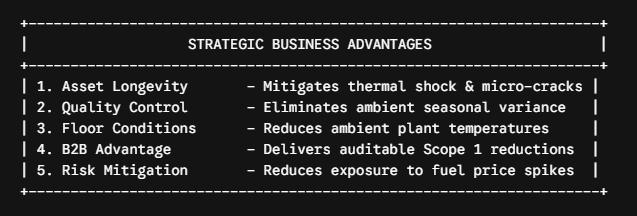
Installing waste heat recovery acts as an operational hedge against energy price swings. By generating a significant portion of your required thermal energy internally from waste streams, your facility becomes less dependent on external fuel supply.
If fuel prices spike by 40%, a plant that recycles 25% of its heat feels a significantly smaller margin squeeze than a competitor operating inefficient, open-loop equipment.
Looking Beyond the Utility Bill
When evaluating a Waste Heat Recovery System, don't stop at the simple payback calculation on gas usage. Take a holistic view of your operations:
What is the capital replacement schedule for your current processing equipment?
What is your current scrap rate due to thermal inconsistencies?
How much are you spending on plant HVAC to fight radiant process heat?
Are upcoming ESG requirements threatening your position with key accounts?
Utility savings pay for the hardware, but the hidden benefits—equipment longevity, product consistency, safer working conditions, and supply chain competitiveness—deliver long-term compound value to your enterprise.
Comments
Log in or sign up to join the conversation.