

Best DevOps Course in Mumbai 2026 | The Honest Selection Guide
TL;DR: This guide compares the best DevOps course in Mumbai with placement support, evaluating institutes across fees, batch sizes, placement records, project quality, and syllabus depth. If you’re along the Western Railway line — Virar, Borivali, Kandivali, Malad, Goregaon — Nixace Technologies in Goregaon West is the most accessible, smallest-batch program in Mumbai. Keep reading for our honest institute comparison, course fee breakdown, and what the 2026 Mumbai DevOps job market actually requires.
Table of Contents
Mumbai DevOps Job Market 2026 — What Companies Actually Need
DevOps Course Fee in Mumbai — Honest Price Breakdown
Top DevOps Institutes in Mumbai — Side-by-Side Comparison
What Your DevOps Syllabus Must Cover in 2026
Mumbai Tech Map — Choose an Institute Near You
What Nixace Technologies Offers — No Marketing Fluff
Student Outcomes — Real Numbers, Real People
3 Traps to Avoid When Enrolling
FAQs — Every Question Answered
1. Mumbai DevOps Job Market 2026 — What Companies Actually Need
If you’re searching for the best DevOps course in Mumbai with placement support right now, here’s the uncomfortable truth: most course listings you’re seeing are optimized for Google, not for your career.
Mumbai’s DevOps hiring in 2026 is split across four major employment belts:
BKC / Lower Parel
Major Employers: HDFC Bank Tech, Razorpay, Jio Platforms
DevOps Role Demand: DevSecOps, Platform Engineering
Andheri East / MIDC
Major Employers: TCS, Tech Mahindra, Wipro
DevOps Role Demand: CI/CD, Cloud Migration
Powai / SEEPZ
Major Employers: Accenture, Cognizant, IBM
DevOps Role Demand: Kubernetes, Observability
Goregaon / Malad (Mindspace)
Major Employers: Nesco IT Park companies
DevOps Role Demand: IaC, Cloud Cost Optimization
Navi Mumbai (Mahape, Belapur)
Major Employers: Oracle, L&T Infotech
DevOps Role Demand: Multi-cloud, Container Security
What Mumbai companies actually interview for in 2026:
Linux internals + shell scripting (tested in round 1, most candidates fail here)
CI/CD pipeline design (not just “I’ve used Jenkins”)
Kubernetes cluster management + troubleshooting
Terraform state management at scale
Cloud cost visibility (FinOps basics)
+ AI/ML pipeline integration (new in 2026, see Section 4)
Press enter or click to view image in full size
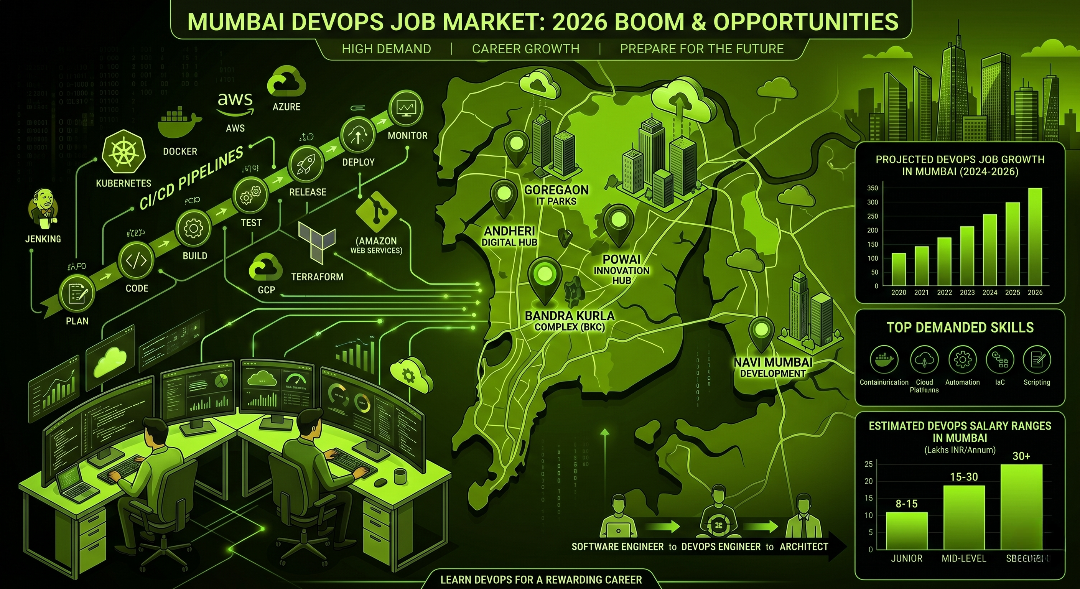
Mumbai’s growing DevOps ecosystem shows strong demand for cloud engineers, platform engineers, Kubernetes specialists, and DevOps professionals across major technology hubs.
2. DevOps Course Fee in Mumbai — Honest Price Breakdown
This is the section every other guide avoids. Here’s the reality:
Large EdTech (Online)
Typical Fee Range: ₹15,000–₹30,000
What You Get: Recorded videos, auto-graded labs, 500+ batch size
Mid-tier Classroom
Typical Fee Range: ₹35,000–₹55,000
What You Get: Live classes, some lab access, placement support
Premium Engineering Centers
Typical Fee Range: ₹55,000–₹100,000
What You Get: Small batches, code reviews, chaos labs, portfolio mentorship
Where Nixace stands apart:
Only institute with classroom infrastructure directly on the Western Railway line (Goregaon West)
Chaos engineering methodology, Instructors break your cluster mid-lab on purpose
Dedicated code review of your Infrastructure as Code pull requests by senior engineers
No pre-recorded module shortcutting: every session is live
4. What Your DevOps Syllabus Must Cover in 2026
Module 1: Linux Core + Shell Scripting
Every cloud service runs on Linux. If you can’t navigate a terminal, write process-management scripts, or debug file permission issues without Stack Overflow, you will fail your first technical interview. This is where most DevOps training programs cut corners and where most candidates get eliminated.
Module 2: CI/CD Pipeline Engineering
Multi-stage builds, artifact management, automated deployment with Jenkins, and GitHub Actions. Not a tutorial. You build a real pipeline for a microservices application from scratch.
Module 3: Infrastructure as Code (Terraform + Ansible)
Manual server configuration is a liability in 2026. You need to version-control your entire infrastructure. This module covers Terraform state management, remote backends, and Ansible playbook design for enterprise config management.
Module 4: AWS + Azure Cloud Architecture
VPC design, IAM policies with least-privilege principles, auto-scaling groups, cost alerts. Fresher-level: you should be able to architect a 3-tier HA application on AWS from memory.
Module 5: Docker + Kubernetes Orchestration
Container lifecycle, multi-stage Dockerfiles, Kubernetes networking, rolling deployments, RBAC, Helm charts. This is where 70% of Mumbai DevOps interviews go deep — practice until cluster troubleshooting is reflex.
Module 6: Observability + GitOps
Prometheus + Grafana dashboards, centralized logging (ELK/Loki), and ArgoCD for GitOps. You are not done until your infrastructure talks back to you.
Module 7: DevOps + AI Integration (2026 Requirement)
This is the skill gap that separates ₹8 LPA offers from ₹18 LPA offers in Mumbai’s 2026 market. Fintech and e-commerce companies are integrating AI-based anomaly detection, LLM-assisted incident response, and ML pipeline deployment into their DevOps workflows. For graduates, career switchers, and entry-level professionals, the learning sequence above also serves as a practical DevOps career roadmap for freshers in India. By mastering Linux, cloud platforms, CI/CD, Infrastructure as code, Kubernetes, observability, and DevOps automation, learners can build the skills required for modern DevOps and cloud engineering roles.
Press enter or click to view image in full size
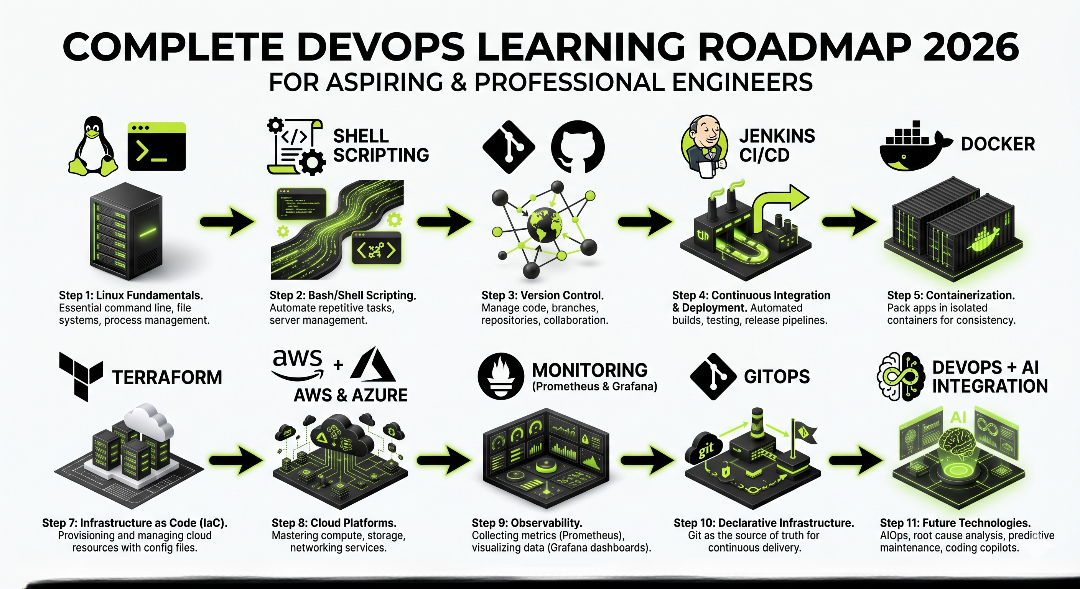
The complete DevOps roadmap for beginners and professionals covering Linux, Cloud, CI/CD, Infrastructure as Code, Kubernetes, Monitoring, GitOps, and AI-powered DevOps workflows.
5. Mumbai Tech Map — Choose an Institute Near You
Stop paying a 3-hour daily commute tax on your learning.
Many students searching for DevOps training in Andheri compare institutes across Andheri East, MIDC, Goregaon, and Powai. Since DevOps learning involves extensive lab work and instructor interaction, location accessibility can significantly influence learning outcomes.
If you live on the Western Railway line, Virar, Vasai, Nalasopara, Nala Sopara, Mira Road, Bhayandar, Borivali, Kandivali, Malad, Goregaon, Jogeshwari, or Andheri, Nixace Technologies in Goregaon West is your most logical choice. Direct Western Line access + Metro Line 2A connectivity means you arrive for class with energy left to actually learn.
Virar / Vasai
Recommended Access to Nixace: Western Railway to Goregaon
Travel Time: ~60–75 min
Borivali / Kandivali
Recommended Access to Nixace: Western Railway to Goregaon
Travel Time: ~20–30 min
Malad
Recommended Access to Nixace: Western Railway / Metro
Travel Time: ~10–15 min
Andheri
Recommended Access to Nixace: Western Line / Metro
Travel Time: ~20–25 min
Thane / Navi Mumbai
Recommended Access to Nixace: Consider online batch
Travel Time: —
—
Students evaluating the best DevOps training in Thane should compare curriculum quality, cloud lab infrastructure, mentorship access, and placement support before making a decision. Many learners from Thane choose hybrid or weekend programs to access more advanced DevOps training options available across Mumbai.
6. What Nixace Technologies Offers: No Marketing Fluff
Duration: 2 months
Batch size: Maximum students
Mode: Classroom (Goregaon West) + optional hybrid
Schedule: Weekday and weekend batches available
Lab environment: Dedicated cloud lab access, not your personal laptop
Code review: Senior engineers review your Terraform and pipeline code
Portfolio: You graduate with a GitHub portfolio of 3+ real deployments
Placement support: Resume review, mock interviews, referral network
DevOps Sprint Program
Duration: 4months intensive program
Batch size: Maximum 10 students
Mode: Classroom (Goregaon West) + optional hybrid
Schedule: Weekday and weekend batches available
Lab environment: Dedicated cloud lab access with AWS, Docker, Kubernetes, and CI/CD tooling
Mentorship: Direct guidance from working DevOps engineers and founders
Portfolio: Build 2–3 production-style DevOps projects and deployment pipelines
Career support: Resume review, interview preparation, and hiring referrals
DevOps Master Program
Duration: 6 months complete career transformation program
Batch size: Maximum 10 students
Mode: Classroom (Goregaon West) + optional hybrid
Schedule: Weekday and weekend batches available
Lab environment: Enterprise-grade cloud labs with AWS, Azure, GCP, Kubernetes, Terraform, and monitoring stack
Code review: Infrastructure, automation, and CI/CD projects reviewed by senior DevOps engineers
Portfolio: Graduate with a GitHub portfolio showcasing 5+ real-world cloud and DevOps deployments
Career support: Resume building, mock interviews, soft-skill training, placement assistance, and referral network
Outcome: Designed to transform beginners into job-ready DevOps professionals with hands-on production experience.
What we don’t do: 100% placement guarantees. Any institute making that promise is lying to you. What we do guarantee is that you’ll be technically ready to pass a real interview.
7. Placement Record & Career Outcomes
Nixace is focused on helping learners become job-ready DevOps professionals through hands-on training, real-world projects, and interview preparation.
Placement Support
Resume & LinkedIn optimization
Mock interviews and technical assessments
GitHub portfolio review
Career mentoring by industry professionals
Referral and placement assistance
Career Outcomes
Our learners have successfully moved into roles such as:
DevOps Engineer
Cloud Engineer
Site Reliability Engineer (SRE)
Platform Engineer
Over the years, Nixace learners have secured opportunities across startups, mid-sized companies, and enterprise organizations in DevOps, cloud, platform engineering, and SRE roles. The placement records below showcase a selection of successful career transitions achieved through our training programs.
The goal is simple: help you build the skills, portfolio, and confidence needed to start or accelerate your DevOps career.
Press enter or click to view image in full size
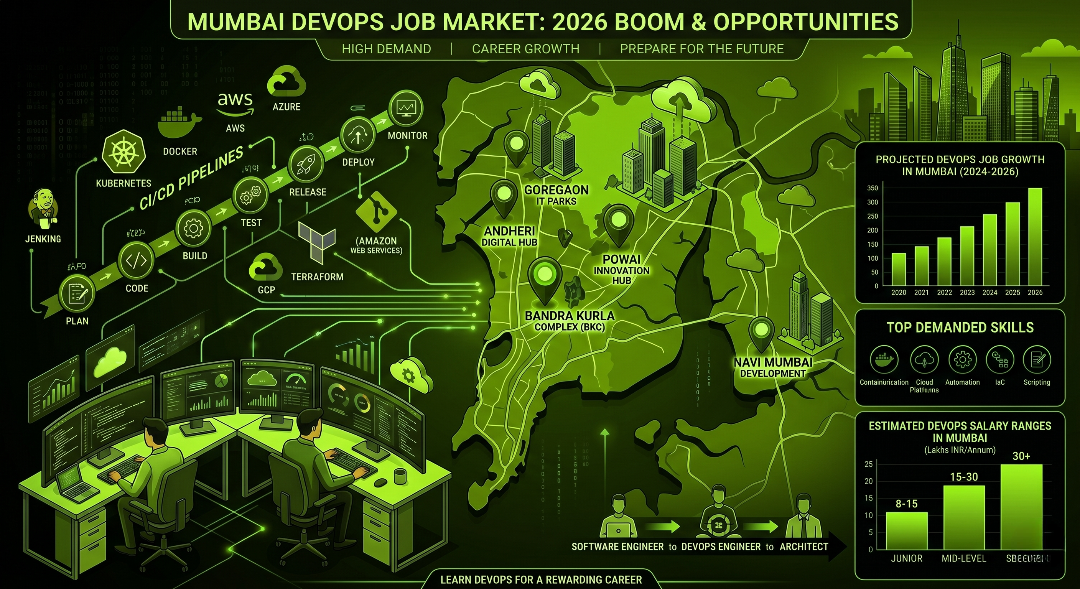
From learner to industry-ready professional: How structured DevOps training, hands-on projects, and placement support help students transition into DevOps engineering careers.
8. Three Traps to Avoid When Enrolling
Trap 1: Choosing purely on price A ₹15,000 course with 500 students and no code review will cost you 6 months of job searching. Calculate the real cost of delayed employment before deciding purely on upfront fees.
Trap 2: The “100% Placement Guarantee” banner No training institute can hand you a job. They can prepare you technically, connect you with hiring managers, and coach your interview; that’s it. If they’re guaranteeing employment, ask to see their refund policy in writing.
Trap 3: Going fully online for complex troubleshooting skills. Kubernetes cluster failures, multi-stage pipeline debugging, and cloud networking issues are incredibly hard to learn asynchronously. Having an instructor debug your specific error in real time compresses weeks of frustration into a 15-minute fix.
9. FAQs
Which DevOps course is best in Mumbai?
The best course is the one with the smallest batch size, verifiable placement records, a chaos engineering lab methodology, and physical or hybrid access convenient to your commute. For Western Mumbai residents, Nixace Technologies in Goregaon West meets all four criteria.
What is the DevOps course fee in Mumbai?
Fees range from ₹15,000 (online, large batch) to ₹100,000+ (premium classroom).
Is AI replacing DevOps?
No. AI automates routine scripts and generates configuration templates; it cannot manage production outages, design hybrid-cloud architectures, or own incident response. AI actually increases the value of skilled DevOps engineers by making junior tasks automated, shifting demand toward senior-level systems thinking.
Fresher
Experience: 0–1 year
Salary Range: ₹4.5–8 LPA
Mid-level
Experience: 2–4 years
Salary Range: ₹10–18 LPA
Senior / L3
Experience: 5+ years
Salary Range: ₹20–30 LPA
Principal / L4
Experience: 8+ years
Salary Range: ₹35–60 LPA
Can I learn DevOps in 3 months?
You can build a strong foundation in 3 months: Linux comfort, basic AWS, CI/CD fundamentals. Mastering Kubernetes, advanced IaC, and cloud security takes 6–12 months of consistent hands-on practice.
Is DevOps still in demand in 2026?
Yes, Mumbai’s demand is particularly driven by fintech, e-commerce, and banking technology sectors, where cloud-native infrastructure at scale requires dedicated platform and DevOps engineers.
Is DevOps a future-proof career?
As long as software runs on cloud infrastructure, which will be for the foreseeable future, there will be demand for engineers who automate, secure, and optimize delivery pipelines. The addition of AI/ML workloads has made the role more complex, not less relevant.
What are L1, L2, L3, and L4 DevOps levels?
L1: Associate works on defined tasks with guidance. L2: Mid-level, independently manages pipelines and resolves environment issues. L3: Senior, designs architecture, leads incident response. L4: Principal, owns company-wide infrastructure strategy.
Comments
Log in or sign up to join the conversation.