

The market just left Accenture for dead.
Here is a company that still turns every $1 of operating assets into about 28 cents of profit — a number most businesses can only dream of. And yet, over the past few months, investors cut its stock roughly in half. At today’s price near $126, the market isn’t betting Accenture grows slowly. It’s betting Accenture shrinks.
That gap — between what a business actually earns and what its price assumes — is the whole game right now.
In June 2026, AI and tech stocks had their first real scare in a while. Nvidia slipped from its May high. Famous investors like Michael Burry and Ray Dalio warned about a bubble. So the question every reader is really asking isn’t “are these good companies?” Most of them are. The question is: at today’s price, what is the market already assuming — and is that assumption fair?
This is our best AI and tech stocks list for 2026, built around that one question. We ranked 15 leaders not by who ran the most, but by how much of the good news is already in the price.
AI stocks vs tech stocks — what we actually mean
Quick definition, because the words get blurry. “AI stocks” earn a real chunk of their value from artificial-intelligence demand — the chips, the cloud, the software. “Tech stocks” is the bigger family they belong to. Almost every AI leader is a tech company; not every tech company is riding AI.
Our 15 names cover the whole stack: the model-makers (Meta, Alphabet, Microsoft), the device and software giants (Apple, Adobe), the “picks and shovels” that sell to everyone building AI (Nvidia, Broadcom, the chip-equipment makers), and the consultants who install it (Accenture).
How we ranked them — the framework
Most lists rank by what already happened: biggest company, best one-year return. That rewards the stocks that already ran the furthest. We do the opposite, using three lenses, in plain English.
First, is the engine real? We measure return quality with RNOA — Return on Net Operating Assets. It’s simply profit margin multiplied by how hard the assets work. A high RNOA means a great money-machine, not just a big one.
Second, is it actually creating value? We track residual operating income — ReOI. That’s the profit left after charging the company for the capital it uses. Positive and rising ReOI means real wealth is being built, year after year.
Third — the one nobody else shows you — how much of today’s price is a bet on the future? We call it speculative growth. We work out what the business is worth on its current earnings alone, then measure how much of the share price sits above that. The rest is hope. Sometimes hope is justified — but you should know how much you’re paying for it.
We don’t use a DCF. (We’ve written separately about why a discounted-cash-flow model mostly measures a guess about the year 2050.) Our intrinsic values come from what a company earns now — grounded, not forecast-dependent.
One more number ties it together: the market-implied growth rate — the growth the current price is quietly assuming. Put it next to what the company has actually delivered, and you can see instantly whether the market is being stingy or greedy.
The one number, in one sentence: the more of a price that rests on growth a company hasn’t delivered yet, the more that has to go right just to stand still.
The 15, sorted from grounded to stretched
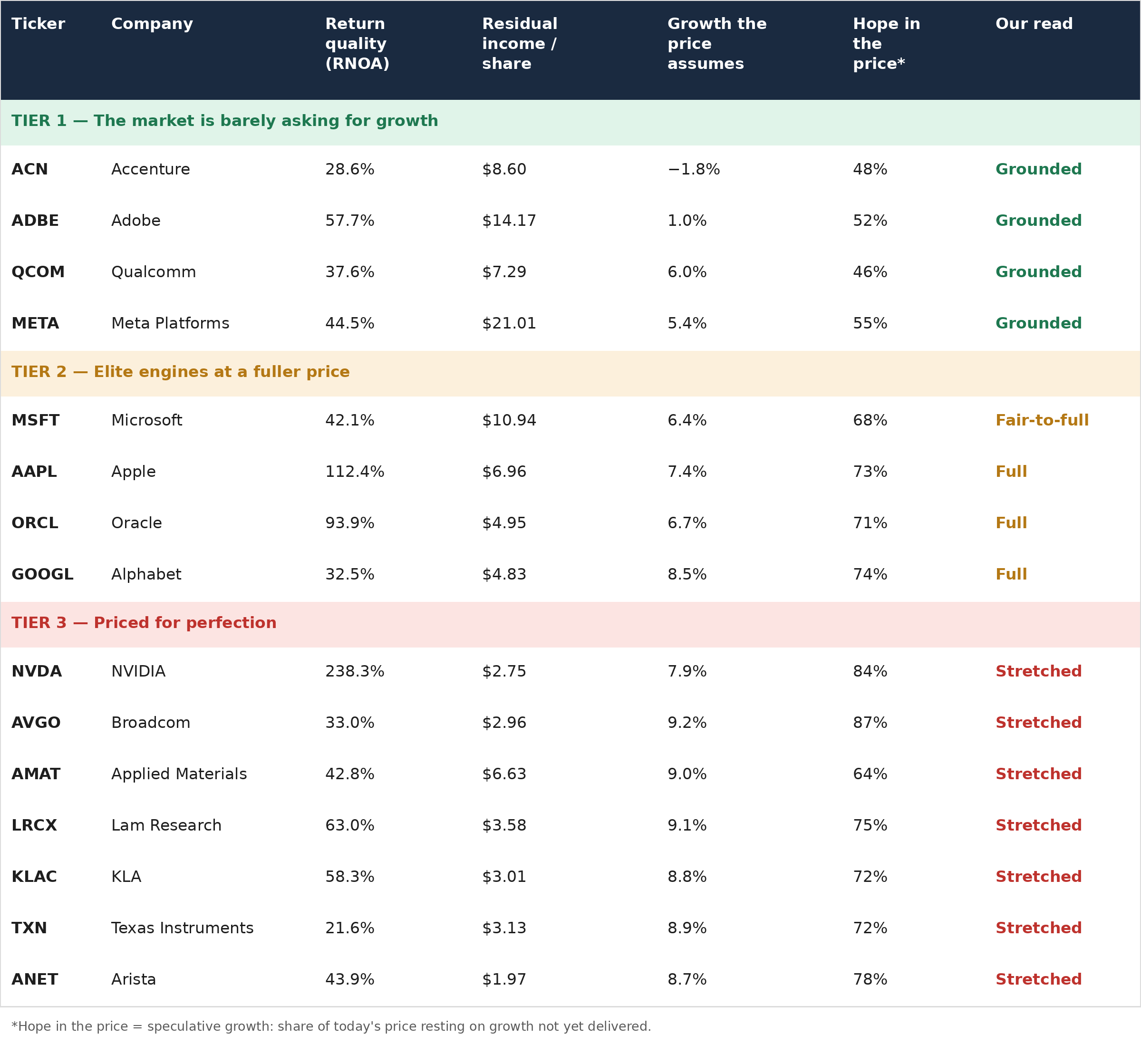
“Hope in the price” = speculative growth: the share of today’s price that rests on growth not yet delivered. RNOA, residual income and implied growth are FY2025 outputs of the FinancialBeings residual-income model. Figures as of 25–26 June 2026; verify against company filings before acting.
Tier 1 — The market is barely asking for growth
These four share one trait: the price is asking for very little. That’s where a value investor’s heart rate picks up.
Accenture (ACN). Start here, because it’s the clearest mispricing-or-warning in the group. The stock fell about 50% this year, and near $126 the market now implies growth of roughly minus 2% — a slow shrink — for a firm still earning 28% on its operating assets. The bear case is real: consulting demand has cooled, and clients wonder if AI will do some of the billable work; Accenture’s residual income did slip from its 2023 peak. But you don’t need it to boom. You need it not to collapse. On the current engine alone, our model puts intrinsic value well above the price. This is the textbook “priced for decline, still printing profits” setup.
Adobe (ADBE). The market is pricing in about 1% growth — almost none — for a software toll-booth that earns a remarkable 58% on operating assets. Why so glum? Fear that generative-AI image tools erode Adobe’s creative moat. That fear is the opportunity: residual income is actually rising, and barely any growth is baked into the price. If Adobe merely holds its ground, today’s price looks light.
Qualcomm (QCOM). The cheapest engine in the group on an unlevered P/E near 17, and the lowest share of price resting on hope (about 46%). The worry is old and familiar: phone cycles, and Apple eventually building its own modems. But edge-AI — running AI on your device instead of the cloud — is optionality you’re getting close to free.
Meta Platforms (META). The residual-income champion of the whole list — about $21 per share of economic profit. Its AI-and-advertising machine earns 44% on operating assets, and the price asks for only ~5% growth, less than Meta has been compounding. The catch: heavy AI spending and lumpy profits (2022 was an air-pocket). But you’re not paying a fortune for the future here.
Tier 2 — Elite engines at a fuller price
World-class businesses — but now roughly two-thirds to three-quarters of each price is a bet on growth. Wonderful companies; you’re just paying closer to full freight.
Microsoft (MSFT). The cleanest compounder in tech — residual income up from $54bn to $81bn in four years, 42% returns on operating assets, Azure and Copilot humming. The price implies about 6–7% growth, fair for this quality. Not a bargain; not crazy.
Apple (AAPL). The most consistent profit machine here — its residual income dipped only once in a decade — and an eye-watering 112% return on operating assets, because it owns brands, not factories. The price assumes steady ~7% growth from a maturing hardware giant. Quality you can trust; valuation you should respect.
Oracle (ORCL). The re-rating story: a cloud backlog (its “RPO”) that investors are betting converts into years of growth, on top of a 94% return on operating assets. The asterisk is the balance sheet — Oracle is the most financially levered name in this group, funding the boom with debt — so size it like the higher-risk bet it is.
Alphabet (GOOGL). Gemini, Cloud, and the cash-gusher of Search. Yet the price now implies about 8.5% growth — toward the top of our range — just as AI search raises a real question about Google’s core. Great business; the market has already priced a lot of the win.
Tier 3 — Priced for perfection
Here is the heart of the AI trade — and the heart of the risk. These are often superb businesses. But 64% to 87% of each price rests on growth that hasn’t happened yet, and the market is demanding roughly 9% growth across the board. They can still win. They just can’t afford to disappoint.
Nvidia (NVDA). Let’s be clear: the engine is the best we’ve ever measured — a 238% return on operating assets, residual income that went from a rounding error to nearly $100bn. The quality isn’t the question. The price is. About 84% of it is a bet on the future, at an unlevered P/E above 60. After the run, you’re not buying a cheap stock; you’re buying a magnificent company at a magnificent price. Position size is the whole conversation. (Worth noting: on our risk screen Nvidia is one of the structurally safest operating engines here — the risk is the valuation, not the balance sheet.)
Broadcom (AVGO). The most stretched name on the board: roughly 87% of the price is speculative growth, at an unlevered P/E near 81. The custom-AI-chip story is genuine. But almost nothing about today’s price is supported by today’s earnings. Handle with care.
The chip-equipment trio — Applied Materials (AMAT), Lam Research (LRCX), KLA (KLAC). The real picks-and-shovels: they sell the machines that make every AI chip, and they earn beautiful returns (43%, 63%, 58%). The catch is that this is a cycle, and the price assumes ~9% growth as if the boom never ends. Their residual income has been choppy. Wonderful franchises, priced as if cyclicality were cured.
Texas Instruments (TXN). A caution flag. The price implies ~9% growth, but TXN’s residual income has actually been falling — from $6.8bn to under $3bn. That’s the widest gap on the list between what the market wants and what the company is currently delivering. A heavy factory-building phase is the reason; just know you’re paying up for a turnaround that hasn’t shown up yet.
Arista (ANET). The quiet winner of AI networking — residual income up every single year, from $0.6bn to $2.5bn, at 44% returns. The only knock is price: about 78% of it is hope, implying ~9% growth. A lovely business doing everything right, with little room for error left in the stock.
Are AI and tech stocks overvalued right now?
Some are. Some aren’t. That’s the honest answer the cheerleading lists won’t give you.
The warning signs are real. The market’s long-term valuation gauge (the Shiller P/E) sits above 40 — a level seen only a couple of times in history. A handful of giant names make up an unusually large slice of the whole S&P 500. And the industry is spending over a trillion dollars on AI while AI revenue is still measured in the tens of billions. Burry, Dalio, and even the Bank of England have raised a hand.
But “the market” doesn’t have one price. Our 15 names split cleanly. Accenture, Adobe, Qualcomm and Meta are asking for little growth — some are priced for decline. Nvidia and Broadcom and the equipment makers are priced for years of near-flawless execution.
The June 2026 drawdown didn’t make everything cheap. It made a few things grounded and left others rich. The work is telling them apart.
How to size up any AI stock (the questions to ask first)
You don’t need our spreadsheet to think like an owner. Before you buy any AI stock, ask these six plain questions:
1. Does the business earn strong returns on the money tied up in it? And does it do that year after year, not just in one hot patch? Consistent beats flashy.
2. Is it genuinely creating value, or just getting bigger? Growth only counts if the company earns more than the capital it consumes to get there.
3. How much of today’s price is a bet on the future? The more the price leans on tomorrow rather than today’s earnings, the more has to go right.
4. What is the price quietly assuming about growth — and has this company ever delivered it? Optimism you can check against a company’s own history is safer than optimism you can’t.
5. Is the balance sheet strong enough to survive a bad year? A great business with fragile financing is still fragile.
6. Are you too concentrated? If a handful of names dominate your portfolio, you own their risk too.
Those are the questions. The disciplined math behind them — and the ranking it produces — is the work we do for you.
Frequently asked questions
What are the best AI and tech stocks to buy in 2026?
On quality and value together, the most grounded names in our screen are Accenture, Adobe, Qualcomm and Meta — strong returns on capital with relatively little growth baked into the price. The mega-cap engines (Microsoft, Apple, Alphabet) are excellent but fuller-priced. Always re-check current figures before acting.
Are AI stocks in a bubble?
Parts of the market are richly priced — the Shiller P/E is above 40 and a few names dominate the index. But it’s name-by-name: several leaders screen as reasonable on current earnings, while others are priced for perfection.
What are “picks and shovels” AI stocks?
Companies that sell into the AI build-out no matter which model wins — chip-equipment makers like Applied Materials, Lam Research and KLA, and networking suppliers like Broadcom and Arista.
Is Nvidia still a buy after its run?
Its competitive position and returns on capital are exceptional. The live question isn’t quality — it’s price. With most of the stock resting on future growth, this is a position-sizing decision, not a momentum chase.
The bottom line
Own the demand, own the toolchain — but let price decide how much you own of each. The companies on this list are mostly superb. In June 2026, the difference between a good investment and a bad one is almost entirely about what you pay.
The market left Accenture for dead. Whether that’s a mistake or a warning is exactly the kind of question this framework is built to help you answer — for yourself.
Comments
Log in or sign up to join the conversation.