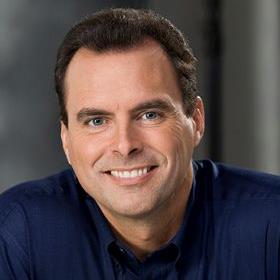


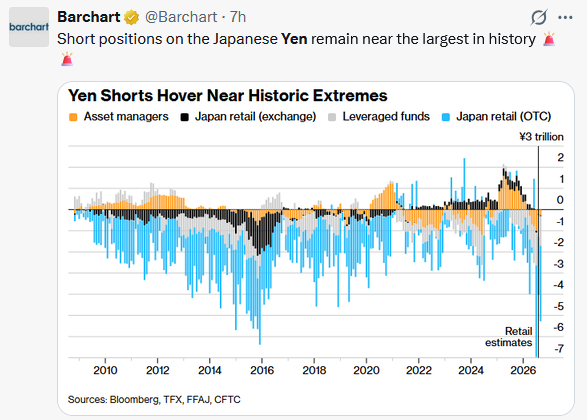
At a speech Tuesday night at SMU, Treasury Secretary Scott Bessent threatened currency traders to bet against him on the Japanese yen, claiming,
I am the house now, so when we intervene with the Japanese yen, I have pretty good insight into what the Japanese, what the Bank of Japan is going to do, what Japanese policymakers are going to do … And you can bet against me if you want.
While Bessent aimed his threatening comments at yen currency traders, the media is taking notice and presuming the words were also directed at the US Treasury markets.
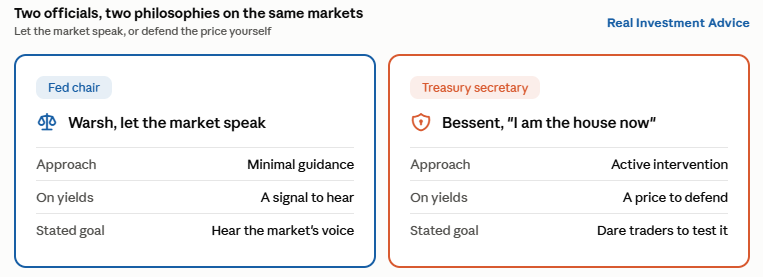
Interestingly, Bessent’s verbal and physical market interventions fly in the face of recent commentary from his old boss, famed investor Stanley Druckenmiller, and Fed Chair Warsh. In our summary of Druckenmiller’s editorial (Druckenmiller Has A Warning: Don’t Mess With Markets), he argues the 30-year yield is “the only fiscal disciplinarian the U.S. has left,” and that “every basis point of artificial yield suppression is a subsidy to procrastination.” Fed Chair Warsh has limited forward guidance to better hear the bond market’s message. Bessent’s threatening “I am the house” makes it clear he intends to defend a price rather than let market levels prevail. This runs opposite to Warsh and Druckenmiller’s views.
There’s a real irony here, as we elaborate in a section below. Bessent helped George Soros bet against the Bank of England’s currency peg in 1992, earning them roughly $1 billion in profits.
What To Watch Today
Earnings

Economy
Market Trading Update
Yesterday, we flagged that the buyers who carried August are stepping back, and the tape spent the session leaning on support again (see yesterday’s commentary). Today, let’s widen the lens, because the real risk in this market isn’t any single chart. It’s that almost everything is crowded at the same time.
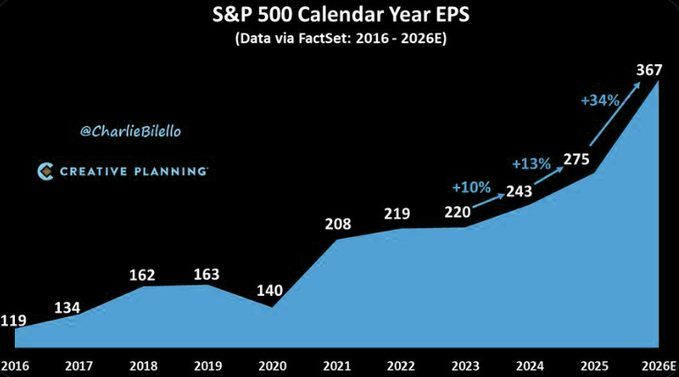
Step back, and the setup rhymes across markets. S&P 500 earnings are now expected to grow 34% in 2026, more than double the 15% penciled in at the start of the year. We’ve only seen that pace coming out of recessions. This time there was NO recession.
Add to that the fact that forward hyperscaler capex has risen from under $300 billion to roughly $940 billion, per BofA. Refining cracks just hit records, and Brent is knocking on $100. The 10-year yield touched 4.82% last week, its highest since late 2023. Different markets, same direction.
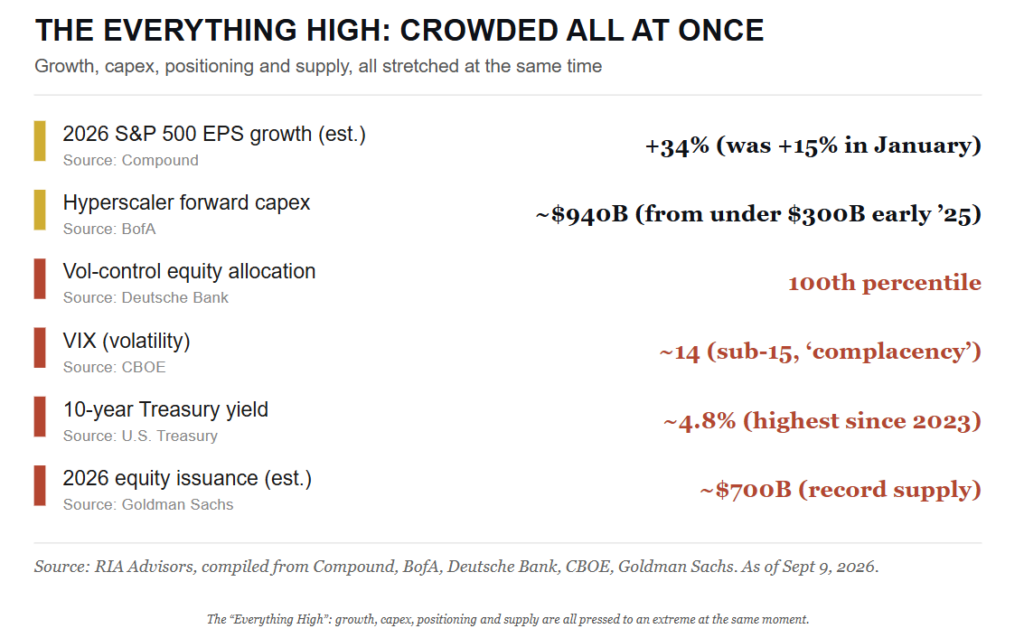
Here’s what matters for risk. That same “everything up” shows up in investors’ positioning. Deutsche Bank pegs vol-control equity allocations at the 100th percentile, a direct product of how quiet the tape has been. The VIX is near 14, which Mike Santoli aptly called “eerie complacency.” Dollar positioning is stretched. Goldman looks for a record $700 billion of equity supply to arrive in 2026. When everyone leans the same way, the exits get narrow.
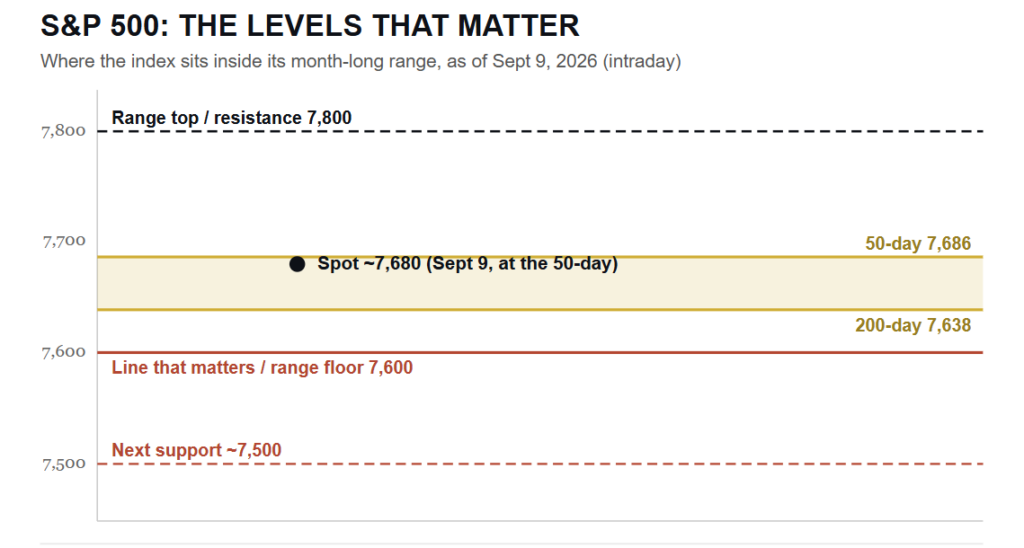
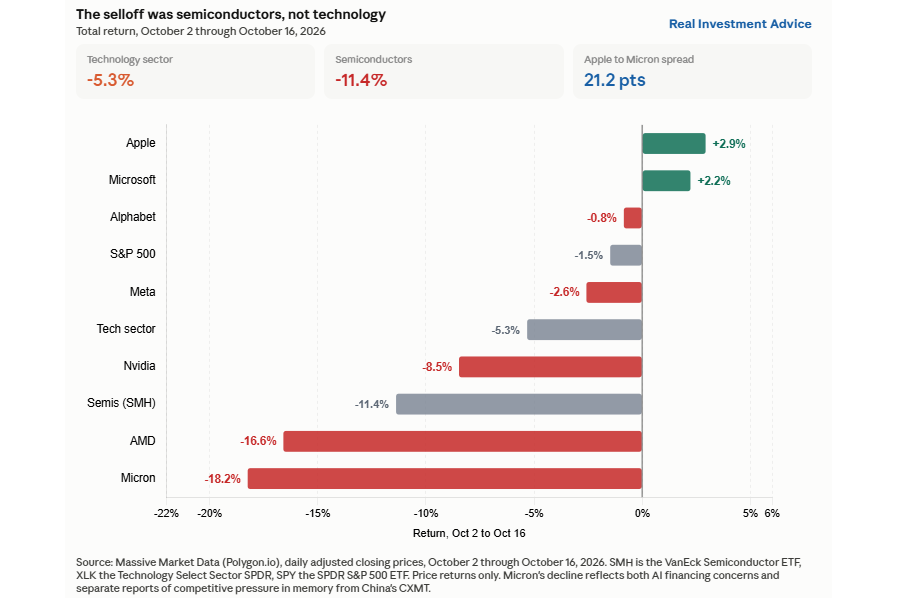
Now look at where the index actually sits. Around 7,680 on Wednesday, the S&P is pinned to its 50-day average near 7,686 and just above its rising 200-day average near 7,638. Momentum has cooled, not collapsed. The 14-day RSI is in the mid-40s, and the MACD has rolled under its signal line. Underneath, breadth turned weeks ago. Nvidia and Micron alone drive about a third of this year’s profit growth, per Schwab, so the index is being carried by a shrinking handful of names.
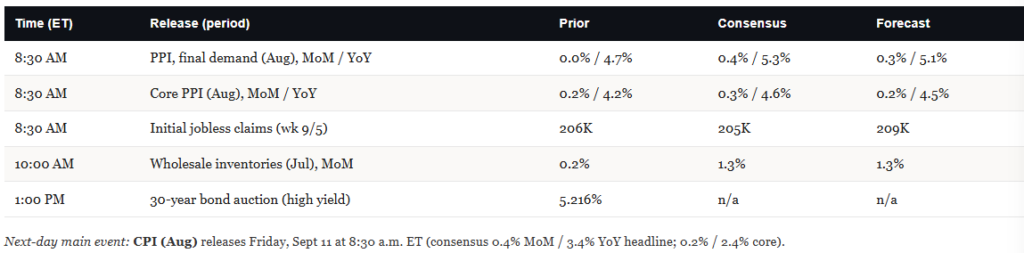
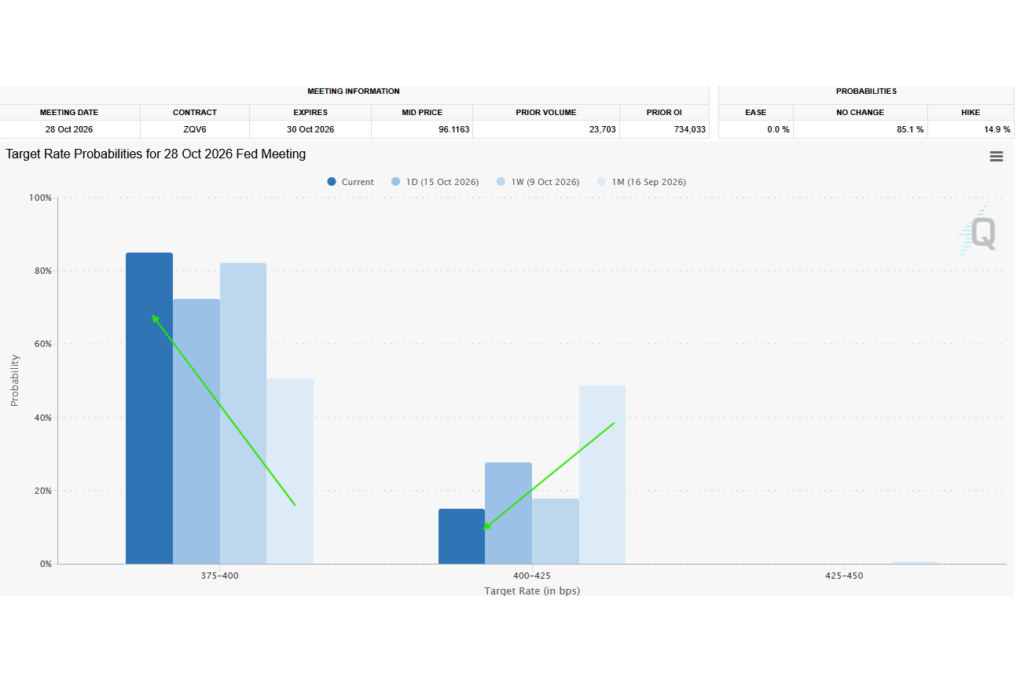
You don’t need a recession to unwind crowded positioning. You need a catalyst, and this week hands the tape two of them: PPI today and CPI tomorrow, with a Fed that may actually hike on the 16th.
7,600 is the level that matters, the floor of a month-long range. The 200-day at 7,638 is the first thing to give on the way there. Lose 7,600 and the low-7,500s come quickly. Rebalance winners to target, lift quality, and keep dry powder. Capital preservation comes first. We can always buy back in.
Bessent, Druckenmiller And Soros Bet Against The House
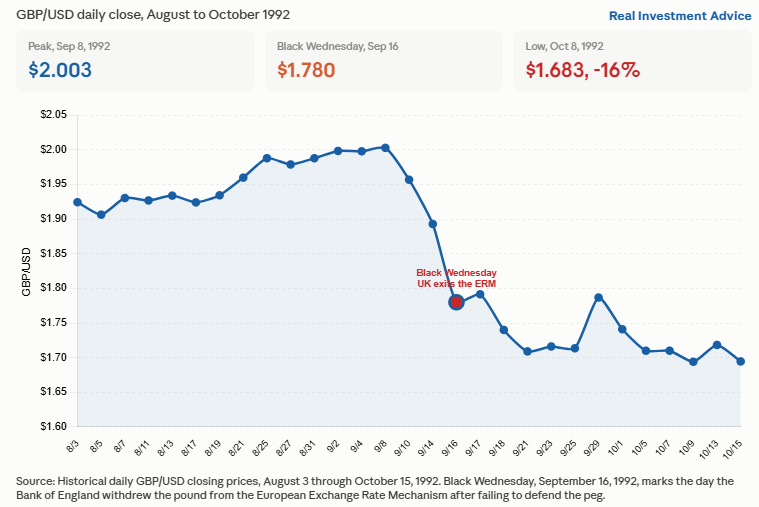
Bessent’s threatening traders that “I am the house now” is paradoxical. In September 1992, a young 29-year-old Bessent headed the George Soros Fund Management’s London office. At the time, the Bank of England (BOE) pledged to peg the pound inside a narrow band against the German mark. Most UK mortgages had variable rates, meaning defending the pound with higher interest rates would devastate British homeowners and the economy. Thus, instead of raising rates to defend its currency, the BOE opted to defend it in the markets. Bessent, believing that the BOE could not counter market forces, convinced George Soros to bet against the pound. Stanley Druckenmiller, then Soros’s chief strategist, backed the trade too.
Bessent, Soros, and Druckenmiller were right. Currency traders sold/shorted more pounds than the BOE could buy, forcing Britain out of the European Exchange Rate Mechanism (ERM) on what became known as Black Wednesday. It is estimated that the trade earned Soros’s fund over $1 billion, and Soros has since been known as “the man who broke the Bank of England.“
Bessent returned to Soros as the chief investment officer from 2011 to 2015. During this period, he successfully bet against the yen, the same currency he’s now defending as Treasury Secretary.
It’s ironic that Bessent made millions exploiting two central banks defending an unsustainable price and is now on the other side of that trade, as he threatens to defend the yen and implicitly US Treasury yields.
Hike Or Hold? Debating The Coming FOMC Decision
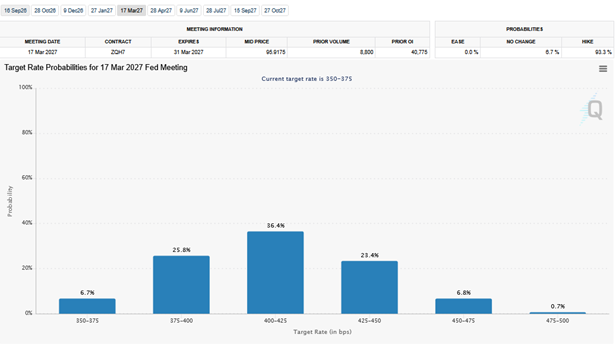
We are sympathetic to both sides. The prosecutor is 100% correct that we need to get inflation back to 2% as soon as possible. It has been above target for too long, and the Fed risks consumer and corporate spending behaviors changing in a pro-inflationary way. The debate at the Fed seems to come down to whether they let that occur naturally or force the issue.
The prosecuting side wants to raise rates to force inflation lower. The defense wants to wait, claiming the disinflationary trends that existed before the Iranian conflict are reasserting themselves and that higher rates could worsen an already weak labor market.
Some Fed members, including Warsh, claim that the recent spike in yields across the yield curve makes borrowing more restrictive for consumers and corporations, effectively doing the job for them.
We come down on the side of….. READ MORE…
Tweet of the Day

Comments
Log in or sign up to join the conversation.