


There’s quite a bit to talk about right now: The U.S. stock markets continue to hold up surprisingly well near their all-time highs, while precious metals appear to have finally broken out, bringing an end to a correction phase that lasted about half a year. However, it’s unlikely that Gold and Silver will sprint back to their peak levels at record speed just yet. That will require a bit more groundwork. But the broader conditions are beginning to shift in favor of precious metals again: First, the U.S. Dollar appears to have largely exhausted its bullish momentum, and second, the U.S. Treasury is now intervening in the interest rate landscape—which could mean that real market yields have also peaked for the foreseeable future. But first things first:
Let’s recall the carry trade in the Japanese Yen. For new subscribers, here’s a quick recap: Many investors have taken on debt in Japanese Yen at extremely low interest rates in order to then invest the equivalent amount at higher yields—for example, in U.S. Treasuries. To do this, the borrowed Yen must, of course, first be exchanged for U.S. Dollars. The interest rate differential is the profit—as long as a stronger Yen doesn’t put a damper on this lucrative deal. After all, at some point the loan must ultimately be repaid in Japanese Yen. So far, however, the strategy has been highly profitable: thanks to the falling Yen, investors were even able to reap substantial currency gains on top of that. Just how large is the volume of these Yen carry trades? No one knows for sure. Some estimate it at many hundreds of billions, while others put it at several trillion.
The current situation: Japanese market yields have risen sharply in the meantime, and new loans at rock-bottom interest rates are no longer available. This means the moment is approaching when many of these loans will have to be repaid. To do so, U.S. Treasuries are being sold, and the U.S. Dollars received from these sales are being exchanged back into Japanese Yen to pay off the loans.
Then there are the Japanese investors themselves. And, as is well known, they aren’t exactly short on cash. While Japan does have one of the highest levels of public debt in the world—measured as a percentage of GDP—Japanese investors could, in theory, finance this debt with their own savings—in stark contrast to the situation in the U.S. However, because interest rates in Japan have been extremely low over the past 30 years, many Japanese, just like professional investors, preferred to invest their savings abroad for higher returns—for example, in U.S. Treasuries. To do so, they first had to buy U.S. Dollars and sell Japanese Yen.
The current situation: Japanese investors are now once again earning quite respectable returns in their own country and in their own currency.
To prevent Japanese investors from selling their U.S. Treasury holdings, the U.S. Federal Reserve is offering the FIMA Repo Facility. This allows Japanese investors to lend their U.S. Treasury bonds instead of selling them and receive U.S. Dollars in return. This way, the bonds do not have to be sold on the open market, and market yields would not be driven up as a result. It’s a nice idea, but why would Japanese investors do this—instead of simply cashing out their investments?
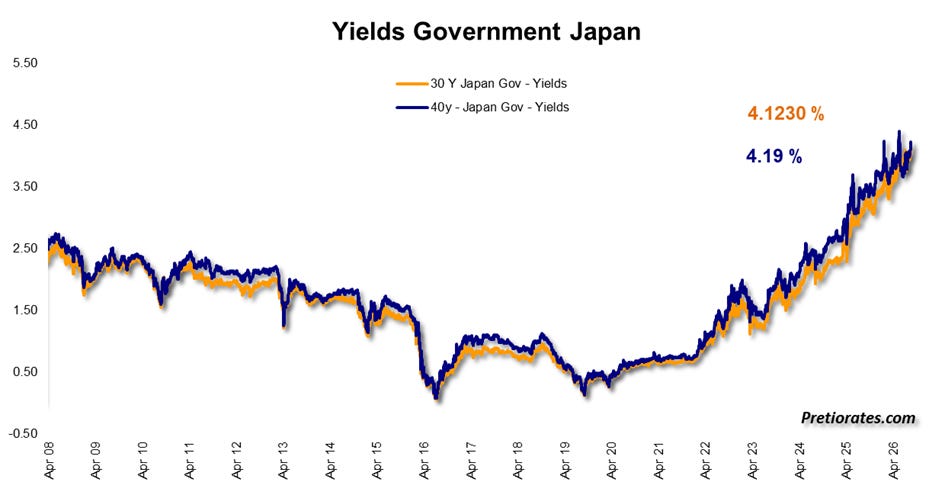
With their investments in U.S. Treasuries, they have also—thanks to the depreciation of their own currency—accumulated huge currency gains in U.S. Dollars. In the past five years alone, the U.S. Dollar has risen by no less than 45% against the Yen. No one would likely hold it against Japanese investors if they were now to sell their U.S. Treasuries and, in the process, pocket the currency gains as well. To do so, they would have to sell their U.S. Dollars and buy Yen again.
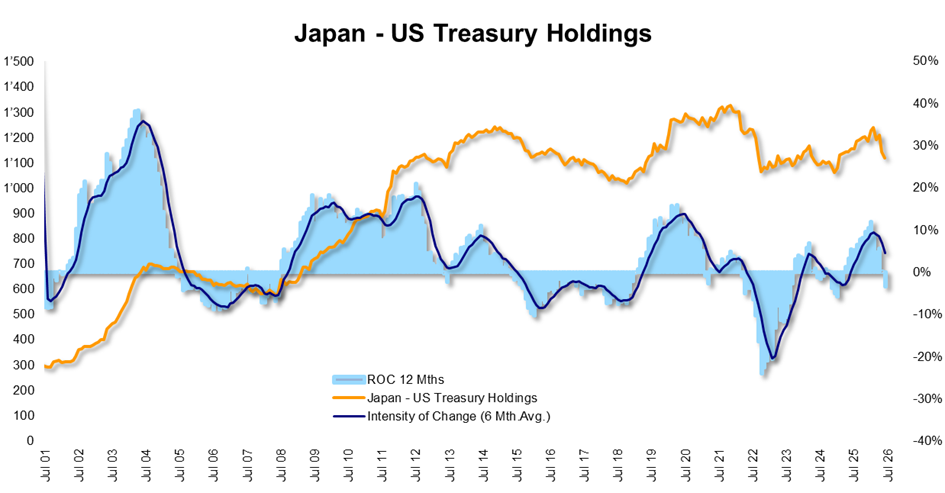
With approximately 1.1 trillion U.S. Dollars, Japanese investors are the largest foreign investors in the U.S. Treasury market. And they have already begun selling off their holdings.
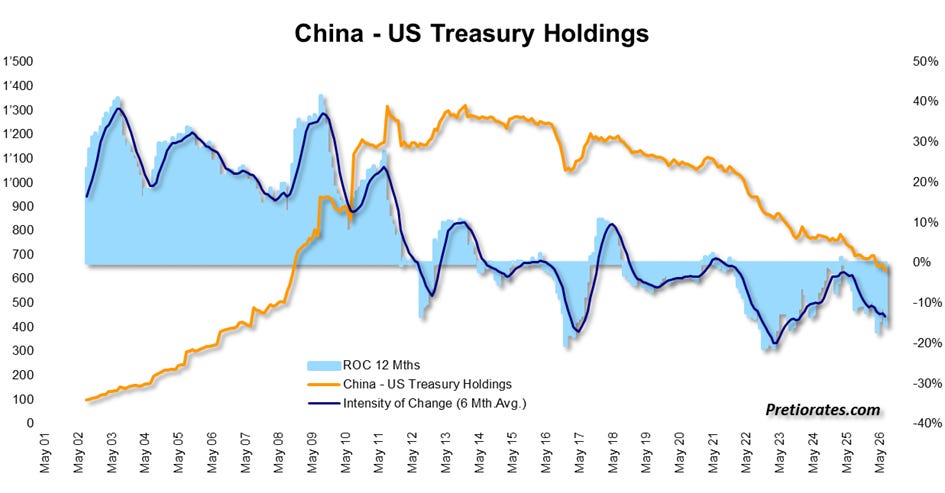
China, on the other hand, still holds about $600 billion in U.S. Treasuries, though it has been reducing this holdings for more than 14 years.
To summarize: Two very large investor groups in the U.S. Treasury market have entirely understandable reasons for reducing their positions: those investors who have financed their investments through Yen carry trades, and the Japanese investors themselves.
It is therefore hardly surprising that the yield curve in the U.S. Treasury market has undergone a remarkable reversal over the past twelve months. In the chart, the light blue line shows that a year ago, short-term yields were even higher than long-term yields. Since then, short-end market yields have fallen and have remained virtually unchanged since the end of last year. At the long end or at the far right end of the chart, however, the situation looks quite different: yields there have continued to rise. Market professionals refer to this as the yield curve becoming steeper at the long end.
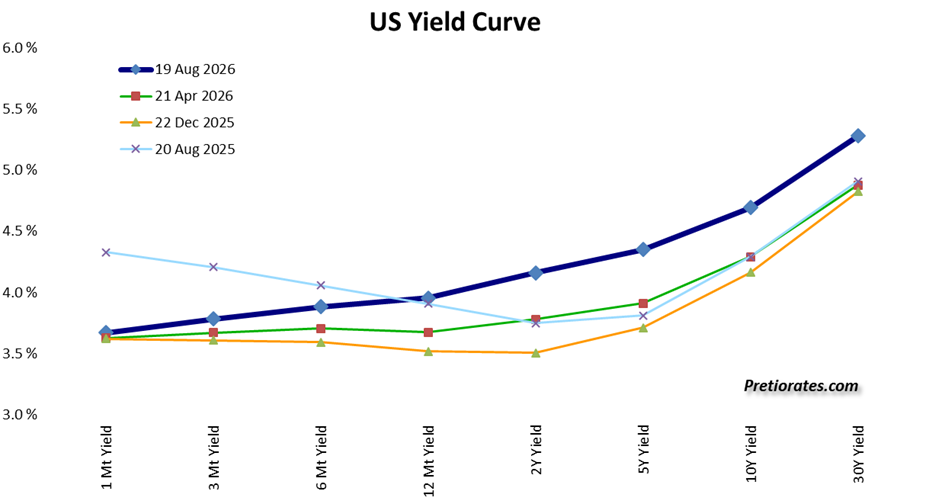
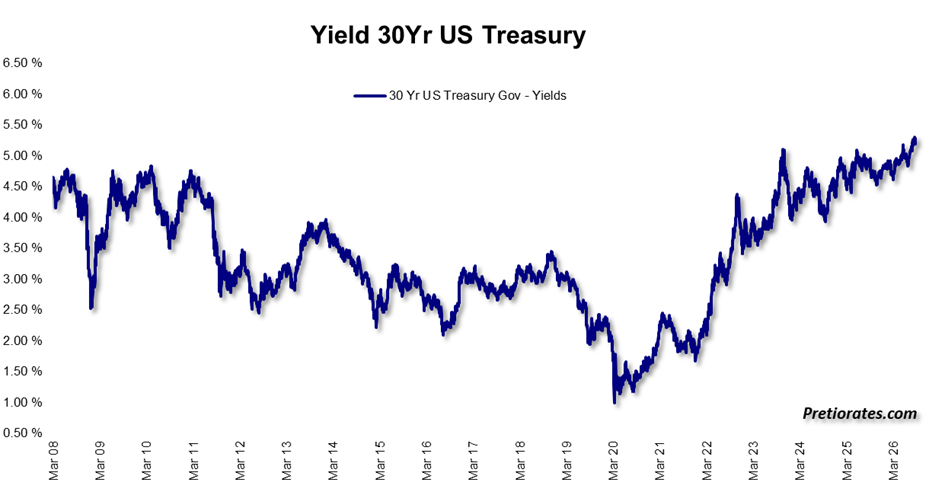
In fact, the yield on 30-year U.S. Treasuries clearly illustrates what has happened: from a low of around 1% in the first quarter of 2020, it has since risen to 5.3%.
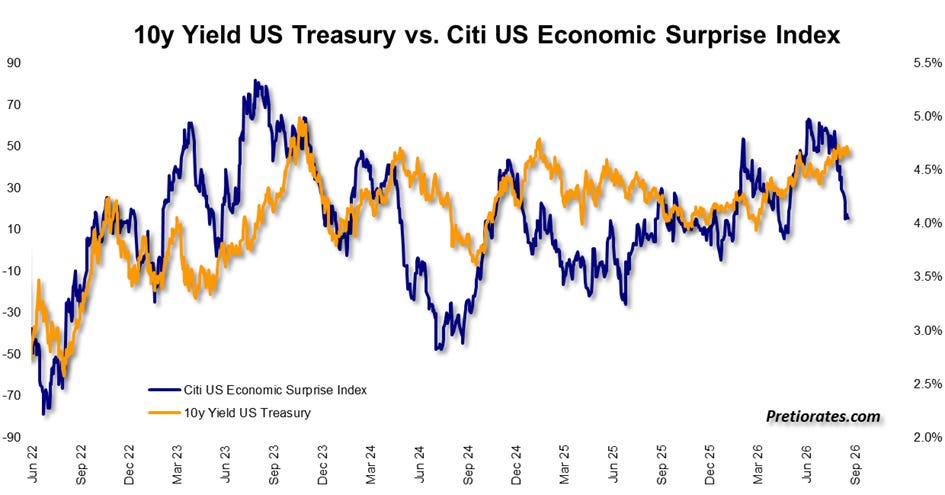
When interest rates rise, investment in the economy declines and economic growth slows. In fact, the Citi U.S. Economic Surprise Index already indicates that recent economic data has been largely disappointing. Strictly speaking, that would be an argument for lower interest rates again.
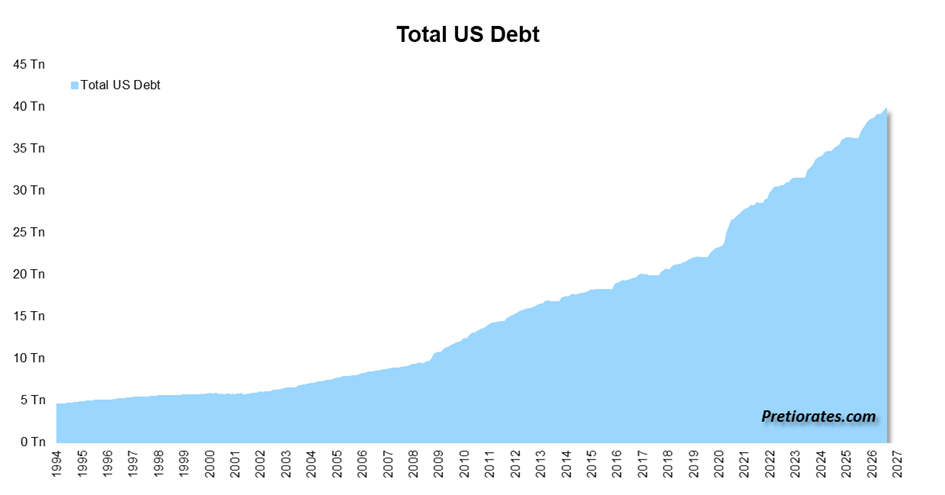
But then there’s the U.S. national debt—an issue that is likely to return to the forefront very soon. In a few weeks, the U.S.’s total debt will exceed the 40 trillion U.S. Dollar mark. This is likely to reignite the debate, which doesn’t exactly make investments in U.S. Treasuries more attractive. Consequently, market yields are rising. The law of the market is, after all, not very romantic: those who take on more risk also demand a higher return. Incidentally, at nearly 1.4 trillion U.S. Dollars, the annual cost of servicing the U.S. national debt is now higher than the GDP of more than 175 of the world’s 195 countries.
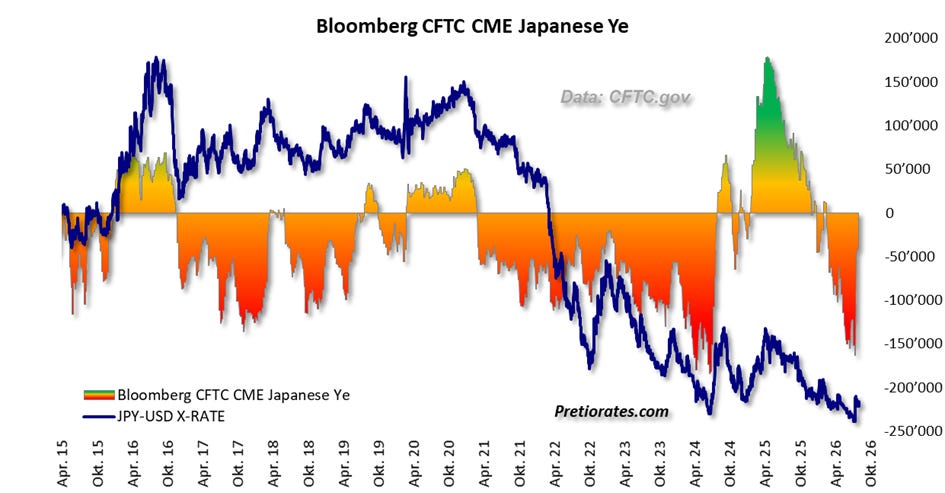
The futures market is also reacting: Hedge funds’ large short positions in the Japanese Yen have recently been drastically reduced.
Thus, this week’s summary highlights much of what we already knew about the current situation in the U.S.—but now with a much bolder stroke:
Yen carry trade investors are likely to sell U.S. Treasuries and U.S. Dollars and buy Yen instead.
Japanese investors are also likely to increasingly sell off their U.S. Treasury holdings, while simultaneously realizing their profits in U.S. Dollars and buying Yen as well, in order to reinvest the capital more heavily in the domestic market.
The U.S. Treasury is aware of this, is concerned about the Yen’s weakness, and—for the first time since 1998 during the Asian financial crisis and 2011 following the Fukushima disaster—intervened jointly with the Bank of Japan just under ten days ago. This is less a friendly favor to Tokyo than an expression of concern for the U.S. Treasury market.
Today, the U.S. Treasury Department also announced that it would increase repurchases of long-term U.S. Treasury bonds with a 30-year maturity from $2 billion to $4 billion.
Now, one might argue that an additional $2 billion in this gigantic market makes about as much of an impact as a glass of water in a swimming pool. And indeed: purely in terms of volume, the effect is modest. But what matters is the message and the timing—and they reveal a great deal between the lines:
A market yield of 5.30% on 30-year U.S. Treasuries seems to be slowly becoming the pain threshold.
Apparently, the U.S. Treasury Department is prepared to bring the first elements of yield curve control into play to defend this pain threshold.
Just two weeks ago, the U.S. Treasury presented its planned schedule for buybacks this quarter. That’s why today’s update comes as a complete surprise. Nerves are clearly on edge.
The increased buybacks will dampen the pressure, but not eliminate it entirely. This is also not quantitative easing—that is, not classic QE. Nor are any additional U.S. Dollars being printed. But the market now knows at least this much: U.S. Treasury Secretary Scott Bessent’s pulse is likely to beat a little faster at 5.3% on the long end.
This situation is particularly positive for precious metals, whose “insurance premium” is likely to become more expensive again: a U.S. Dollar facing selling pressure; interest rates that can hardly be allowed to rise much further; and U.S. government debt that is once again coming into sharper focus.


Comments
Log in or sign up to join the conversation.