

Oracle Corporation (ORCL), headquartered in Austin, Texas, is one of the world’s largest enterprise technology companies. Founded in 1977 by Larry Ellison, Bob Miner, and Ed Oates, Oracle has built its reputation around data management, enterprise software, and cloud computing. While the company’s fundamentals remain strong, the technical picture suggests a deeper correction is still unfolding.
Weekly Elliott Wave View — October 21, 2026
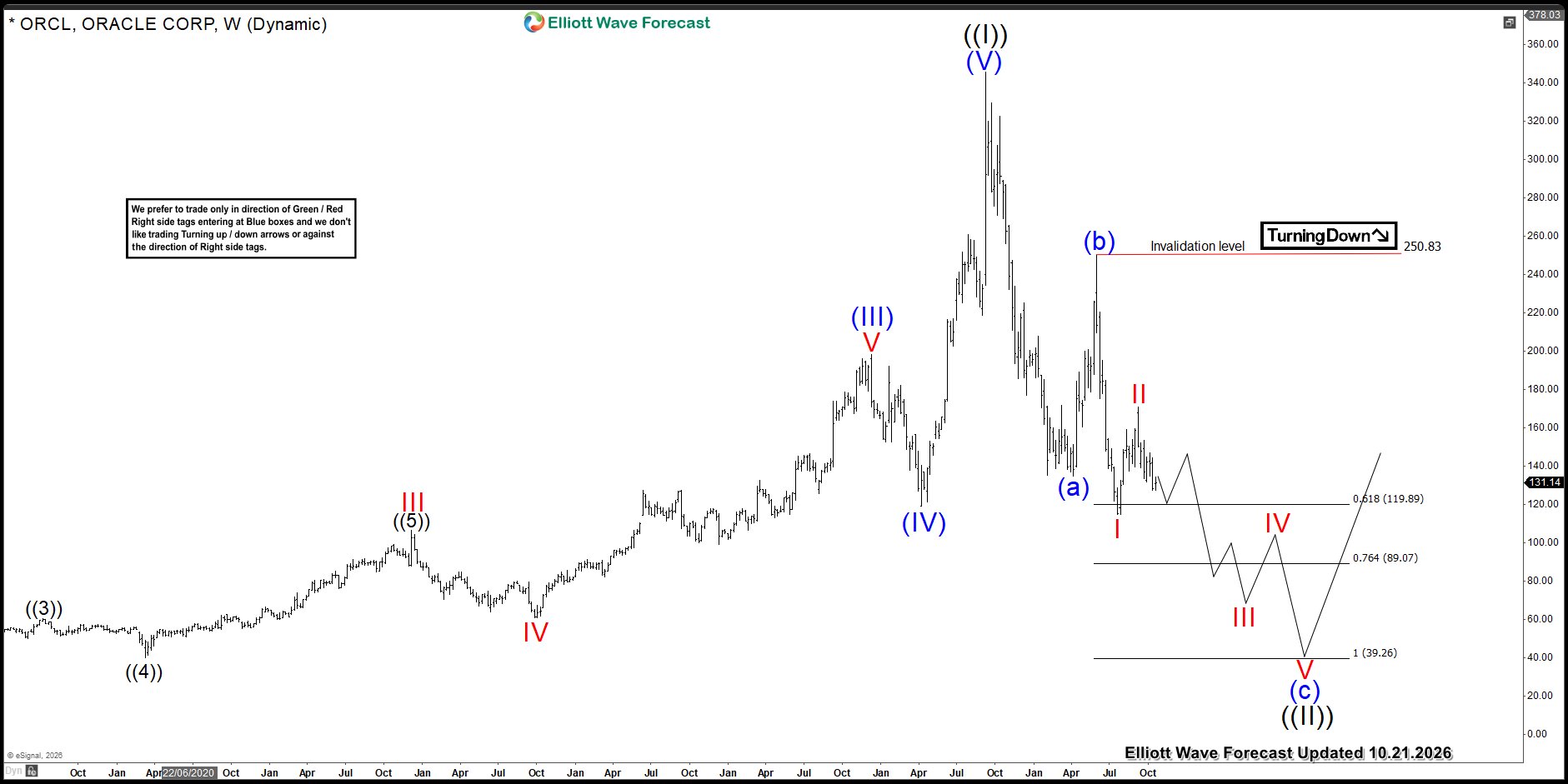
Chart Headline — Grand Super Cycle Pullback in Progress
The rally from all‑time lows peaked in Grand Super Cycle wave ((I)) at $345.72 in September 2025.
Since then, ORCL has been correcting within wave ((II)), unfolding as a zigzag structure.
Wave (a) ended at $134.57.
Wave (b) bounced to $250.83.
Wave (c) remains in progress, already breaking below the prior $134.57 low.
The lower‑low sequence points toward the 100% extension area at $39.26, where buyers may eventually re‑enter for the next cycle higher.
Current Outlook
Chart Headline — Bounces Likely to Fail Lower
Any short‑term rallies are expected to fail until the full corrective sequence completes.
The bearish bias remains intact while price stays below $250.83.
Traders should anticipate further downside before a sustainable bottom forms.
Trading Insight
Bias: Bearish until the correction completes.
Entry approach: Avoid chasing rallies; wait for the next blue‑box zone near $39.26 for potential long setups.
Stops: Define invalidation above $250.83.
Targets: Downside toward $39.26 before buyers can regain control.
Risk management: Use disciplined stops and position sizing to protect capital during volatile corrections.
Why This Matters
The Elliott Wave framework highlights how even strong companies like Oracle can undergo deep cyclical corrections. Recognizing these structures helps traders avoid buying too early and instead position for risk‑defined entries once the correction completes.



Comments
Log in or sign up to join the conversation.