

Summary
Bank stocks are sensitive to interest rates.
Interest rates are sensitive to the strength of the business cycle.
The attractiveness of bank stocks depends on the trend of the business cycle.
Stocks of financial companies (XLF), banks (KBXB), and regional banks (KBWR) have been strong in the past several months. From September 23, 2020 to March 19, 2021, they appreciated +48%, +76%, and +112% respectively while the S&P 500 (SPY) rose only +22%. During the same period yields on the 10-year Treasury bonds jumped +111%.
Wall Street applauded the performance of the bank stocks and decided the reason was the sharp rise in yields. The explanation for the performance of the bank stocks is more subtle.
Yields rise because business need to borrow money and the need to borrow money is closely related to the need to invest in new production facilities to increase output and replenish inventories.
Since March 2020, the inventory to sales ratio has been declining quite sharply. As I discussed in detail in my article “A Strong Economy And Risks For The Markets”, a decline in the ratio means business is running short of inventory relative to the growth in demand.
As long as growth in demand is higher than the growth of inventory, as reflected by the decline in the inventory to sales ratio, business is forced to increase production. The increase in production must happen to replenish inventories. The alternative is a loss in sales.
To increase production businesses must hire workers. The outcome is faster growth in manufacturing employment. The business will have also to pay these workers, resulting in rising income. And most important, businesses will have to borrow money to finance capacity expansions, capacity improvements, and to pay for the production of goods and their delivery.
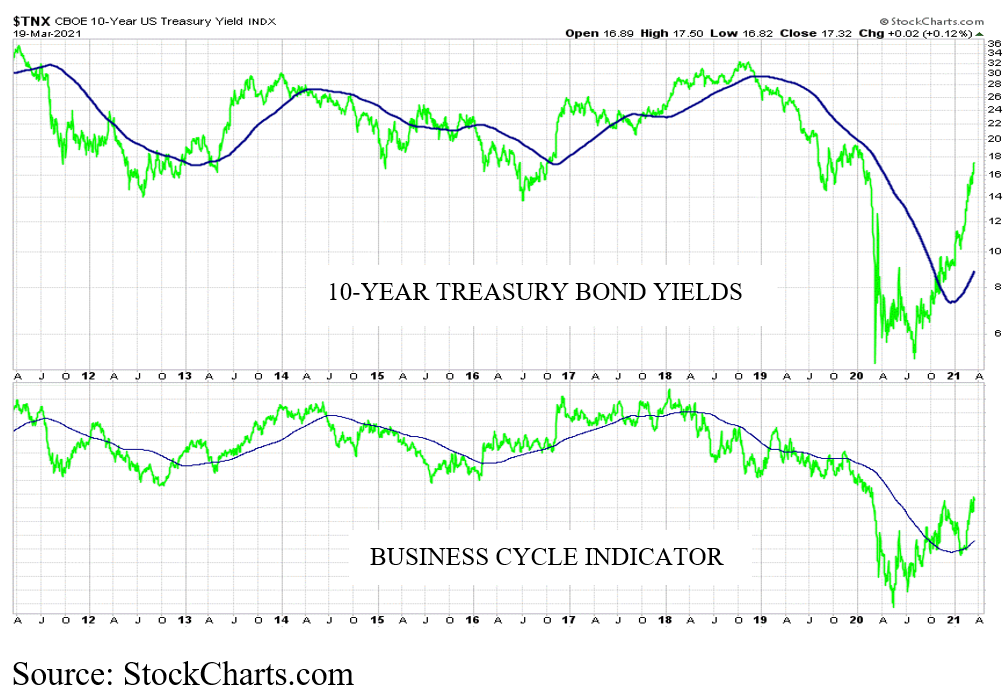
In the past, yields on 10-year Treasury bonds have moved in perfect synchronism with our business cycle indicators (see above chart). This indicator is updated in each issue of The Peter Dag Portfolio Strategy and Management on www.peterdag.com. (Complimentary subscription available to readers of this article.)
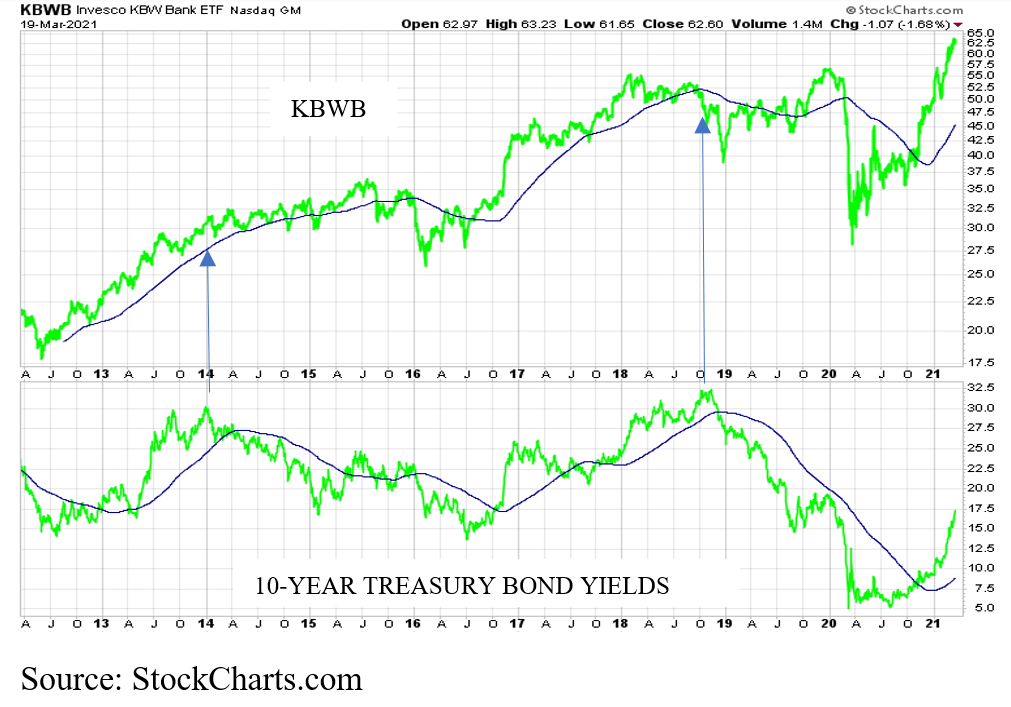
As recognized by Wall Street, bank stocks appreciate during a period of rising interest rates. Of course, bank stocks are strong because of the demand for money by a business during the rising phase of the business cycle. It is this increased demand that raises the price of the commodity money.
What is interesting to note in the above chart is bank stocks do not necessarily decline when interest rates decline. This pattern suggests watching only interest rates may lead to strategic errors.
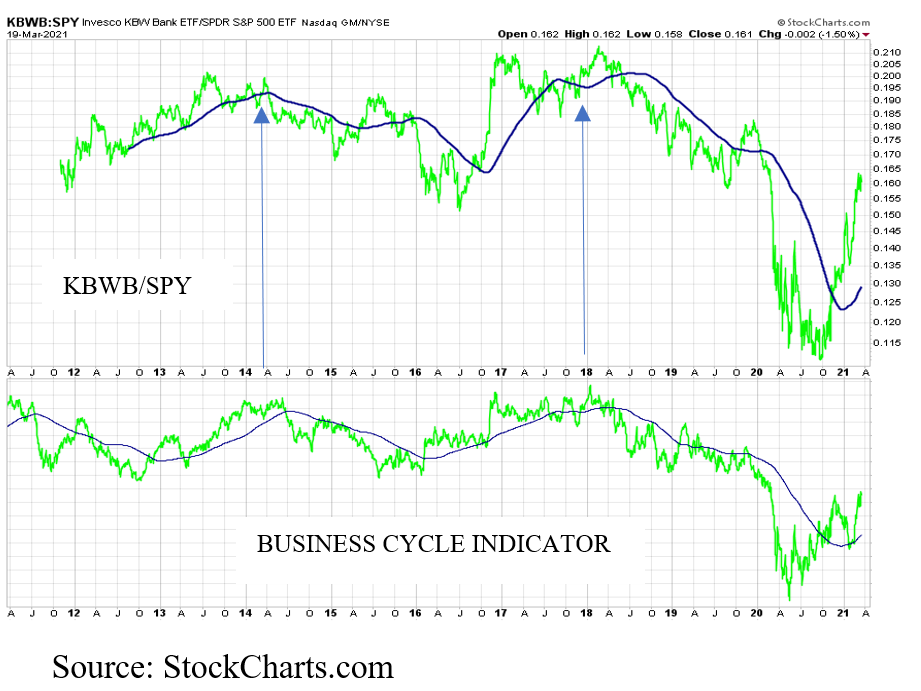
What is more relevant, however, is the direct relation of bank stocks to the business cycle. The above chart shows the performance of bank stocks (KBWB) compared to the S&P 500 (SPY). The business cycle indicator is shown in the lower panel.
A rising line in the upper panel of the chart shows bank stocks outperform the S&P 500. Bank stocks underperform the S&P 500 when the line declines. The graphs show bank stocks outperform the market when the business cycle rises. This is exactly what has been happening since March 2020. The chart also shows bank stocks begin to underperform the market when the business cycle declines.
Key Takeaways
Rising interest rates reflect a rising business cycle indicator.
Rising interest rates are good news for bank stocks.
Declining interest rates are not necessarily bearish for bank stocks. Bank stocks may rise even when interest rates decline.
Bank stocks begin to underperform the S&P 500 (SPY) when the business cycle declines. They outperform the market when the business cycle rises.



Comments
Log in or sign up to join the conversation.