

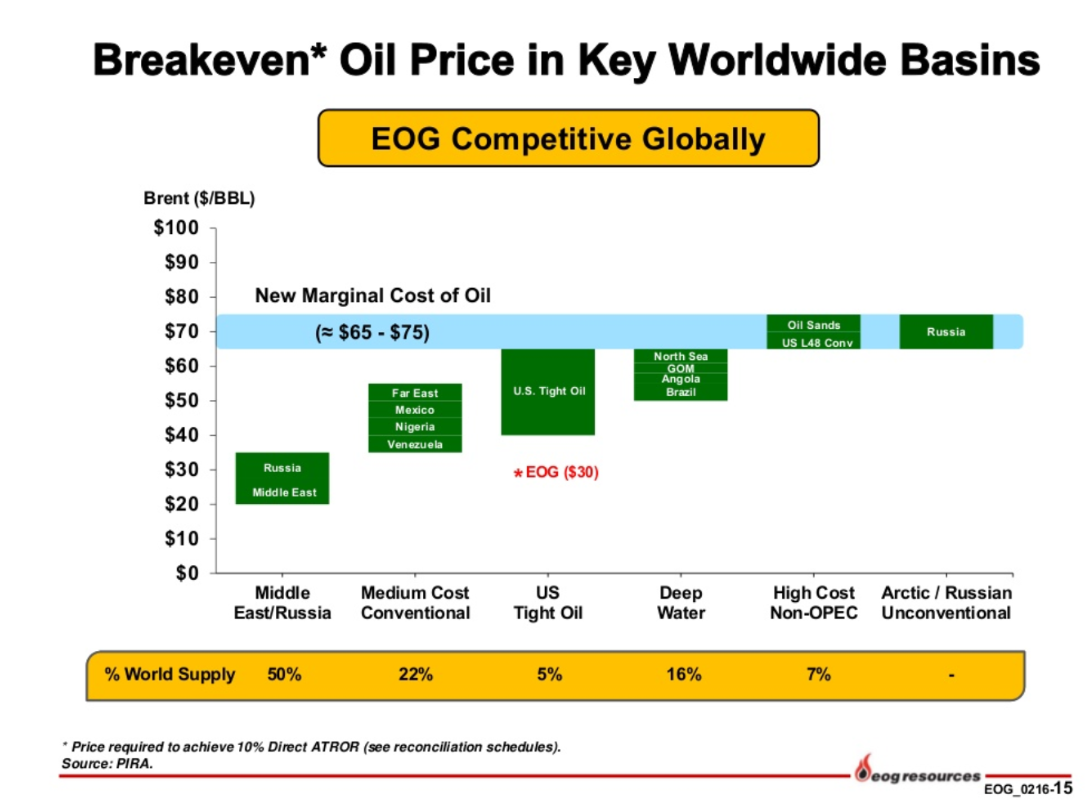
The recent oil price run up has led many to believe we are headed to the marginal cost of production.
(SOURCE: EOG)
Most would like prices to move into the range EOG Resources highlights above. $65 to $75/bbl oil provides very good economics in US core unconventional locations and would add to an already impressive gain in the US Oil ETF (NYSEARCA:USO).
(Source: Yahoo Finance)
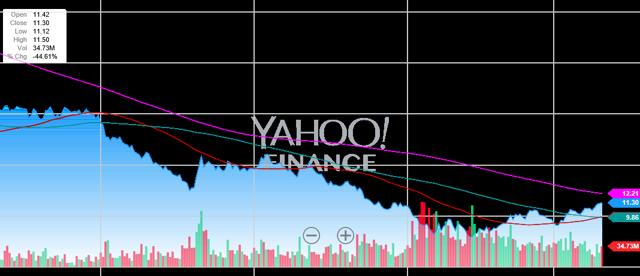
The key to this move is its commonality with 2015. It happened a couple of weeks earlier, but the same move last year saw the 50-day (red) intersect with the 100-day green) in mid-May. This bullish move was followed with a relatively flat USO. At the end of June, the USO saw the start of a significant drop. In late July the 50-day crossed below the 100-day. The 50-day began a bullish move again in 2016, but no one knows if this is the start of a prolonged bull market for oil, or if we see another drop.
Big improvements have been seen in world oil markets, as supply has continued to decrease while US demand has improved. Supply disruptions in Iraq, Kuwait, Nigeria, and Libya have all helped to balance supply and demand. This has been aided by natural declines from several countries including Brazil, the US and Venezuela. The key is if this is transient in nature or the beginning of something bigger. Oil prices could have difficulty in breaking above $50/bbl due to the possibility of production coming back on line. The US Fed is also an issue with a probable hike in June. Three hikes are possible in 2016, but the current nature of the Fed may lead to just one. More emphasis seems placed on the stock market than economic numbers, which could be a mistake. A stronger dollar is probably ahead, but the timing is the question. The possibility of increased production from low cost producers may also occur. The no-deal at Doha may push OPEC members to seek increased revenues. The Saudis recently stated production could increase by 2 million bbls/d in the next 6 to 9 months. It may be forced to increase production depending on Iran's ability to enter the market. Bloomberg recently stated Iran had increased production by 600K bbls/d since sanctions were lifted. Some believe the number is closer to 400K bbls/d, but it has been successful in getting back on line. With over 50 million barrels stored on the Gulf, Iran has large volumes to push in Europe and Asia. It is possible the oil markets have already balanced, but the upcoming refinery maintenance will substantially decrease throughput. This could lead to another pull back, but the hope is for a better year in 2017. No matter how one looks at the situation, it is difficult to grasp the direction of this market.
Half of world crude production comes from areas like the Middle East, but the oil sands, Russian arctic and conventional US are more important. These have higher production costs and are the new swing producers. OPEC and Russia may be able to increase production, but a large number of analysts do not believe this is the case. Although only a small percentage of world supply, US unconventionals could do more to effect oil prices. This isn't necessarily based on its ability to increase production in a low price environment, but maintaining production with hedges. Operators are currently being pressured by banks to add to its hedge book. Hedges can meaningfully affect how much a bank will decrease the operator's credit. When operators hedge production, it manages to put a ceiling on crude prices.
There are a large number of differing opinions on when and what price operators will start hedging production. Given the volatility of oil prices, most operators want to lock in at a price with a decent rate of return. Some believe operators wont hedge until we see forward pricing of $60/bbl, while others think a much lower price is needed. This article focuses on operator hedges developing areas with the lowest costs. We believe there could be significant resistance oil prices heading higher in 2016. When looking at operator hedges, it is best broken into a range delineated by the core areas of the three top producing oil plays. The first is the Permian. This includes the best areas of both the Midland and Delaware basins. These core areas produce decent returns at $45/bbl to $55/bbl WTI. In the Eagle Ford, core areas need between $50/bbl and $60/bbl. The Bakken, due to higher taxes and wider differentials, needs $55/bbl to $65/bbl. Since most analysts see oil prices improving in the 3 rd and 4 th quarters, it is possible operators will wait to hedge. It is also likely the lowest cost producers will be proactive just in case the market drops in a meaningful way.
There are many ways to lock into a price or price range for a specific time frame. Swaps are used to guarantee a specific price. There is no downside or upside to the price. If an operator has a $60 swap, it will receive $60 for that barrel of oil. Collars guarantee a price range. If a collar has a ceiling (sold call) of $60/bbl and a floor (purchased put) of $50/bbl the operator will receive no less than $50/bbl. A trades upside for downside security, so it will not get more than $60/bbl. Three-way collars are like collars in that upside is limited, but there is an additional sold put. Downside is not limited but set to a certain dollar value above the price of WTI if oil prices fall below the purchased put. If the sold put is $10/bbl less than the purchased put, the operator will receive $10+ the price of WTI. So if WTI trades down to $30/bbl, the operator will receive $40/bbl. Keep in mind, these differing types of hedges are all done due to cost and a belief the operator has for forward oil prices. It could be done to ensure revenues going forward to help plan capex plans. Three-way collars are an excellent hedge if the operator is correct on the floor price of oil. If it needs $40/bbl for decent economics, it can put in a sub-floor to ensure it will achieve break even. Historically, operators haven't been very good at hedging. When oil prices are high, many get lethargic in placing hedges. After prices drop, some will hedge to make sure the E&P can maintain enough revenues to continue its cap ex plan. It is important to study an operator's hedges. These can be deceiving, as the numbers may provide an optimistic view. When looking at E&Ps as an investment, it is important to focus on low cost areas. One never knows where oil prices are headed. If we see another move down, the wave of defaults could be much greater. We have already seen a significant number of bankruptcies, and if OPEC has its way this will continue. The recent Halcon (NYSE:HK) chapter 11 wasn't surprising. We have been bearish the name since 2014. The same could be said for Emerald (NYSEMKT:EOX).
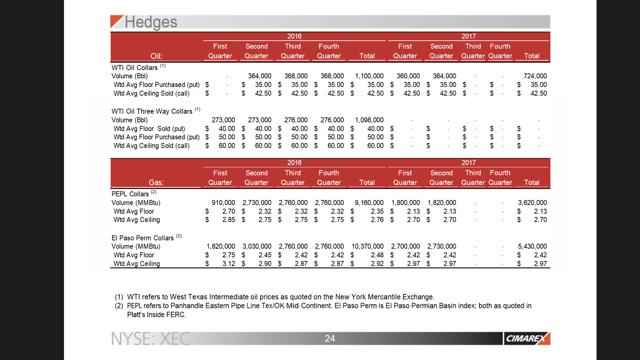
Cimarex (NYSE:XEC) has hedged approximately 2.2 million barrels of crude in 2016. This has been done with another 724K bbls in 2017. The interesting dimension to these hedges are the prices. Its collars have a ceiling of $42.50/bbl and floor of just $35/bbl. It would appear, XEC feel secure in producing at $35/bbl. Its three-way collars seem to show XEC believes that oil prices will stay above $25/bbl WTI. The $10/bbl difference between the purchased put and sold put provides a $35/bbl price if oil falls to $25/bbl. Since most believe the bottom has already in, it is a fair assumption oil will not drop below this level. That said, anything is possible. If E&Ps are wrong, and we do set a new low, the three-way collars could be a disaster. XEC has reasons for focusing on low oil prices. The first is very good acreage in the Permian Basin and SCOOP in Oklahoma. These may be the top two plays in the country right now. The Permian has some of the lowest costs and excellent well results from several intervals in the core. The SCOOP/STACK is the single fastest growing play in the country. It may have more upside than any current play. XEC is a natural gas focused company, and since a large percentage of its revenues are derived from this, it may be less focused on oil.
(Source: Cimarex)
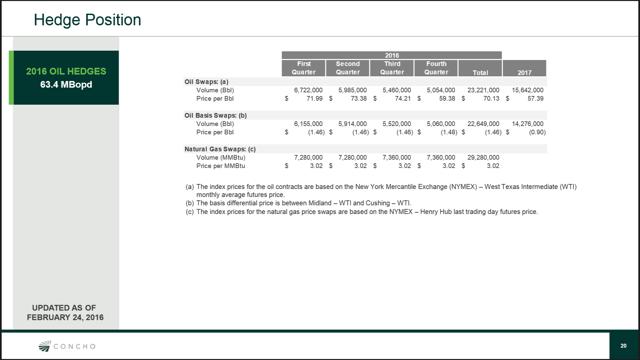
Concho (NYSE:CXO) is another Delaware Basin focused player. It has done a much better job of hedging. The key is it's 2017 barrels. If we use 2016 as an example, it still has approximately 8 million barrels to hedge for next year. There is a big decline in price, but it still has still attained $57.39/bbl. CXO looks well placed, but its possible CXO will look to increase the size of its hedge book.
(Source: Concho)
Although Pioneer (NYSE:PXD) has very good acreage in the Eagle Ford, its Midland Basin assets are the focus. Pioneer has moved away from swaps. In 3Q16, it starts the use of three-way collars exclusively. The realized price decreases significantly from 2016 to 2017. It targeted 85% of its oil production to be hedged, but only 50% next year. It would need to add an additional 39,000 bo/d or 14 million hedged bbls of oil to reach 2016 numbers. Pioneer has done an excellent job of using three-way collars. It was able to keep its call price high. This could provide significant upside if oil prices recover. By keeping the short put price between $23.29 and $18.38, there is an opportunity to receive a decent premium to oil prices if it falls. 2017 hedges have a much lower call price and the short put price is just $8.88 below.
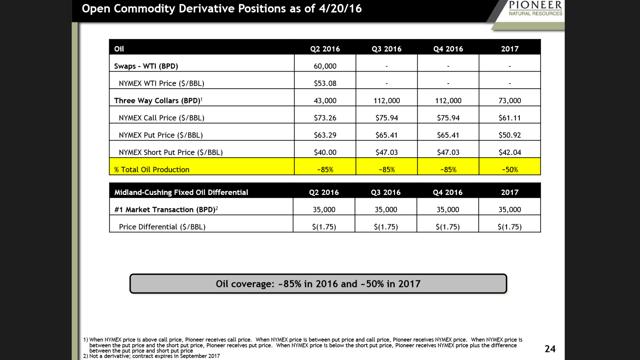
(Source: Pioneer)
Matador (NYSE:MTDR) was an Eagle Ford player that moved to the Delaware Basin. This was an excellent move. Its current acreage not only has better producing wells, but also lower operating costs. It has 2.3 million barrels of crude hedged this year, and 1.6 million in 2017. 50% of 2016 production is hedged. It has used costless collars with ceilings over $60/bbl. Floors range from $45.12 to $42.48. 2017 looks more difficult as ceilings are $47.62. Floors are $38.62/bbl. These ranges have tightened significantly from 1Q16. The difference between the average ceiling and floor in 2017 is $9.00/bbl. Essentially, MTDR had to reduce its upside in exchange for a guaranteed low.
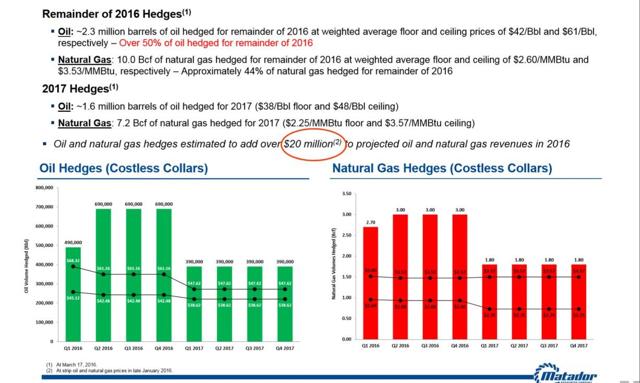
(Source: Matador)
Parsley (NYSE:PE) is Midland Basin focused. It didn't sell any upside to pay for downside protection. The put price is its floor which improves meaningfully later this year. The short put or subfloor means the Parsley wont collect the floor price but the difference between the floor and subfloor if WTI falls below. It still protects PE if oil prices drop. It has almost all of its production hedged through the mid-point of 2017, and only 10% in 3Q17 and 4Q17. It will need to add approximately 18,000 bopd for those 182 days. It seems to be targeting a $13/bbl difference between the floor and subfloor. Its absolute bottom for oil prices looks to be around $40/bbl if we re-test lows.
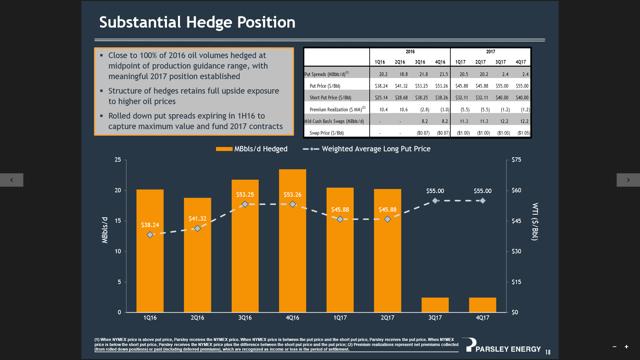
(Source: Parsley)
Although Chesapeake (NYSE:CHK) does not have a meaningful position in the Delaware or Midland Basins, it has core acreage in the SCOOP/STACK. Lower break evens are seen here as well with more improvements expected. It only has 2/3 of its production hedged this year. It has focused on $46.51/bbl.
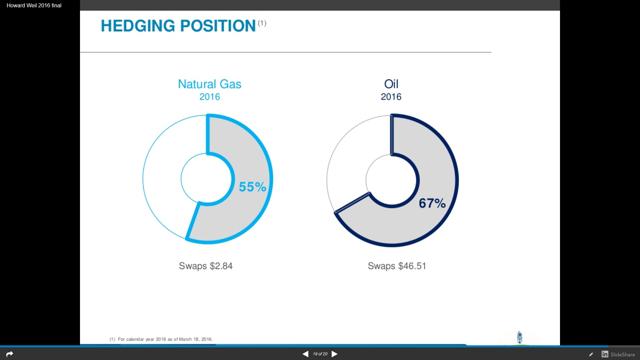
(Source: Chesapeake)
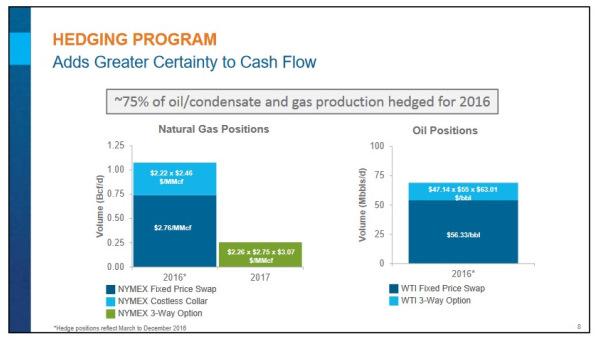
Encana (NYSE:ECA) has acreage in Canada and the Eagle Ford, but spends the most capital in the Midland Basin. It has very good acreage in Martin, Midland and Upton counties. Its swaps have a 2016 average of $55.61. The three-way swaps have a ceiling of $62.99. The floor is $55.00 and subfloor is $47.11. It has very little production hedged for 2017. These swaps average $50.86. 75% of its 2016 oil and condensate production is hedged. It could hedge another 26,000 bbls/d this year and approximately 98,000 bbls/d next year.
(Source: Encana)
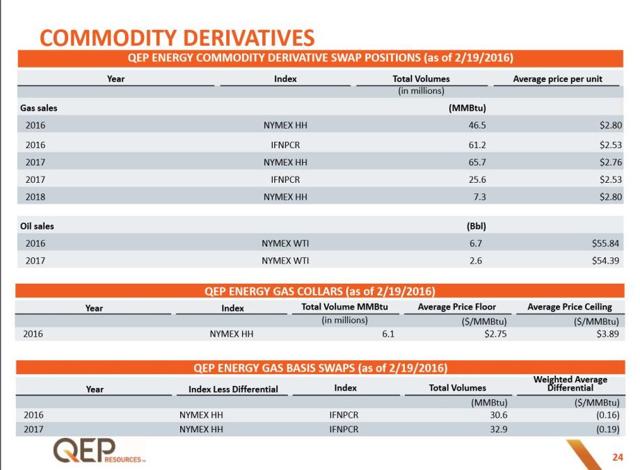
QEP Resources (NYSE:QEP) has acreage in the Permian. Its development is also focused on the Bakken and Pinedale. There are no rigs in the Uinta. It is important to note that QEP has some of the best acreage in North Dakota. Although costs are higher in the Williston Basin based on proximity to refineries, the South Antelope wells still provide excellent economics. In six months, these wells average a cumulative production of 175,000 Boe. The middle Bakken, and Three Forks benches has all been productive. QEP's swaps from April through June are priced at $57.09/bbl. Through this time frame 1.7 million bbls are hedged. In 2H16, it hedged another 5.2 million bbls at $51.82. In 2017, QEP has 5.1 million bbls at $50.18/bbl. QEP's production guidance for 2016 is in a range of 19 million to 20.5 million Bo. Approximately half of its 2H16 production is hedged. It if produces 20 million Bo in 2017, it has only 25% of production hedged. QEP is situated like many US unconventional E&Ps. Only a small percentage of production is hedged and oil prices have still not recovered.
(Source: Newfield)
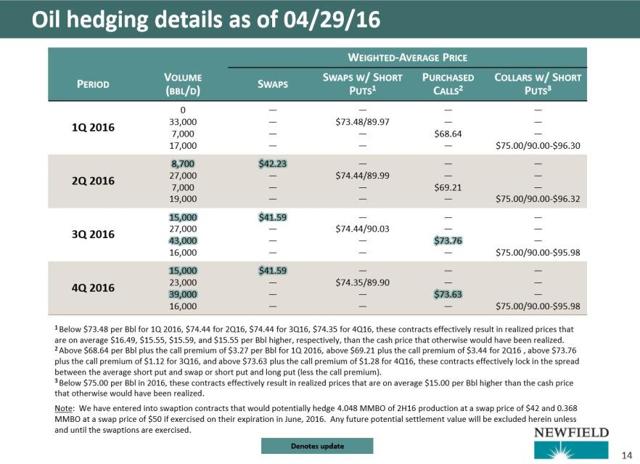
Newfield (NYSE:NFX) has a large footprint in the SCOOP/STACK. The Anadarko Basin accounts for 53% of its domestic production. This will probably increase. It has locked in an estimated oil price of $51.97 this quarter. Hedges continue to improve the effective realized price to $59.59 in the first quarter of next year.
Newfield has locked in swaps averaging between $41.59 and $42.23/bbl in 2016. It has also used swaps with short puts and other hedges including three-way collars. It is important to note that its three-ways are valued at $15/bbl over the current price of WTI. Its recent purchase of swaps for $42.23 show Newfield can produce decent economics with a very low realized oil price.
(Source: Newfield)
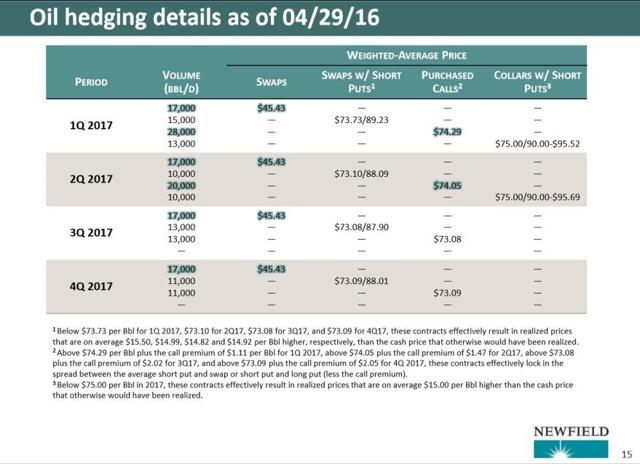
In 2017, it is also well hedged. It has swaps at $45.43/bbl.
(Source: Newfield)
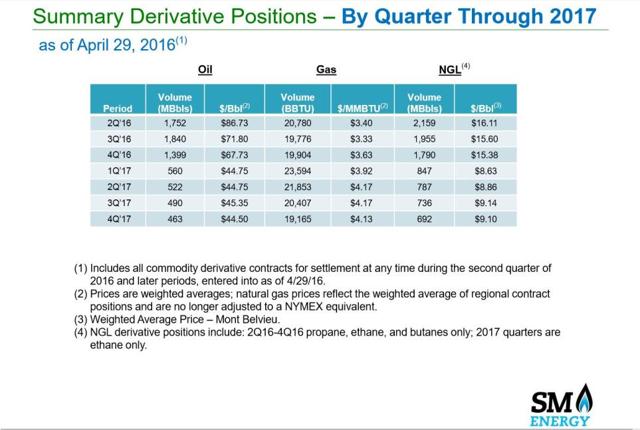
SM Energy (NYSE:SM) spends 30% of its capital in the Permian. The same in the Bakken and Eagle Ford. Through year end approximately 55% of its volumes are hedged. Oil is just 40% hedged through the remainder of 2016. Only 35% of total production is hedged in 2017 (this includes NGLs and natural gas. SM may not have the best production results in the Wolfcamp/Spraberry, but its costs are some of the lowest. $40/bbl oil is producing IRRs of approximately 22%.
(Source: SM Energy)
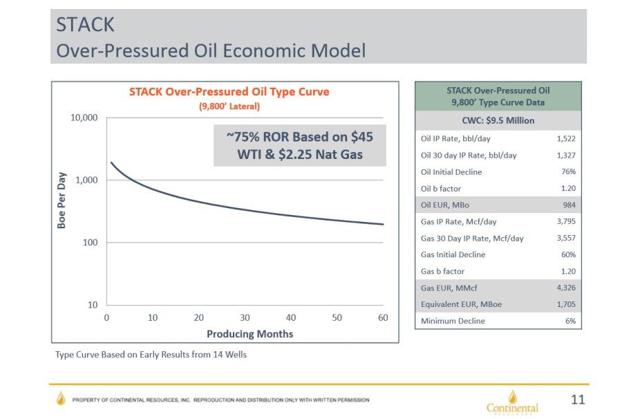
It would seem Permian and STACK operators are very comfortable with low oil prices. The Permian has the best horizontal economics in the US. As a stacked play, there are many pay zones to choose from. The SCOOP may have the most upside of any play, as initial completions have provided excellent economics.
(Source: Continental)
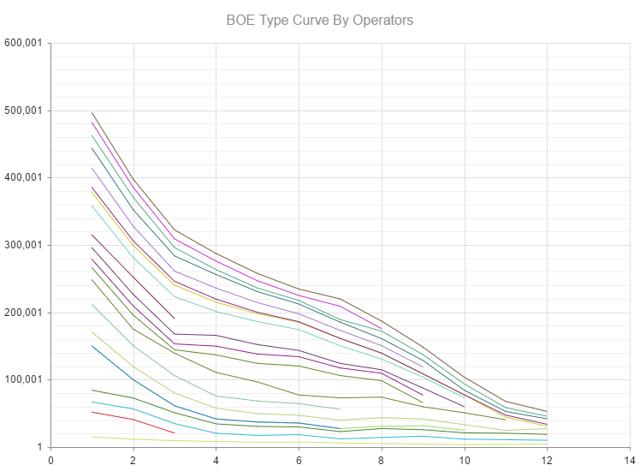
Continental (NYSE:CLR) has seen very good returns, even at $45/bbl WTI. The CLR model shows a very flat decline curve when compared to other unconventional plays in the US. It is possible the SCOOP ends up being a better play than the Midland and Delaware Basins.
When we look at E&P hedge positions for 2017, it puts things into perspective. Some operators are focused around $55/bbl. Others are ok closer to $40.
The table above may not provide the exact realized price by the operator for all barrels, but it does show many E&Ps worry the price of oil could collapse again in the near future. It is possible we see a large number of hedges set around $50/bbl. We don't know if there will be a retest of 52-week lows. It is possible, due to several head winds for oil. A stronger dollar and the possibility of increased production from Russia and OPEC could push prices lower. We don't think prices could stay in the mid to low $30s over the long term, but volatility could cause short term moves. E&Ps will probably be conservative until we have more transparency. There are millions of barrels of crude that could be hedged over the course of 2016. If this occurs, it could provide an effective ceiling for prices going forward.
Comments
Log in or sign up to join the conversation.