

The path to avoiding a 2026 rate hike widened this morning after a pair of reports signaling stressed household budgets re-ignited slowdown angst on Wall Street. A colossal double miss on retail sales and consumer sentiment is worrying investors that affordability pressures, dwindling savings and reduced hiring could mean that the engine of the economy could be on its last legs. The weaker-than-expected prints arrive subsequent to stronger tax refunds that were offering alleviation to personal wallets; however, with that source of fiscal stimulus behind us, market participants are rightfully concerned about the potential for a further deterioration in shopper momentum. But despite the awful numbers, yields are still rising on the session, as Washington’s threats to impose a maximum isolation program on Tehran are causing oil prices to climb, which together with UMich’s higher-than-anticipated inflation expectations is battering duration. The curve is climbing in bear-steepening fashion though, as increasingly dovish monetary policy prospects help the short-end remain contained while plunging the greenback to its softest level in a week. Stocks and cryptocurrencies are suffering from the retreat in speculative enthusiasm too, with every major domestic benchmark lower, although 8 of the 11 principal sectors are advancing. Elsewhere, commodities are loftier across the board, premiums on volatility protection instruments are expanding modestly and prediction markets are catching bids.
Retail Sales Experience Largest Contraction in 14 Months
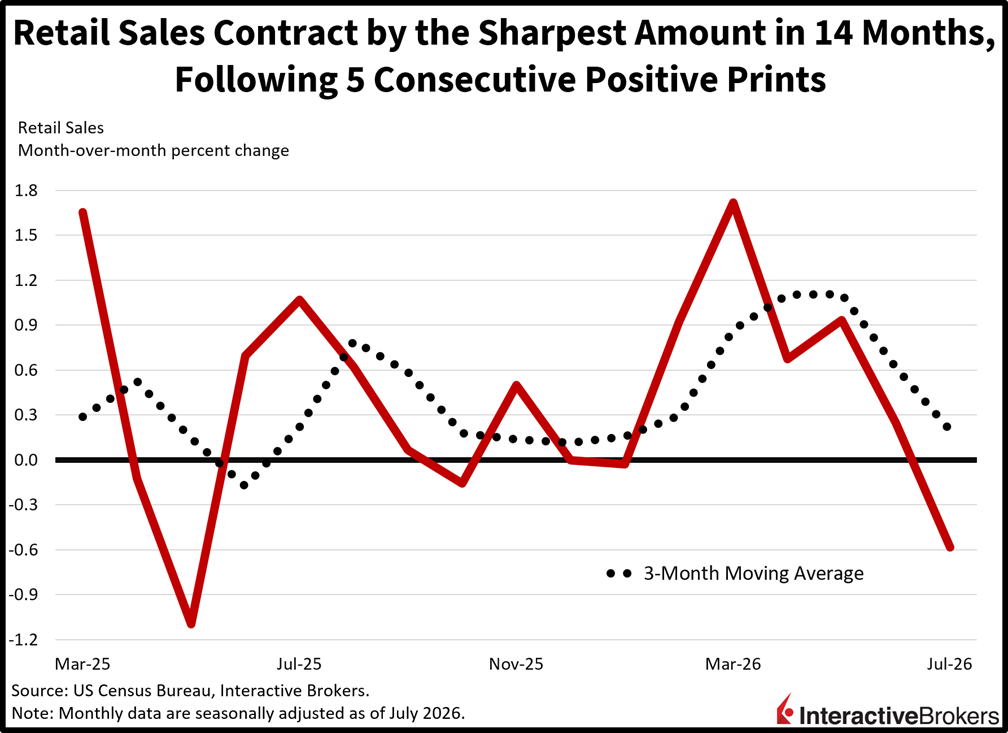
July retail sales posted the sharpest drop in 14 months in a sign that consumers may be getting exhausted as the year progresses. The headline dropped 0.6% month over month (m/m), materially worse than the 0.1% growth expected and the 0.2% increase from June. The control group, a section of the print that is critical to the government’s Gross Domestic Product calculation, tanked 0.4% m/m, well beneath the 0.3% projection and the positive 0.4% recorded in the previous period. The weakness was driven by m/m transaction dollars in ecommerce, automobile dealerships and repair shops, gasoline stations and electronics and appliance destinations sinking 2.2%, 1.8%, 0.9% and 0.5% m/m. Conversely, however, apparel stores, health/personal care retailers and restaurants/bars offset some of the declines by expanding 1.9%, 0.7% and 0.5% m/m. Elsewhere, establishments focused on general merchandise, building materials/garden equipment and furniture saw revenues rise 0.3% m/m each, while sporting goods places and food markets were relatively unchanged during the interval.
Decline in Purchasing Power Hits Consumer Sentiment
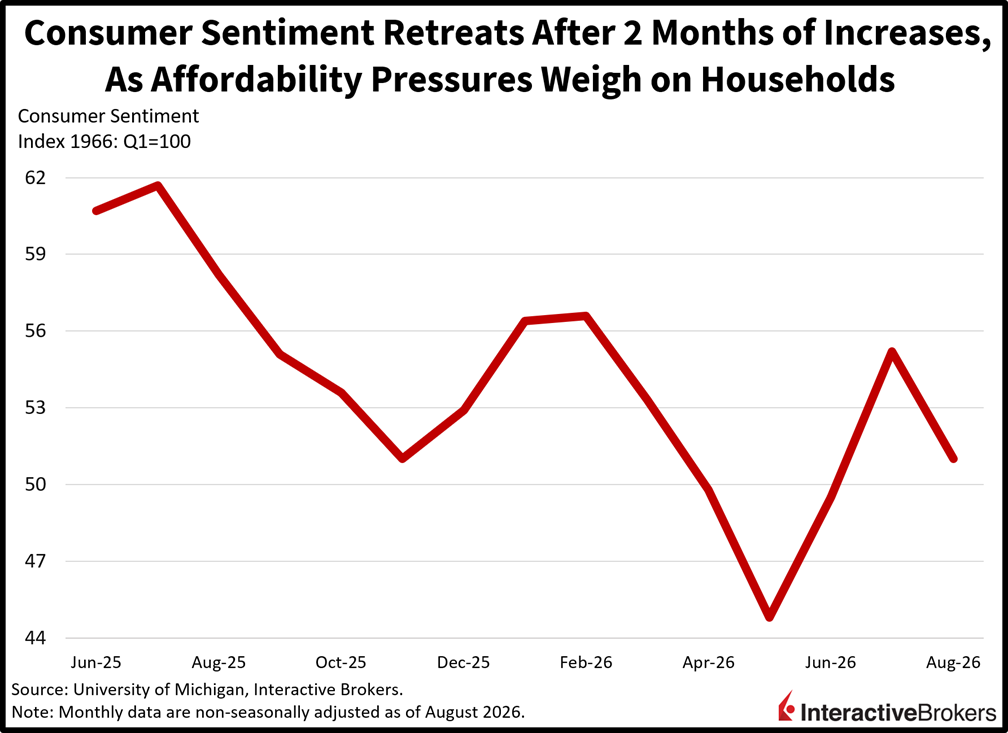
Household moods concerning the economy weakened for the first time in three months as elevated costs continued to weigh on purchasing power. The University of Michigan’s (UMich) Consumer Sentiment Index sank to 51 in August, much worse than the 55.2 median estimate and the 55.4 from July. The sub-indices representing current and future conditions dropped from 54.8 and 55.4 to 51.8 and 50.6 during the period, as heavy price pressures and restrictive interest rates lifted feelings of pessimism. Furthermore, 1- and 5- year inflation expectations came in at 4.3% and 3.3%, 0.1 percentage point higher m/m on the former, while unchanged on the latter.
A Weaker Consumer Derails AI Pricing Power
A weaker consumer could weaken pricing power in the critical AI space, as waning spending appetites from individual end users could spread to enterprises, risking a deceleration in corporate earnings. Furthermore, deteriorating household expenditures may not offer as much interest rate relief as Wall Street became accustomed to during previous slowdowns, and emblematic of this possibility is duration failing to catch a bid today despite the colossal double miss on retail sales and UMich, as the longer tenors face selling pressure instead. Overall, investors shouldn’t be hoping for sluggish consumption data and job losses to drive looser financial conditions, since that combination is poised to punish stocks; however, fixed income is certainly geared to outperform in a softer cyclical environment. Finally, the weeks ahead will provide insights into whether slower shopping and heavy payroll contractions represent a short-term slump or present a real risk of an economic downturn.
International Roundup
Euro Employment Growth Was Steady
The number of employed individuals in the euro area grew 0.5% year over year (y/y) and 0.1% quarter over quarter (q/q) during the second quarter, according to a flash estimate from Eurostat. Both metrics were unchanged from the first three months of the year and arrived near expectations.
Europe’s Trade Balance Turns Positive
The euro area produced a €8.6 billion trade surplus in June, a strong reversal from the €9 billion deficit in May. The result also exceeded the economist consensus expectations for the value of imports to exceed exports by €2.2 billion. Imports in June were up 13.1% but exports jumped 14.4%. During the month, surpluses in manufactured goods, food, beverages, machinery, vehicles and chemicals offset the impact of a higher deficit in energy products triggered by higher oil and natural gas prices. For the year-to-date period that ended in June, the euro area’s €9.6 billion surplus was down considerably from the positive €82.2 billion balance in the same period of 2025. The year-to-date number, like the June print, faced the headwind of higher energy costs.
South Korea Exporters Fetch Higher Prices
Prices for products from Korea shipped abroad were 1% higher m/m and up 49.1% y/y in July while import prices relative to June sank 1% but were still 18.7% above the stickers in the year-ago period. Among exports, agricultural, forestry and marine products experienced a 1.7% decline, but the more heavily weighted manufactured products category more than offset the impact of the weakness by moving north by 1.1%. With imports, raw materials were 0.8% more expensive while intermediate goods, capital goods and consumer goods posted declines of 2.2%, 1.8% and 0.1%.


Comments
Log in or sign up to join the conversation.