


Today's post starts with this image from a paper about alts published by Simplify.
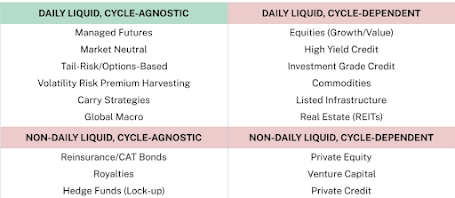
Simplify says their funds focus on the upper left quadrant. Not included in the lower left, which I would mention so we don't forget about it, is litigation finance. I am aware of one fund that doesn't have daily liquidity. I'm not going to use funds that don't have daily liquidity, but the way things evolve, this might come in a daily liquid vehicle or be added to a multi-strategy fund.
Cat bonds are in Simplify's illiquid bucket, but there are three dedicated mutual funds and one ETF in the space. As a quick note, I use SHRIX for blogging purposes because it has by far the longest track record, but I use a different fund in real life. Hedge funds aren't liquid, but there are countless funds with daily liquidity that do track hedge fund strategies. The Unlimited suite of ETFs is all hedge fund-like, so if you're interested, it's accessible.
Then we get to royalties, and again, there are more than a handful of companies that collect royalties that are usually in the MLP neck of the woods. There are a few outside of natural resources, but they don't appear to be very yieldy. This brought me around to Dorchester Minerals (DMLP). I've looked at this name a couple of times in the past but not sure whether I ever brought it to the blog. DMLP collects royalties from oil and natural gas with a very wide geographic footprint, including the Permian Basin. It fits in with our recent conversations about seeking yields in the face of a decade to nowhere for stocks.
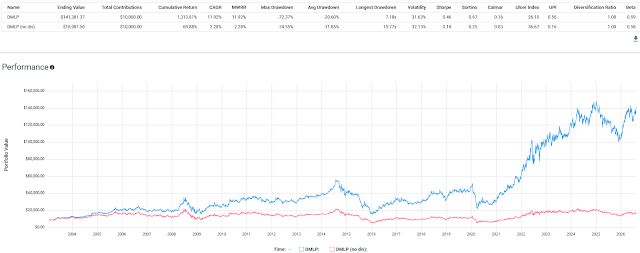
It has had a good yield all the way through, but man, it is a wild ride at times.

Dennis Eckersley might say that it goes down 30% just to stay in shape.
The growth rate numbers for Saba Closed End Fund ETF (CEFS) are pretty much identical to DMLP over its shorter lifespan, but the drawdown pain is quite a bit less. The 40% drop in the Covid Crash was big but nothing like some of the drops put in by DMLP.

Now here is the latest on the GraniteShares NVDA Autocallable ETF (ANV). The chart compares ANV to the common and the YieldMax for NVDA.
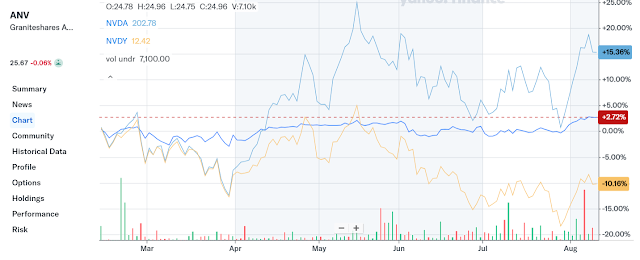
The chart is price only. What is interesting is that during that big lift for the common for April into mid-May, ANV didn't move. Then in that serious decline from mid-May to early July, ANV didn't move. So far, ANV has paid out $2.07 in distributions, including the one that will pay later this week, which annualizes out to an 18% yield compared to a 40.14% distribution rate posted on NVDY's website.
To even consider a single stock autocallable or single stock covered call fund, or one of the put sellers for that matter, it is very important to realize you are not buying the common stock. NVDA is the reference security, but that is not what you're buying. To buy ANV for NVDY, you need to believe that the common won't blow up, but these are not the common repeating for emphasis. If NVDA goes up 100%, you're not going to get anywhere close to that from ANV or NVDY.
Does harnessing the volatility of NVDA or another stock that has funds like this referenced to it interest you? Does it fit into your strategy? I am spending time on how to make portfolios yieldier. That won't mean blowing up the portfolio as it sits now; it means adding a little yield here and there, and while the odds are low that I will end up with a single stock autocallable or YieldMax product "yielding" 40%, there's no need to ignore how these both evolve.
Buying DMLP in this context would probably just result in anguish for clients, but understanding the name a little helps me define the space some. MLPs are yieldy and could play a role in the context we've been talking about. My nit to pick, as I mentioned the other day, is that a 20-25% weighting in MLPs is a terrible idea; if stocks go down a lot, there's a good chance MLPs will go down a lot too. That has been the case sometimes but not in others, so I'd assume the worst on that front, but a lost decade doesn't necessarily mean down a lot; it could mean down a little to up a little, very little. That is where I'd want to dial up the yield. Not blow up the portfolio, just dial up the yield a little bit.



Comments
Log in or sign up to join the conversation.