


Let's start with some more retirement doom from a few places. Barron's has all sorts of numbers in a new article about how stretched and stressed retirees are. Because of increased inflation or concerns that inflation might persist, 58% of retirees have some sense of insecurity about inflation shortening how long their assets last. There were 19% struggling, 5% were "living the nightmare", but there were also good numbers with people who are comfortable and living the dream.
Alicia Munnell is sounding the alarm over the increase in out-of-pocket medical expenses and, to a lesser extent, Medicare inflation going up at a higher rate than the COLA adjustment for Social Security. That doesn't mean people are going backwards, though. A 10% bump in Medicare might be $25/mo while a 3% COLA for Social Security might be $120 as a simplistic example.
I am obviously going to take the Munnell article as a chance to make a bigger priority out of diet changes and vigorous exercise. The simplest path is to eat less sugar (carbs) and do some sort of resistance training with weights. If someone can get ten years into retirement without needing polypharmacy and constant doctor visits, how much less money are they spending? As my contemporaries and I all get older, I see this play out in terms of who is having more issues come up and who is having fewer issues come up. This may not be easy to implement, but it is very simple: cut carbs and lift weights.
Bill Bengen, the founder of the 4% rule for sustainable retirement withdrawals, sat for a podcast with Morningstar. I would guess that most people view the 4% rule as a set-and-forget sort of thing, but based on the podcast and some other interviews he's done, set and forget is pretty much the opposite of what he is doing. He is constantly researching and refining. Lately, the safe number in his estimation has been more like 5.8%. The biggest threats, as he sees them, are the combination of high price inflation and lower stock returns.
He places a lot of emphasis on the potential for higher inflation to really jam up a lot of retirement plans. Where we have used the phrase "something's gotta give" if someone does hit the amount of money saved that they think they need, something extreme might have to give if inflation really gets out of hand. I don't think he was making a prediction, though; it seemed more like he had a concern that inflation might go up quite a bit. That's a subtle nuance and I might not be wording it very well.
My take on the 4% rule has always been to try to simplify it, whatever you have, take 4% or more realistically, take 1% per quarter. The growth in the portfolio will address keeping up with inflation. Obviously, when markets go down, there is visibility that a retiree would have to take less. Bengen thinks that most people cannot be flexible enough in their spending to weather a 25% drop in their portfolio, leading to a 25% drop in their income. He might be right; there's certainly truth in that but I don't know how universal it is.
One way to mitigate this is to set aside cash in an attempt to manage sequence of return risk. Something like two years' worth of regular expenses would last through most bear markets.
There's been a lot of content lately about the rise in bond yields and whether there is more trouble ahead. I certainly don't know if rates will go up, but I do think the volatility is here to stay, and as we've been talking for several years, bonds with duration have become a source of unreliable volatility.
All the above make up a cocktail of reasons why I place so much importance on adding robustness to portfolios using tools that take different approaches to offsetting equity volatility without taking on the volatility of bonds.
Most of what we build overlaps with each other, some combo of equity beta, managed futures, bond substitutes that have almost no volatility and a little bit of negative convexity. Here's another version;
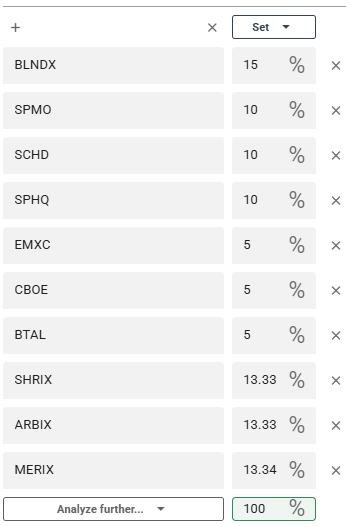
The only one not in my ownership universe is SHRIX. I use a different cat bond fund for clients, but SHRIX is more useful here for having a longer track record.

With just over six years to backtest, the portfolio was close to VBAIX most of the time, but much of the improved CAGR comes from only being down 3% in 2022.
For people who are truly desperate, something called a home equity investment contract might be an answer. Basically, you sell some of the future price appreciation of your home to get cash now. The way it compounds, though, you might actually get zero or close to zero when you sell your house. Like I said, for people who are truly desperate. This is not a HELOC to consolidate debt or remodel the kitchen. About the only application I can think of is using this to pay for something that was very medically expensive. Someone has $300,000-$400,000 and needs to spend $150,000 for something not covered? That might be desperate enough. You can't get kicked out of your house, but the smaller portion of future gains that you sell today might become all of your appreciation in the future, leaving you with almost zero. Save your life, but be able to stay in your house? Yeah, maybe.
The world is getting more complicated, but I think my message is very similar to what it has always been in terms of health, having a simple withdrawal strategy (the way Bengen constantly tinkers is not simple) and a robust investment strategy. Building other income streams in order to be less reliant on the portfolio is a logical (to me) extension to try to reduce the odds of personal, retirement calamity.



Comments
Log in or sign up to join the conversation.