

Whether you're new to aerospace procurement or a seasoned maintenance professional, questions about aviation fasteners come up constantly — what standard applies, what material to use, and where to find a reliable source. Below, we answer the most common questions about aircraft fasteners and how to source them correctly.
What exactly are aviation fasteners?
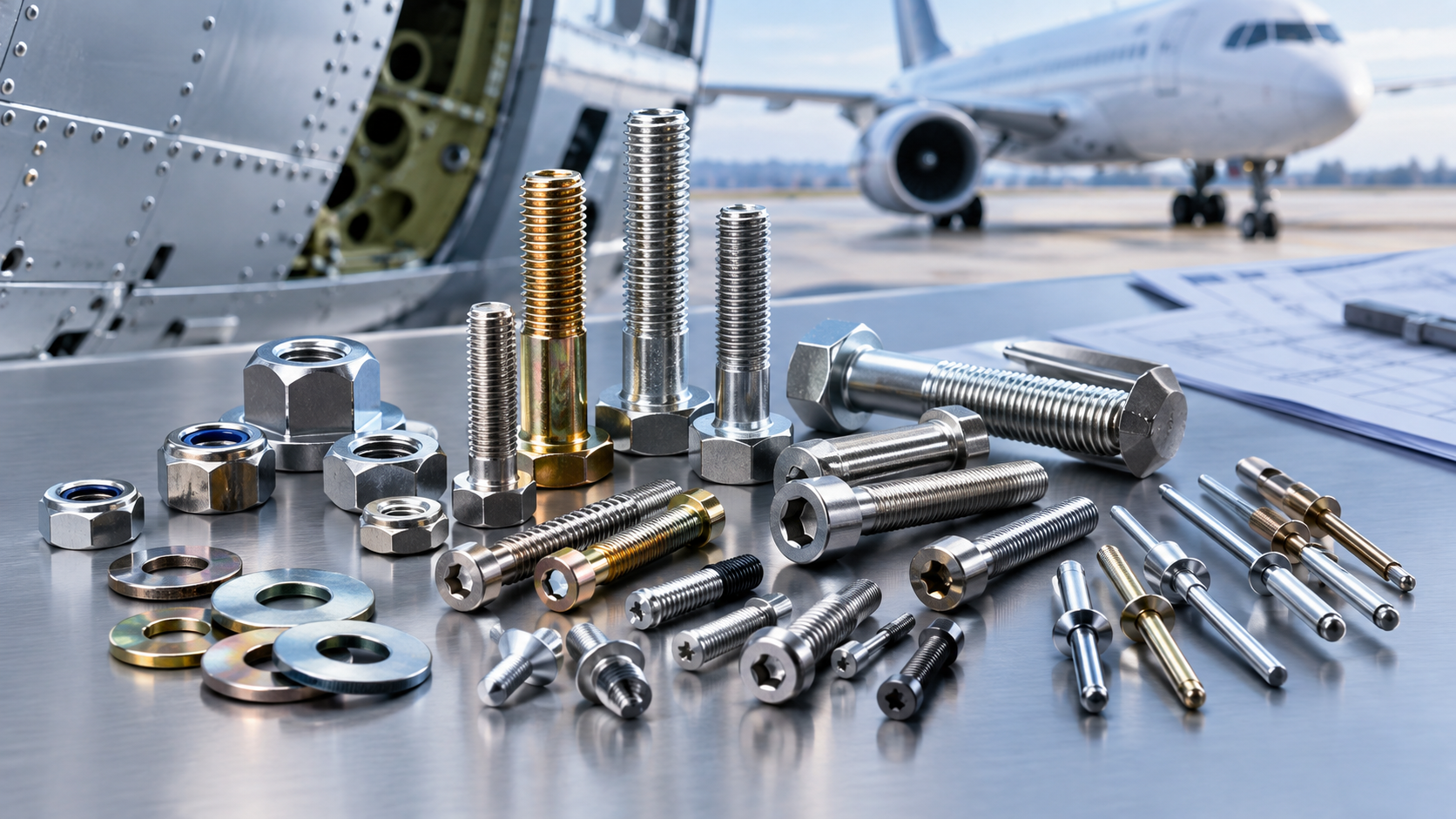
Aviation fasteners are the bolts, nuts, screws, rivets, washers, pins, and inserts used to join and secure aircraft structures and components. Unlike hardware store fasteners, aerospace fasteners are manufactured and tested to strict military and aviation specifications, since even a single failed part can compromise the safety of the entire aircraft.
What standards govern aircraft fasteners?
Most aircraft fasteners are manufactured to one of several recognized specifications, including:
AN (Air Force-Navy) standards
MS (Military Standard) specifications
NAS (National Aerospace Standard) parts
BAC (Boeing Aircraft Company) specifications
Each standard defines precise requirements for material, dimensions, strength, and finish. Buyers should always confirm the exact standard listed on the engineering drawing or maintenance manual before ordering.
What materials are aviation fasteners made from?
Common materials include:
Titanium – excellent strength-to-weight ratio, used in high-stress applications
Corrosion-resistant steel (CRES) – used where corrosion resistance is critical
Cadmium-plated alloy steel – widely used for structural fasteners
Aluminum alloys – lightweight options for lower-load applications
The right material depends on the load requirements, environmental exposure, and compatibility with surrounding metals to avoid galvanic corrosion.
Why can't I just use standard industrial hardware on an aircraft?
Standard hardware isn't tested or certified for the fatigue cycles, vibration, temperature extremes, and load conditions aircraft experience. Using non-aviation-grade hardware — even if it looks identical — can void airworthiness certification and create a genuine safety risk. Every fastener used on an aircraft needs documented traceability back to an approved manufacturer.
How do I find the right replacement part?
Cross-referencing is essential. The same fastener may be listed under an NSN (National Stock Number), a manufacturer part number, or a military specification number. A well-organized aviation parts catalog lets you search by any of these identifiers to confirm you're ordering the correct aircraft components for your application.
Where can I buy certified aviation fasteners?
Look for a distributor that provides:
Full material traceability and certificates of conformance
A searchable catalog organized by specification and manufacturer
Support for both current-production and obsolete part numbers
A responsive RFQ process for competitive quotes
ASAP NSN Distribution's aviation fasteners catalog offers exactly this kind of searchable inventory, making it easier to locate the correct aerospace fasteners for military, commercial, or MRO applications.
Can obsolete or hard-to-find fasteners still be sourced?
Yes. Many aircraft in service today use legacy hardware that's no longer in active production. A distributor with a broad inventory network — spanning both current and discontinued part numbers — can often locate these harder-to-find aviation parts without requiring a full redesign of the assembly.
Final Takeaway
Sourcing aviation fasteners correctly comes down to three things: confirming the right specification, choosing a distributor with verifiable traceability, and never substituting non-certified hardware for aviation-grade parts. Getting these details right protects both safety and compliance.
Explore the full range of aircraft fasteners and request a quote at ASAP NSN Distribution.
Comments
Log in or sign up to join the conversation.