


Janus Henderson (JELH, JELM) has entered the autocallable terrordome, as Eric Balchunas calls it. Janus has two funds for now; they do something that is unique to the current autocallable ETF market. We'll get to Janus in a moment, but want to circle back to the Calamos Autocallable Income ETF (CAIE).
Autocallables are structured notes that pay out a very high yield as long as the underlying index or common stock doesn't go below a certain price or percentage drop. Banks issue these to generate fees, and they hedge out their risk.
I am both fascinated by them; they often yield 12-14%, but can't get over the nagging feeling that there's more risk to the story than bad things don't happen until the underlying index drops 40%.
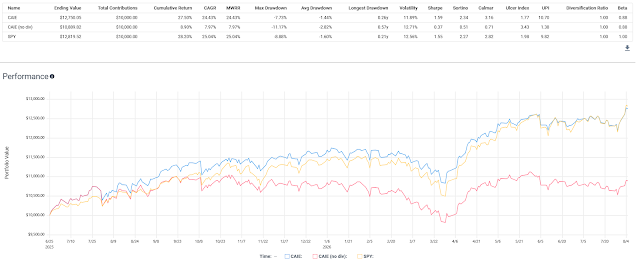
After 13 months, I can't imagine there are too many complaints about the result. If the S&P 500 had been flat over the 13 months, then the price-only return would likely be down by the amount of the distributions. If markets were meaningfully lower, autocallable funds should be expected to have some degree of sensitivity when declines occur, and you can see that in the chart.
CAIE is an income product; autocallables are an income niche. I used Finominal's optimizer to try to understand what it thinks the relative risk of CAIE might be. I equal-weighted CAIE, ANGL, which is a specific type of junk bond fund, CWB, which is convertible bonds, and USMV, which is min volatility equities. I ran the optimizer for risk weighting the four funds.
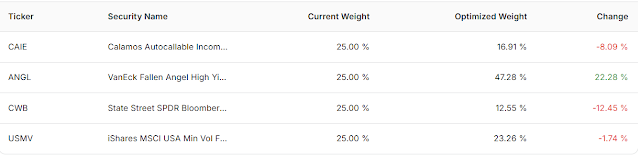
Again, I optimized for risk weighting. CWB is the riskiest of the four, with CAIE not that far behind. For kicks, here's the four funds equal weighted compared to Finominal's risk weighting and VBAIX.
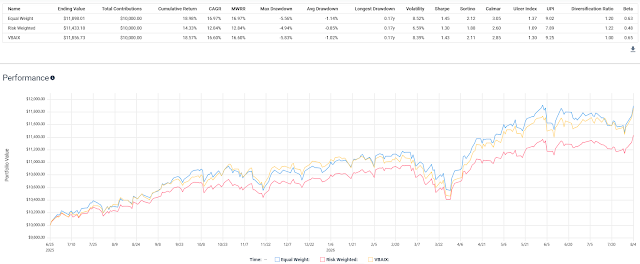
That one may not be too interesting, but there you go.
Back to Janus, which listed JELH, which is high income, and JELM, which targets a lower income. The funds being so new, it's not clear what the yields will be. Gemini has the average weighted coupons of the respective autocallables at 12.7% and 9.4%. So maybe those will be close?
The point of differentiation, as reported by Bloomberg News and Bloomberg columnist Matt Levine, is that the structured notes include crash protection sold to ETF providers that carry 2x and 3x ETFs. If a company drops more than 50% in a day like Lucid (LCID) did recently with a 57% decline, a 2x fund is probably going to get wiped out. The crash puts, as they're apparently called, will cover the difference between 50% and 57% for the fund provider. Buying the insurance prevents the banks' capital from being wiped out, only the people speculating on the 2x ETF.
That's a simplified explanation, but this concept seems similar to catastrophe bonds. It's a form of risk transfer which is interesting to me.
The two funds own autocallables on individual stocks. They own many different stocks in this context, not like the GraniteShares single stock autocallable funds.
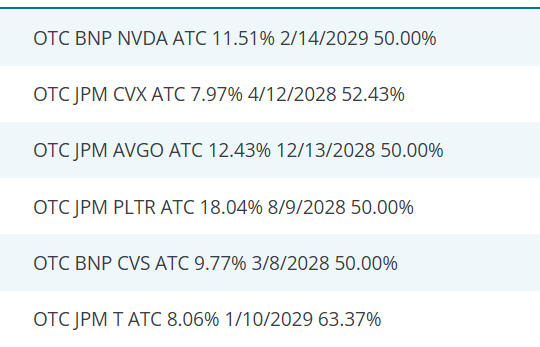
Looking at the full holdings, I counted seven banks; the screenshot shows BNP Paribas (BNPQY) and JP Morgan (JPM). Not all the autocallables have 2x ETFs, so they don't all have crash protection embedded. Chevron (CVX), CVS, and T do not, but NVDA, AVGO, and PLTR do have 2x ETFs.
CAIE targets a yield of 14%, but JELH might only be 12%, combining autocallables and autocallables with crash protection built in. My initial thought is that the Janus funds should yield a little more. Selling crash protection probably dials up the risk a little. It's early days, so that initial thought could be wrong.
Lately I have been thinking about how to adapt the portfolio if we go through another long stretch like the 2000's where the indexes compound far lower than "normal." Making portfolios a little more yieldy, maybe with equity income added in with the straight equity exposure. That's a developing thought, but it places importance on learning more about vehicles like these.



Comments
Log in or sign up to join the conversation.