

Market Overview
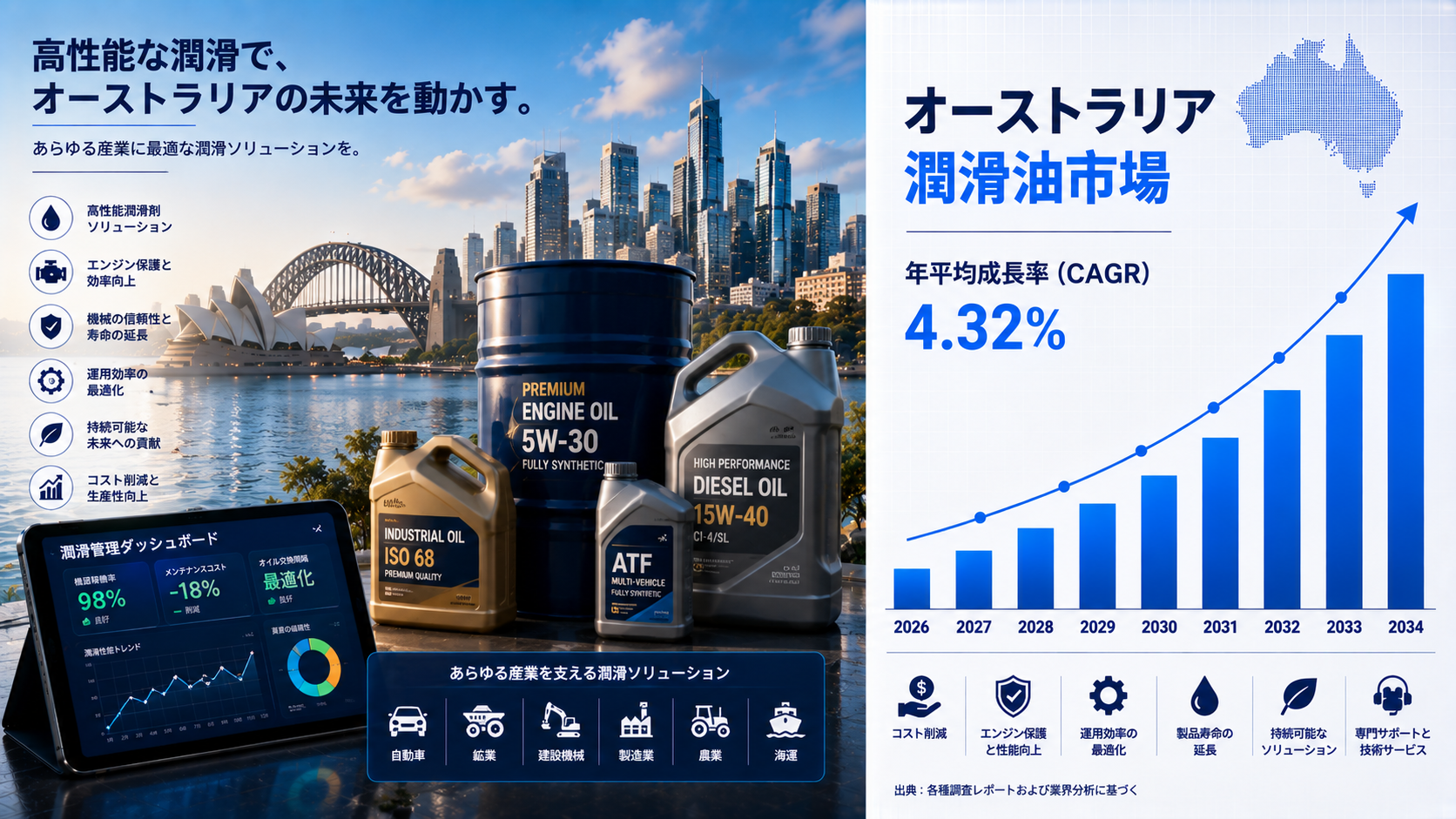
The Australia lubricants market is witnessing steady growth, supported by a strong automotive industry, large-scale mining activities, and ongoing infrastructure development. Rising vehicle ownership and increased industrial mechanization are driving consistent lubricant demand across multiple sectors. The market size reached USD 2,961.53 Million in 2025 and is projected to reach USD 4,333.36 Million by 2034, growing at a compound annual growth rate (CAGR) of 4.32% from 2026 to 2034.
A growing shift toward high-performance, energy-efficient, and environmentally sustainable lubricant formulations is reshaping product preferences, further strengthening market expansion across automotive, industrial, and heavy equipment applications. The market is strategically important to Australia's economy as it supports the automotive, mining, construction, and industrial sectors, ensuring equipment reliability and operational efficiency.
Request a Sample Report for In-Depth Market Insights: https://www.imarcgroup.com/australia-lubricants-market/requestsample
Australia Lubricants Market Summary
The Australia lubricants market encompasses a system where lubricant products (engine oil, transmission/hydraulic fluid, metalworking fluid, general industrial oil, gear oil, grease, process oil, and others) are manufactured, distributed, and applied across automotive, industrial, and heavy equipment sectors.
These lubricants are valued for their role in reducing friction, protecting engines and machinery from wear, enhancing fuel efficiency, extending equipment life, and ensuring reliable operations across demanding conditions.
The ecosystem includes lubricant manufacturers (LIQUI MOLY, Shell, Graphene Manufacturing Group, SKF, Viva Energy Australia), base oil suppliers (mineral, synthetic, bio-based), distributors and retailers, end-use industries (power generation, automotive and other transportation, heavy equipment, food and beverage, metallurgy and metalworking), and consumers across Australian regions.
Major segments identified in the market include product type (engine oil at 26%, transmission/hydraulic fluid, metalworking fluid, general industrial oil, gear oil, grease, process oil, others), base oil (mineral oil at 48%, synthetic oil, bio-based oil), end use industry (automotive and other transportation at 30%, power generation, heavy equipment, food and beverage, metallurgy and metalworking, others), and region (Australia Capital Territory & New South Wales at 27%, Victoria & Tasmania, Queensland, Northern Territory & Southern Australia, Western Australia).
The market is benefiting from expanding automotive fleet and vehicle ownership growth, mining industry expansion and heavy equipment operations, infrastructure development and government investment programs, accelerating adoption of synthetic and high-performance lubricants, and growing emphasis on sustainable and biodegradable lubricant solutions.
The Australia automotive market size was valued at 1.22 Million Units in 2024, expected to reach 2.50 Million Units by 2033 at a CAGR of 7.60%, reinforcing lubricant demand.
PORTER'S FIVE FORCES ANALYSIS—AUSTRALIA LUBRICANTS MARKET
Bargaining Power of Suppliers—Moderate
Lubricant suppliers include base oil providers (mineral, synthetic, bio-based), additive manufacturers, and packaging suppliers. The cost structure of lubricant production remains tied to crude oil price movements, creating margin pressure during periods of feedstock cost increases.
Raw material price volatility and supply chain complexities challenge manufacturers. Australia's geographic isolation adds logistics costs and lead times for imported base oils and specialty additives.
The presence of multiple base oil suppliers globally reduces dependency on any single source, but specialized additive suppliers have moderate bargaining power due to the performance requirements of advanced lubricant formulations.
Bargaining Power of Buyers—Moderate
Buyers include automotive consumers (individual vehicle owners, fleet operators), industrial end-users (mining, construction, manufacturing), and commercial enterprises. Each segment has different requirements, usage patterns, and price sensitivities.
In price-sensitive segments such as heavy-duty transport, mining, and agriculture, mineral oils remain the preferred choice, indicating that cost remains an important factor for many buyers.
The aftermarket channel, including independent workshops and retail outlets, continues to play a significant role in engine oil distribution, giving consumers multiple purchasing options.
However, original equipment manufacturer relationships and approvals represent significant competitive advantages, and vehicle manufacturers increasingly specifying advanced lubricants gives them influence over buyer choices.
Threat of New Entrants—Moderate
The lubricants market features established multinational petroleum corporations alongside specialized regional manufacturers. Distribution network coverage and technical service capabilities represent significant barriers for new entrants.
However, innovation in specialized segments creates entry opportunities. For instance, in May 2025, Graphene Manufacturing Group Ltd. (GMG) launched its website enabling direct sales of its graphene-based liquid concentrate G® Lubricant, demonstrating that entrants with novel technologies can access the market.
The market exhibits a moderately consolidated competitive landscape, but niche players serving specialized applications (e.g., biodegradable lubricants, graphene-based formulations) continue to emerge.
Threat of Substitutes—Low
Lubricants have no direct substitute for their core functions of reducing friction, protecting machinery from wear, and ensuring operational reliability.
Alternative technologies (e.g., solid lubricants, advanced coatings) serve specific niche applications but cannot replace liquid lubricants across the full range of automotive and industrial uses.
Electric vehicle adoption presents a structural challenge to traditional lubricant demand patterns, but battery electric vehicles still require specialized fluids for thermal management and transmissions, representing a different consumption profile rather than complete substitution.
Competitive Rivalry—High
The Australia lubricants market exhibits a moderately consolidated competitive landscape, characterized by the presence of established multinational petroleum corporations alongside specialized regional manufacturers.
Market participants compete across product innovation, distribution network expansion, sustainability credentials, and strategic partnerships with original equipment manufacturers.
In December 2024, LIQUI MOLY launched its new Special Tec T series generalist motor oils for the Australian market, demonstrating ongoing product competition. In August 2024, SKF announced its acquisition of John Sample Group's (JSG) Lubrication and Flow Management divisions, indicating consolidation activity.
Differentiation occurs through product performance (thermal stability, extended drain intervals), brand reputation, distribution coverage, technical service capabilities, and increasingly sustainability credentials.
MARKET GROWTH DRIVERS
Expanding Automotive Fleet and Vehicle Ownership Growth
Australia's automotive sector continues to drive substantial lubricant demand through expanding vehicle ownership and consistent aftermarket activity. For instance, on December 3, the Federal Chamber of Automotive Industries reported that November 2025 saw 97,037 new vehicle registrations. Cumulative new vehicle sales for the first eleven months reached 1,111,064 units. Population growth, rising disposable incomes, and the essential role of personal transportation in Australian lifestyle contribute to sustained vehicle sales and an expanding vehicle parc.
The geographic distribution of Australia's population across significant distances necessitates vehicle ownership for daily commuting and regional travel. Vehicle manufacturers and dealerships promote regular maintenance schedules, reinforcing lubricant replacement practices. The commercial vehicle segment, including light commercial vehicles popular among tradespeople and small businesses, adds incremental demand. The combination of new vehicle acquisitions and maintenance requirements for existing vehicles creates a robust and recurring lubricant demand base that supports market growth.
Mining Industry Expansion and Heavy Equipment Operations
Australia's mining industry represents a critical demand driver for industrial lubricants, requiring specialized formulations for heavy-duty machinery operating under extreme conditions. The nation's abundant mineral resources, including iron ore, coal, lithium, and rare earth elements, support extensive mining operations across multiple states. Mining equipment including haul trucks, excavators, drilling rigs, and processing machinery require substantial quantities of hydraulic fluids, gear oils, and greases to maintain operational efficiency.
The harsh operating environments characterized by high temperatures, dust exposure, and continuous operation necessitate premium lubricant solutions offering enhanced protection and extended service intervals. Investments in automation and advanced mining technologies are creating additional requirements for specialized lubrication solutions compatible with sophisticated machinery systems.
Infrastructure Development and Government Investment Programs
Government-led infrastructure development programs are generating sustained demand for lubricants across the construction and transportation sectors. Federal and state government commitments to road, rail, and urban development projects require extensive deployment of construction machinery and heavy equipment. Major infrastructure initiatives, including highway expansions, railway developments, and urban renewal projects create consistent lubricant consumption patterns across project lifecycles.
The construction sector's reliance on earthmoving equipment, concrete machinery, and material handling systems generates requirements for diverse lubricant product categories. Australia's focus on regional connectivity and logistics infrastructure enhancement further supports lubricant demand growth. The long-term nature of infrastructure investment programs provides visibility and stability for lubricant demand forecasting across the construction sector.
Accelerating Adoption of Synthetic and High-Performance Lubricants
The Australian market is witnessing a pronounced shift toward synthetic and semi-synthetic lubricant formulations that deliver superior thermal stability, extended drain intervals, and enhanced equipment protection. Vehicle manufacturers are increasingly specifying advanced lubricants for modern engine technologies, including turbocharged powertrains and start-stop systems. End-users across automotive and industrial segments are recognizing the total cost of ownership benefits associated with premium lubricant products, driving premiumization trends.
For instance, in May 2025, Graphene Manufacturing Group Ltd. (GMG) launched its website, www.g-lubricant.com, enabling direct sales of its energy-saving G® Lubricant, a graphene-based liquid concentrate designed to improve the performance of diesel and petrol engines. The website debut is accompanied by an animated video highlighting the product's benefits and ease of use, offering customers a visually engaging overview of G-Lubricant's performance-enhancing capabilities.
Growing Emphasis on Sustainable and Biodegradable Lubricant Solutions
Environmental sustainability is emerging as a critical consideration influencing lubricant selection across Australian industries. Biodegradable lubricants are gaining traction in environmentally sensitive applications, including forestry, marine operations, and agricultural machinery. The circular economy concept is driving interest in re-refined lubricants and waste oil management programs. Manufacturers are investing in research and development to formulate eco-friendly products that meet stringent performance requirements while minimizing environmental impact.
For instance, in September 2024, Viva Energy Australia introduced the Shell PANOLIN line of biodegradable lubricants, offering improved environmental performance while maintaining high operational efficiency. Although biodegradable lubricants have been used in the construction sector for years, particularly in projects near water bodies and environmentally sensitive locations, they were traditionally viewed as inferior in quality. Growing advancements in formulation are now changing this perception, positioning environmentally acceptable lubricants as reliable, high-performance solutions for demanding jobsite conditions.
AUSTRALIA LUBRICANTS MARKET SEGMENTATION
Product Type Insights:
Engine Oil (26% share in 2025)
Transmission/Hydraulic Fluid
Metalworking Fluid
General Industrial Oil
Gear Oil
Grease
Process Oil
Others
Base Oil Insights:
Mineral Oil (48% share in 2025)
Synthetic Oil
Bio-based Oil
End Use Industry Insights:
Automotive and Other Transportation (30% share in 2025)
Power Generation
Heavy Equipment
Food and Beverage
Metallurgy and Metalworking
Others
Regional Insights:
Australia Capital Territory & New South Wales (27% share in 2025)
Victoria & Tasmania
Queensland
Northern Territory & Southern Australia
Western Australia
COMPETITIVE LANDSCAPE
The Australia lubricants market features a competitive landscape characterized by established multinational petroleum corporations, specialized lubricant manufacturers, and regional distributors. Market participants compete across multiple dimensions including product performance, brand reputation, distribution network coverage, and technical service capabilities. Original equipment manufacturer relationships and approvals represent significant competitive advantages, particularly in automotive and heavy equipment segments. The market demonstrates consolidation among major suppliers while accommodating niche players serving specialized applications.
Key players include:
LIQUI MOLY
Graphene Manufacturing Group Ltd. (GMG)
Shell (via Viva Energy Australia)
SKF
Viva Energy Australia
In December 2024, LIQUI MOLY launched its new Special Tec T series generalist motor oils for the Australian market, designed and formulated in Germany and manufactured in Thailand. The range provides outstanding wear protection, lowers oil and fuel consumption, keeps engines clean, and ensures fast oil penetration using modern base oils and additives to fulfill the requirements of modern vehicles.
In August 2024, SKF announced its acquisition of John Sample Group's (JSG) Lubrication and Flow Management divisions, a strategy designed to enhance its lubrication management solutions, especially in the expanding India and Southeast Asia markets. JSG, based in Sydney, Australia, is recognized for offering sophisticated lubrication management solutions and services in sectors like mining, construction, pulp and paper, and food and beverages.
In September 2024, Viva Energy Australia introduced the Shell PANOLIN line of biodegradable lubricants. In May 2025, Graphene Manufacturing Group Ltd. launched its website enabling direct sales of its graphene-based G® Lubricant.
REGIONAL ANALYSIS
Australia Capital Territory & New South Wales (27% share): Steady economic growth and expanding infrastructure development are key factors driving the lubricants market in ACT and NSW. The expansion of road networks, public transport projects, and construction activities increases the use of construction machinery and heavy vehicles. The high concentration of urban commuters and commercial fleets in cities like Canberra and Sydney supports demand for automotive lubricants. Both regions serve as transportation hubs, with NSW housing Australia's busiest ports and freight corridors, leading to increased usage of lubricants in long-haul trucking, warehousing equipment, and rail services.
Victoria & Tasmania: Victoria, anchored by Melbourne, and Tasmania represent a significant lubricants market driven by strong automotive activity, industrial manufacturing, and logistics operations. The region's focus on infrastructure development and urban renewal projects generates demand for construction equipment lubricants. Melbourne's status as a major port and industrial hub supports lubricant consumption across multiple end-use industries.
Queensland: Queensland's lubricants market is driven by the state's significant mining and resources sector, including coal and mineral extraction. The state's rapid population growth and infrastructure development, especially in Brisbane and the Gold Coast, fuel demand for automotive and construction lubricants. The logistics and transportation sector serving Queensland's extensive geography also contributes to lubricant consumption.
Northern Territory & Southern Australia: In the Northern Territory and South Australia, the lubricants market is driven by mining operations, defense sector activities, and infrastructure development in Darwin and Adelaide. The region's remote locations and harsh operating conditions necessitate high-performance lubricants for heavy equipment reliability. The expansion of renewable energy projects and critical minerals mining supports specialized lubricant demand.
Western Australia: Western Australia's lubricants market is dominated by the state's massive mining and resources sector, including iron ore, lithium, and natural gas extraction. The heavy equipment requirements of mining operations generate substantial demand for industrial lubricants, greases, and hydraulic fluids. Perth's growing population and infrastructure development add automotive and construction lubricant demand. The state's focus on operational efficiency and equipment reliability in harsh conditions supports premium lubricant adoption.
RECENT INDUSTRY DEVELOPMENTS
May 2026: The Australia lubricants market is experiencing rising demand from mining, transportation, construction, and heavy industrial sectors as infrastructure activity and freight movement continue expanding nationwide. Industrial operators are increasingly shifting toward high-performance synthetic lubricants to improve machinery efficiency, reduce equipment downtime, and extend maintenance cycles.
April 2026: Electric vehicle adoption is reshaping lubricant consumption patterns across Australia’s automotive industry. While EVs require fewer conventional engine oils, demand for advanced transmission fluids, battery cooling fluids, and specialty greases compatible with electric drivetrains is increasing steadily as EV penetration rises across passenger and commercial vehicle segments.
February 2026: Mining operations continued to be a major contributor to industrial lubricant demand across Australia. The country’s mining industry maintained strong investment in autonomous haul trucks, drilling equipment, and heavy machinery, increasing consumption of durable lubricants capable of operating under high-pressure and extreme-temperature conditions.
January 2026: Sustainability and emissions reduction initiatives are increasingly influencing lubricant product development. Manufacturers are expanding portfolios of biodegradable, low-emission, and energy-efficient lubricants designed to support corporate ESG targets and compliance with tightening environmental standards.
December 2025: Australia’s vehicle aftermarket sector continued supporting lubricant sales growth as the average age of vehicles remained above 11 years. Older passenger and commercial vehicles require more frequent oil changes, transmission fluid replacements, and maintenance servicing, strengthening long-term aftermarket lubricant demand.
November 2025: Industrial automation and predictive maintenance technologies are becoming increasingly integrated with lubricant management systems. Companies are adopting AI-enabled monitoring systems and smart sensors to track lubricant performance, detect machinery wear, and optimize maintenance scheduling across industrial facilities.
2025–2026 (market trend): The Australia lubricants market is being shaped by industrial automation, mining sector expansion, EV-related lubricant innovation, and growing adoption of synthetic and environmentally friendly lubricant products. At the same time, crude oil price volatility, supply chain disruptions, changing automotive technologies, and environmental compliance pressures continue influencing product development strategies and operational costs across the industry.
Note: If you need any specific information that is not covered currently within the scope of the report, we will provide the same as a part of customization.
Speak to an analyst: https://www.imarcgroup.com/request?type=report&id=33374&flag=C
About Us
IMARC Group is a global management consulting firm that helps the world's most ambitious changemakers to create a lasting impact. The company provides a comprehensive suite of market entry and expansion services. IMARC offerings include thorough market assessment, feasibility studies, company incorporation assistance, factory setup support, regulatory approvals and licensing navigation, branding, marketing and sales strategies, competitive landscape and benchmarking analyses, pricing and cost research, and procurement research.
Contact Us
IMARC Group
134 N 4th St., Brooklyn, NY 11249, USA
Email: [email protected]
Tel No: (D) +91 120 433 0800
United States: +1-201-971-6302
Comments
Log in or sign up to join the conversation.